Search results for: 'cl01 ca02 bear lower flint teeth fossils'
- Related search terms
- cl01 of good is my co pinu
- ca02 good couple
- bear good cave in texanus river
- ca02 good desenho/
- ca02 good couple/
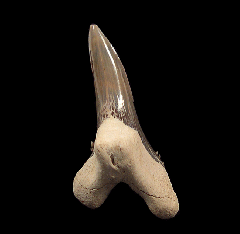
- Hemipristis serra - BV$115.00
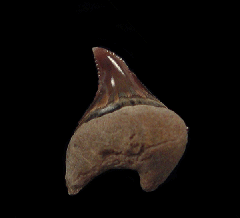
An EXTRA LARGEl Top Quality Bone Valley Hemipristis serra shark tooth from Polk Co., Florida. A lower jaw tooth with complete side cusps. Highest quality enamel. A beautiful tan colored crown with a white root. Exceptional color! An excellent white root. Great eye appeal. A colorful Bone Valley collector's Hemipristis tooth. No repair or restoration. Authenticity guaranteed. You don't see these any more!
F258 SIZE: 1-3/4"
Note - Adding 17 new BV Hemipristis teeth in April 2025. -> Link to BV Hemipristis teeth
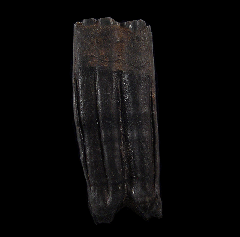
Learn More - Equus sp. - So. Carolina$27.50
A LARGE, well preserved horse tooth (Equus sp. ) from ACE Basin, So. Carolina. The horse arrived in North America during the late Pliocene and became extinct at the end of the Pleistocene. Very well fossilized lower jaw specimen. No repair or restoration. Authenticity guaranteed.
XH50 Size: 3"
Name: Equus sp.
Age: Pleistocene
Location: ACE Basin, So. Carolina
Note - Posting 23 horse fossils in December 2024. Link to Horse Fossils
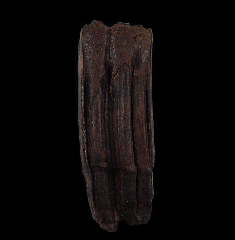
Learn More - Equus sp. - So. Carolina$27.50
A LARGE, well preserved horse tooth (Equus sp. ) from ACE Basin, So. Carolina. The horse arrived in North America during the late Pliocene and became extinct at the end of the Pleistocene. Very well fossilized lower jaw specimen. No repair or restoration. Authenticity guaranteed.
XH48 Size: 2-7/8"
Name: Equus sp.
Age: Pleistocene
Location: ACE Basin, So. Carolina
Note - Posting 23 horse fossils in December 2024. Link to Horse Fossils
Learn More - Equus sp. - So. Carolina$25.00
A LARGE, well preserved horse tooth (Equus sp. ) from ACE Basin, So. Carolina. The horse arrived in North America during the late Pliocene and became extinct at the end of the Pleistocene. Very well fossilized lower jaw specimen. No repair or restoration. Authenticity guaranteed.
XH47 Size: 3-1/4"
Name: Equus sp.
Age: Pleistocene
Location: ACE Basin, So. Carolina
Note - Posting 23 horse fossils in December 2024. Link to Horse Fossils
Learn More - Equus sp. - So. Carolina$30.00
A LARGE, well preserved horse tooth (Equus sp. ) from ACE Basin, So. Carolina. The horse arrived in North America during the late Pliocene and became extinct at the end of the Pleistocene. Very well fossilized lower jaw specimen. No repair or restoration. Authenticity guaranteed.
XH46 Size: 3-1/4"
Name: Equus sp.
Age: Pleistocene
Location: ACE Basin, So. Carolina
Note - Posting 23 horse fossils in December 2024. Link to Horse Fossils
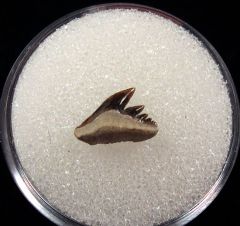
Learn More - Notidanoides muensteri - Germany$0.00
An ultra rare, Top Quality early Cow shark (Notidanoides muensteri) - a lower jaw lateral tooth from Holderbank, Germany. A late Jurassic age tooth (Tithonian - 148 MYA). A special tooth for the very rare tooth collector! No repair or restoration. Perfect tooth. Authenticity guaranteed. These teeth were found in many closed quarries.
GR410 Size: 3/8"
Note - Adding 12 German Cow shark teeth in August 2022 -> Link to German Shark Teeth
Learn More - Otodus megalodon$0.00
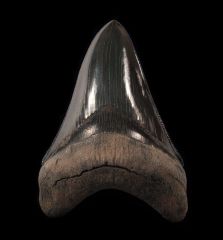
A ~5" GEM JET BLACK colored Megalodon - lower jaw ANTERIOR tooth. An exceptional true black crown - not a charcoal gray color. Highest quality enamel - the surface is like glass! The large jet black bourlette is essentially complete. The large serrations are razor sharp with a good tip. The serrations are essentially complete - rare for a big Meg! The root has few hydration cracks and is complete. A GEM BLACK Meg tooth from the Miocene. A killer collector's tooth!
SC045 Size: 4-15/16" (3-15/16" W)
Learn More - Edestus heinrichi$195.00
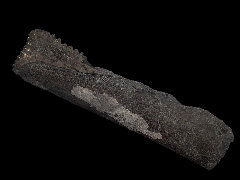
A very rare, Top Quality Edestus heinrichi shark tooth, from Herrin, Illinois. This is a Paleozoic shark that lived in swamps that our now underground coal deposits. An incredible brown colored specimen - very unusual. Excellent preservation, serrations, and serration detail. The Edestus shark would have an upper and lower tooth whorl that are vertically opposed. Research showed that they could use their opposing teeth in a scissor-like motion or a vertical whipping motion to cut prey. It is the first animal to cut vertically. A very strange looking and unique acting shark. Shark recreation image is credited to Julio Lacerdo. These rare teeth are Pennsylvanian age from Illinois. No repair or restoration. Authenticity guaranteed.
I10 SIZE: 3-1/2" w/ root (1-5/8" crown)
Adding 22 Edestus shark teeth in July 2025. Link to Edestus shark.
Learn More - Edestus heinrichi$195.00
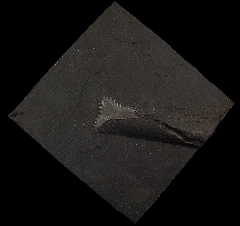
A very rare, Top Quality Edestus heinrichi shark tooth, from Herrin, Illinois. This is a Paleozoic shark that lived in swamps that our now underground coal deposits. An excellent matrix specimen that inludes the opposing tooth mold as well. Excellent preservation, serrations, and serration detail. The Edestus shark would have an upper and lower tooth whorl that are vertically opposed. Research showed that they could use their opposing teeth in a scissor-like motion or a vertical whipping motion to cut prey. It is the first animal to cut vertically. A very strange looking and unique acting shark. Shark recreation image is credited to Julio Lacerdo. These rare teeth are Pennsylvanian age from Illinois. No repair or restoration. Authenticity guaranteed. Note - shipping weight is 1.9 lbs. International "free shipping" will require supplemental postage.
I11 SIZE: 3" w/ root (1-1/2" crown) ; Matrix block is 3.5" x 3.5"
Adding 22 Edestus shark teeth in July 2025. Link to Edestus shark.
Learn More - Edestus heinrichi$175.00
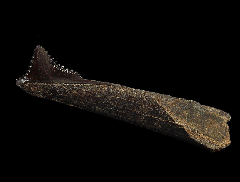
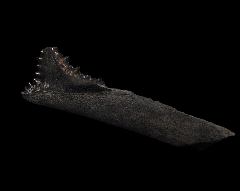
A very rare, LARGE, Top Quality Edestus heinrichi shark tooth, from Herrin, Illinois. This is a Paleozoic shark that lived in swamps that our now underground coal deposits. Note - this tooth has a lot of pyrite and the tip is naturally rounded (polished) which thought to be due to the vertical whipping motion used to slice prey. Excellent preservation, serrations, and serration detail. The Edestus shark would have an upper and lower tooth whorl that are vertically opposed. Research showed that they could use their opposing teeth in a scissor-like motion or a vertical whipping motion to cut prey. It is the first animal to cut vertically. A very strange looking and unique acting shark. Shark recreation image is credited to Julio Lacerdo. These rare teeth are Pennsylvanian age from Illinois. No repair or restoration. Authenticity guaranteed.
I09 SIZE: 4-1/8" w/ root (1-7/8" crown)
Adding 22 Edestus shark teeth in July 2025. Link to Edestus shark.
Learn More - Otodus auriculatus - Kazakhstan$325.00
An ultra rare, early Auriculatus parasymphyseal tooth from Kzil-Orda region, Kazakhstan. A July Fossil of the Month. Note - The center teeth would rarely be lost during feeding. So, very few are in the fossil record. The bourlette is complete. Excellent coarse serrations and killer with typical small side cusps. These teeth exhibit fantastic color, gloss, and preservation. A rare early Eocene Auriculatus tooth (Ypresian age - 55 MYA)! No repair or restoration. Authenticity guaranteed. The true early Eocene Auriculatus tooth!
K515 SIZE: 3/4"
Note - Adding 24 Kazakh Auriuclatus or transition teeth in July 2024. --> Link to Kazakh Auriculatus teeth.
Learn More - Edestus heinrichi$70.00
A very rare, Top Quality Edestus heinrichi shark tooth, from Herrin, Illinois. This is a Paleozoic shark that lived in swamps that our now underground coal deposits. Excellent preservation, serrations, and serration detail. The Edestus shark would have an upper and lower tooth whorl that are vertically opposed. Research showed that they could use their opposing teeth in a scissor-like motion or a vertical whipping motion to cut prey. It is the first animal to cut vertically. A very strange looking and unique acting shark. Shark recreation image is credited to Julio Lacerdo. These rare teeth are Pennsylvanian age from Illinois. No repair or restoration. Authenticity guaranteed.
I23 SIZE: 1-7/8" w/ root (7/8" crown)
Adding 22 Edestus shark specimens in July 2025. Link to Edestus shark.
Learn More