Search results for: 'icebreaker 26 teeth mexico like sleeper base label'
- Did you mean
- icebreaker 26 teeth mexico line sleeper base label
- Related search terms
- bases good with blue
- bases good wide blue
- bases good white blue
- base good wide blue
- base good white blue
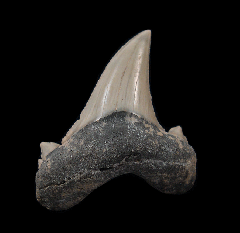
- Otodus aksuaticus (Partial serrated)$425.00
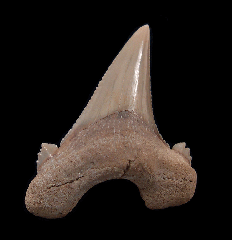
A very rare, early Otodus aksuaticus lateral tooth from Kzil-Orda, Kazakhstan. A transitional tooth leading to O. auriculatus (see detailed discussion below) which leads to Megalodon. The bourlette is complete. This tooth exhibits small serrations along the lower 1/3 of the crown and micro serrations to the tip. These teeth exhibit excellent color, gloss, and preservation. A rare, early (Ypresian) Eocene Auriculatus transition tooth. A very challenging tooth to find when building a Megalodon evolutionary set! No repair or restoration. Authenticity guaranteed. This western Kazakhstan site is one of the few places in the world where the Otodus obliquus to Otodus auriculatus transition can be found in adjacent geologic layers.
K543 SIZE: 1-7/8"
Note - Adding 24 Kazakh Auriuclatus or transition teeth in July 2024. --> Link to Kazakh Auriculatus teeth.
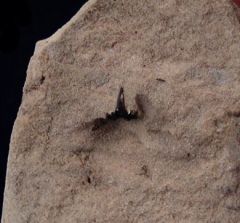
Learn More - Symmorium sp.$0.00
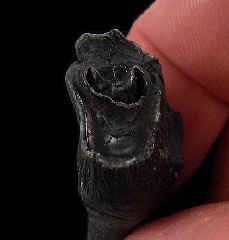
An excellent unclassified Symmorium species. Multiple cusped crown with a large, flat based root. A well preserved extra large specimen. An excellent collector's tooth!
Age: Lower Carboniferous (320 MYA); Serpuchov Fm.
Location: Serpuchov, Russia
R046 SIZE: 1/8"
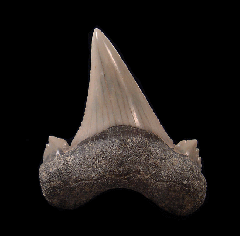
Learn More - Otodus aksuaticus (Partial serrated)$450.00
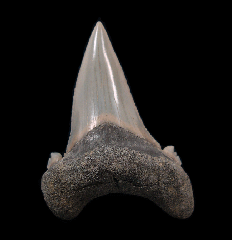
A very rare, early Otodus aksuaticus upper jaw, lateral tooth from Kzil-Orda, Kazakhstan. A transitional tooth leading to O. auriculatus (see detailed discussion below) which leads to Megalodon. A July Fossil of the Month. The bourlette is complete. This tooth exhibits small serrations along the lower 1/3 of the crown and micro serrations to the tip. These teeth exhibit excellent color, gloss, and preservation. A rare, early (Ypresian) Eocene Auriculatus transition tooth. A very challenging tooth to find when building a Megalodon evolutionary set! No repair or restoration. Authenticity guaranteed. This western Kazakhstan site is one of the few places in the world where the Otodus obliquus to Otodus auriculatus transition can be found in adjacent geologic layers.
K547 SIZE: 1-15/16"
Note - Adding 24 Kazakh Auriuclatus or transition teeth in July 2024. --> Link to Kazakh Auriculatus teeth.
Learn More - Otodus aksuaticus (Partial serrated)$425.00
A very rare, early Otodus aksuaticus lateral tooth from Kzil-Orda, Kazakhstan. A transitional tooth leading to O. auriculatus (see detailed discussion below) which leads to Megalodon. A July Fossil of the Month.The bourlette is complete. This tooth exhibits small serrations along the lower 1/2 of the crown and micro serrations to the tip. These teeth exhibit excellent color, gloss, and preservation. A rare, early (Ypresian) Eocene Auriculatus transition tooth. A very challenging tooth to find when building a Megalodon evolutionary set! No repair or restoration. Authenticity guaranteed. This western Kazakhstan site is one of the few places in the world where the Otodus obliquus to Otodus auriculatus transition can be found in adjacent geologic layers.
K544 SIZE: 1-3/4"
Note - Adding 24 Kazakh Auriuclatus or transition teeth in July 2024. --> Link to Kazakh Auriculatus teeth.
Learn More - Otodus aksuaticus (Partial serrated)$550.00
A very rare, early Otodus aksuaticus lateral tooth from Kzil-Orda, Kazakhstan. A transitional tooth leading to O. auriculatus (see detailed discussion below) which leads to Megalodon. A July Fossil of the Month. The bourlette is complete. This tooth exhibits small serrations along the lower 1/2 of the crown and micro serrations to the tip. These teeth exhibit excellent color, gloss, and preservation. A rare, early (Ypresian) Eocene Auriculatus transition tooth. A very challenging tooth to find when building a Megalodon evolutionary set! No repair or restoration. Authenticity guaranteed. This western Kazakhstan site is one of the few places in the world where the Otodus obliquus to Otodus auriculatus transition can be found in adjacent geologic layers.
K542 SIZE: 2-1/8"
Note - Adding 24 Kazakh Auriuclatus or transition teeth in July 2024. --> Link to Kazakh Auriculatus teeth.
Learn More - Otodus aksuaticus (Partial serrated)$525.00
A very rare, early Otodus aksuaticus anterior tooth from Kzil-Orda, Kazakhstan. A transitional tooth leading to O. auriculatus (see detailed discussion below) which leads to Megalodon. A July Fossil of the Month. The bourlette is complete. This tooth exhibits small serrations along the lower 1/2 of the crown and micro serrations to the tip. These teeth exhibit excellent color, gloss, and preservation. A rare, early (Ypresian) Eocene Auriculatus transition tooth. A very challenging tooth to find when building a Megalodon evolutionary set! No repair or restoration. Authenticity guaranteed. This western Kazakhstan site is one of the few places in the world where the Otodus obliquus to Otodus auriculatus transition can be found in adjacent geologic layers.
K542 SIZE: 2-3/16"
Note - Adding 24 Kazakh Auriuclatus or transition teeth in July 2024. --> Link to Kazakh Auriculatus teeth.
Learn More - Knightia eocaena$27.50
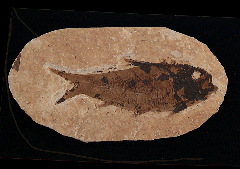
A Knightia fish from the Split-fish layer, Green River Fm., Lincoln Co. Wyoming. The Knightia eocaena is a Herring-like fish from the Eocene age (50 MYA). Very good preservation and preparation. No repair or restoration. All natural. Authenticity guaranteed. An excellent display piece!
X464b SIZE: 4"
Note - Adding 31 Green River Fm. Fossil fish in November 2024 --> Link to Fossil Fish
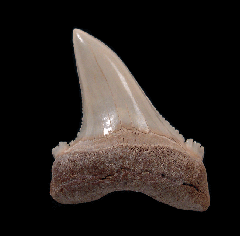
Learn More - Carcharodon carcharias$0.00
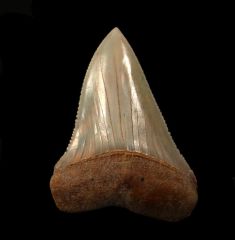
An ULTRA RARE, MONSTER Great White shark transition tooth, Carcharodon hubbelli from Chile. A BIG upper jaw lateral tooth. A June Fossil of the Month. This tooth has a tan colored crown, a distinct gum line, and a brown root. Good color! Highest quality enamel with little hydration cracks and no peeling. This C. hubbelli tooth has medium serrations at the base of the cutting edge, transition to fine serrations at mid crown and disappear towards the tip. Serrations are large at the base with a good tip serration. The root is extra wide. Note - the root root lobe was cracked and probably reatttached - hard to see. Excellent preservation - note nutrient hole on root. No repair or restoration. An exceptional Great White transition form! It will be extremely difficult to locate Carcharodon hubbelli. A super rare collector's tooth. Authenticity guaranteed.
C201 BoP Size: 2-3/4" (2" W)
Note - Adding 32 Chilean Great White teeth in June 2021 Link to Great White shark teeth
Learn More - Camel - So. Carolina$45.00
A well preserved Camel (Camelops) premolar from So. Carolina. The Camelops evolved in the late Pliocene and became extinct at the end of the Pleistocene in North America. This is premolar is complete with little wear. Well fossilized. No repair or restoration. Authenticity guaranteed.
X810 Size: 1-3/4"
Name: Camel (Camelops) premolar
Age: Pleistocene
Location: So. Carolina
Note - Posting 26 mammal and reptile fossils in March 2024. Link to Other Mammals
Learn More - Camel - Florida$75.00
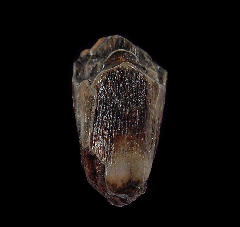
A well preserved Camel (Camelops) molar from northern Florida. The Camelops evolved in the late Pliocene and became extinct at the end of the Pleistocene in North America. This is molar is complete with very little wear. Well fossilized. No repair or restoration. Authenticity guaranteed.
X809 Size: 1-3/8"
Name: Camel (Camelops) molar
Age: Pleistocene
Location: Ruskin, Florida
Note - Posting 26 mammal and reptile fossils in March 2024. Link to Other Mammals
Learn More - Camel - Florida$195.00
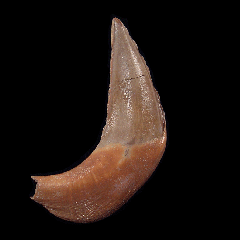
A rare, well preserved Camel (Camelops) canine from Hillsborough Co., Florida. The Camelops evolved in the late Pliocene and became extinct at the end of the Pleistocene in North America. This is molar is complete with no wear. One crack. Well fossilized. No restoration. Authenticity guaranteed.
X807 Size: 1-15/16"
Name: Camel (Camelops) molar
Age: Pleistocene
Location: Hillsborough Co., Florida
Note - Posting 26 mammal and reptile fossils in March 2024. Link to Other Mammals
Learn More - Hoploscaphites brevis$60.00
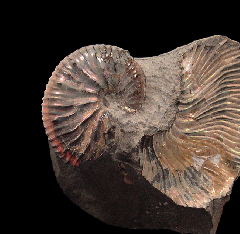
A natural Hoploscaphites brevis ammonite with great preservation of the shell material. The ammonite shell exhibits excellent natural iridescence. This specimen is sits in an original Pierre Shale with a flat base for a great display. The base is a large baculite segment. This ammonite is from the upper Cretaceous, Pierre Shale Fm. of So. Dakota. Authenticity guaranteed. A fantastic display piece.
SD10 Size: 1-1/16"
Note - Adding 6 So. Dakota ammonites in August 2025. --> Link to So. Dakota Ammonites
Learn More