Search results for: 'paper fossil tooth form sa01'
- Did you mean
- paper fossil tooth form sale
- paleo fossil tooth form sa01
- Related search terms
- fossil finder's id good
- fossil finger id good
- fossil fischer id good
- fossil fischeuri id good
- fossil first id good
- Isurus desori$40.00
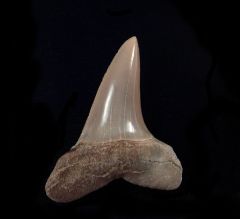
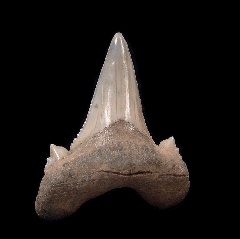
A GEM I. desori, the Narrow-tooth Mako - lateral tooth. Very nice golden tan color with excellent gloss. The root shows incredible detail. Absolutely great preservation and condition - extra sharp edges and tip. These are Miocene age teeth from the Pungo River Fm. Fantastic collector's teeth. Museum quality.
LC334 SIZE: 1-1/2"
Learn More - Isurus desori$40.00
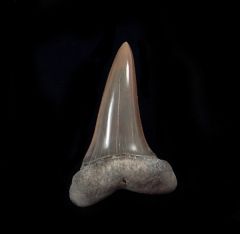
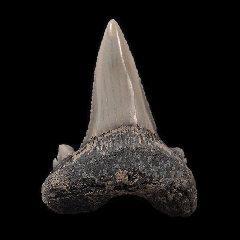
A GEM I. desori, the Narrow-tooth Mako - lateral tooth. Very nice golden tan color with excellent gloss. The root shows incredible detail. Absolutely great preservation and condition - extra sharp edges and tip. These are Miocene age teeth from the Pungo River Fm. Fantastic collector's teeth. Museum quality.
LC333 SIZE: 1-1/2"
Learn More - Isurus desori$35.00
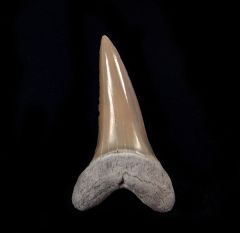
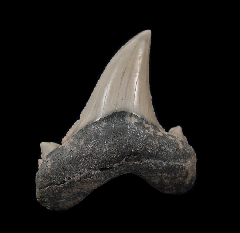
An EXCELLENT I. desori, the Narrow-tooth Mako - anterior tooth. Very nice golden tan color with excellent gloss. The root shows incredible detail. Absolutely great preservation and condition - extra sharp edges and tip. These are Miocene age teeth from the Pungo River Fm. Fantastic collector's teeth. Near Museum quality.
LC332 Size: 1-5/8"
Learn More - Priscacara liops$0.00
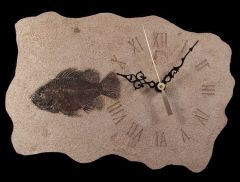
A Large, Top Quality Priscacara (Cockerellites) liops fish from the 18" layer, Green River Fm., Lincoln Co. Wyoming. A new product with clock plus backer board with hanging clip. The Priscacara liops is an extinct Perch from the Eocene age (50 MYA). This piece is from the 18 Inch Layer which is extremely hard and difficult to prepare. It also provides the most detailed, highly preserved fossils. Exceptional preservation and preparation. No repair. All natural. Plate size is 12" x 8". Note - this fish has an intregrated clock and a backer board with hanger. This Priscaccara is ready to hang! Authenticity guaranteed. Museum Quality. An exceptional display piece! Note - This item weighs 3 lbs. An international shipping surcharge will be applied to "Free Shipping". Please inquire for cost.
X481 SIZE: 4-1/2" Clock size is 12" x 8".
Learn More - Carcharodon (Isurus) hastalis$0.00
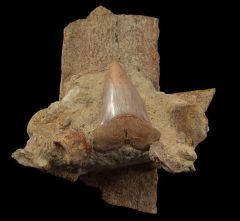
An Extra Large, TOP QUALITY, 3" Carcharodon (Isurus) hastalis tooth with an excellent blue & tan colored crown. A March Fossil of the Month. This is a natural matrix specimen sitting with many whale bones in the original Round Mountain Silt matrix block. The large whale bone at base is 5-3/4" x 3". Plus there are four more whale bones and a shark vertebra exposed in this matrix block. This is a 100% natural matrix piece - nothing added or glued. 100% natural. The root is very well preserved with a nice brown color. Very clean crown. Excellent overall preservation. A fantastic large, quality Mako tooth from the Ernst West quarry which produced the finest teeth with exceptional preservation, high quality, and great color. No repair or restoration. Authenticity guaranteed. A very special display piece.
ST001 BoP2 SIZE: 2-3/4" Matrix block size = 6" x 5.5" x 3" height
Note - Adding 20 Sharktooth Hill Hastalis teeth in March 2021. Link to STH Hastalis teeth.
Learn More - Edestus heinrichi$950.00
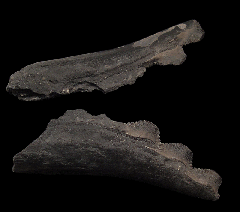
An ultra rare, Top Quality Edestus heinrichi associted pair of whorls, from Herrin, Illinois. A July Fossil of the Month. This is a Paleozoic shark that lived in swamps that our now underground coal deposits. An ultra rare assoiiated pair of tooth whorls. Note - the crown tips are naturally rounded (polished) which thought to be due to wear from the vertical whipping motion used to slice prey. Excellent preservation, serrations, and serration detail. The Edestus shark would have an upper and lower tooth whorl that are vertically opposed. Research showed that they could use their opposing teeth in a scissor-like motion or a vertical whipping motion to cut prey. It is the first animal to cut vertically. A very strange looking and unique acting shark. Shark recreation image is credited to Julio Lacerdo. These rare teeth are Pennsylvanian age from Illinois. No repair or restoration. Authenticity guaranteed. This is the first associated whorl pait that I have seen.
I02 SIZE: 5" & 4-3/4" w/ root (1-1/4"+ crowns)
Adding 22 Edestus shark teeth in July 2025. Link to Edestus shark.
Learn More - Seven-Gill Cow shark (Notorhynchus symphyseal)$0.00
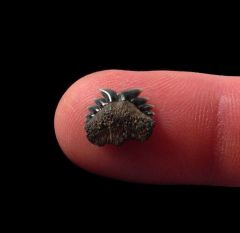
A Top Quality Seven-Gill Cow shark (Notorhynchus) - Lower Jaw Symphyseal (very rare position) fossil shark tooth from Calvert Cliffs, Maryland. A female shark. Razor and complete sharp cusps. Miocene age from the Calvert Formation. Gorgeous tooth for the rare tooth collector! Near perfect tooth. Authenticity guaranteed.
MD011 Size: 9/16" W
Learn More - Seven-Gill Cow shark (Notorhynchus symphyseal)$0.00
A Top Quality Seven-Gill Cow shark (Notorhynchus) - Lower Jaw Symphyseal (very rare position) fossil shark tooth from Calvert Cliffs, Maryland. A female shark. Razor and complete sharp cusps. Miocene age from the Calvert Formation. Gorgeous tooth for the rare tooth collector! Near complete tooth. Authenticity guaranteed.
MD012 Size: 9/16" W
Learn More - Cookie-Cutter shark (Isistius)$0.00
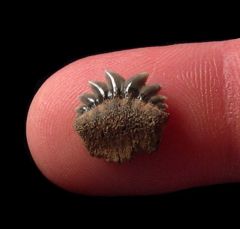
A GEM Cookie-Cutter shark (Isistius), a rare and exotic fossil shark tooth. Rare deep water shark with knife-like crown edges - extra large size. The best that you will find. Miocene age from France. For the rare tooth collector! The BEST of the BEST!
FR060 Size: 1/4"
Learn More - Otodus aksuaticus (Partial serrated)$325.00
A very rare, early Otodus aksuaticus anterior tooth from Kzil-Orda, Kazakhstan. A transitional tooth leading to O. auriculatus (see detailed discussion below) which leads to Megalodon. The bourlette is complete. This tooth exhibits small serrations along the lower 1/2 of the crown and micro serrations to the tip. These teeth exhibit excellent color, gloss, and preservation. A rare, early (Ypresian) Eocene Auriculatus transition tooth. A very challenging tooth to find when building a Megalodon evolutionary set! No repair or restoration. Authenticity guaranteed. This western Kazakhstan site is one of the few places in the world where the Otodus obliquus to Otodus auriculatus transition can be found in adjacent geologic layers.
K546 SIZE: 1-9/16"
Note - Adding 24 Kazakh Auriuclatus or transition teeth in July 2024. --> Link to Kazakh Auriculatus teeth.
Learn More - Otodus aksuaticus (Partial serrated)$350.00
A very rare, early Otodus aksuaticus anterior tooth from Kzil-Orda, Kazakhstan. A transitional tooth leading to O. auriculatus (see detailed discussion below) which leads to Megalodon. The bourlette is complete. This tooth exhibits small serrations along the lower 1/2 of the crown and micro serrations to the tip. These teeth exhibit excellent color, gloss, and preservation. A rare, early (Ypresian) Eocene Auriculatus transition tooth. A very challenging tooth to find when building a Megalodon evolutionary set! No repair or restoration. Authenticity guaranteed. This western Kazakhstan site is one of the few places in the world where the Otodus obliquus to Otodus auriculatus transition can be found in adjacent geologic layers.
K545 SIZE: 1-3/4"
Note - Adding 24 Kazakh Auriuclatus or transition teeth in July 2024. --> Link to Kazakh Auriculatus teeth.
Learn More - Otodus aksuaticus (Partial serrated)$425.00
A very rare, early Otodus aksuaticus lateral tooth from Kzil-Orda, Kazakhstan. A transitional tooth leading to O. auriculatus (see detailed discussion below) which leads to Megalodon. The bourlette is complete. This tooth exhibits small serrations along the lower 1/3 of the crown and micro serrations to the tip. These teeth exhibit excellent color, gloss, and preservation. A rare, early (Ypresian) Eocene Auriculatus transition tooth. A very challenging tooth to find when building a Megalodon evolutionary set! No repair or restoration. Authenticity guaranteed. This western Kazakhstan site is one of the few places in the world where the Otodus obliquus to Otodus auriculatus transition can be found in adjacent geologic layers.
K543 SIZE: 1-7/8"
Note - Adding 24 Kazakh Auriuclatus or transition teeth in July 2024. --> Link to Kazakh Auriculatus teeth.
Learn More