Search results for: 'with al good early'
- Did you mean
- wide al good early
- with al guid early
- Related search terms
- goods terrestri a none
- good terrestri a none
- good terrestri a none/
- good terrestri a none//
- goods terrestri a none//
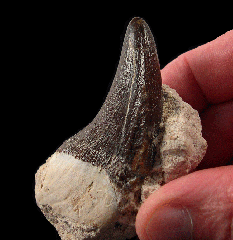
- Pappocetus lugardi (Ancient whale)$950.00
An Ultra Rare Pappocetus lugardi (Andrews, 1920) canine tooth from Morocco. Pappocetus was in the Protocetidae family of ancient whales . Note - this tooth is a large canine with a partial root. This material is a new find and represents one of the earliest transition forms of the whale. Pappocetus is a protocetid (see discussion below) and a large amphibious aquatic carnivore. Pappocetus is also an ancestor of the Basilosaurus. This material is complete and without repair. This is an opportunity to own an incredibly rare specimen from an early evolutionary stage of the modern whale. A fantastic collector's specimen. Authenticity guaranteed.
M2102 Size: 3-1/8" (straight line)
Mid. Eocene (Bartonian) age (40 MYA)
Gueran, (25 km SE of Boujdour), Boujdour Basin
West Sahara, Morocco
Note - adding six early whale teeth in August 2023. Link to the early whales.
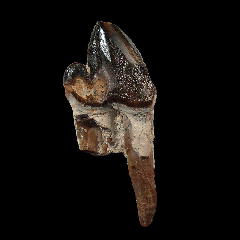
Learn More - Pappocetus lugardi (Ancient whale)$950.00
An Ultra Rare Pappocetus lugardi (Andrews, 1920) premolar tooth from Morocco. Pappocetus was in the Protocetidae family of ancient whales . Note - this tooth is a premolar with a natural wear facet and most of the root. This material is a new find and represents one of the earliest transition forms of the whale. Pappocetus is a protocetid (see discussion below) and a large amphibious aquatic carnivore. Pappocetus is also an ancestor of the Basilosaurus. This material is complete and without repair. This is an opportunity to own an incredibly rare specimen from an early evolutionary stage of the modern whale. A fantastic collector's specimen. Authenticity guaranteed.
M2101 Size: 3-5/8" (straight line)
Mid. Eocene (Bartonian) age (40 MYA)
Gueran, (25 km SE of Boujdour), Boujdour Basin
West Sahara, Morocco
Note - adding six early whale teeth in August 2023. Link to the early whales.
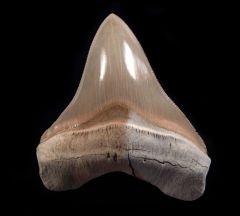
Learn More - Otodus chubutensis$0.00
A GEM HUGE, 4-1/4" CLASSIC Lee Creek Carcharocles chubutensis, a C. megalodon predecessor - upper jaw Principal Anterior tooth. LC006 is an absolute monster sized Chubutensis tooth. This tooth was found in the Pungo River Formation (middle Miocene age). Note that the crown exhibits small cusplike bumps at the base of the serrated edge and the root ends also show grooves where the teeth interlocked. These are characteristic traits of the Lee Creek early Meg - C. chubutensis. A gorgeous light tan colored crown with an excellent tan bourlette. The bourlette is 100% complete. No enamel peel. The serrations are long, razor sharp, and essentially complete including a good tip serration. Highest quality enamel! The root is an excellent light tan color and complete. An exceptionally large Chubutensis collector's tooth. NO repair! The BEST of the BEST! One of my favorites. It will be difficult to find another early Meg like this one.
LC006 Size: 4-1/4" (3-11/16" W)
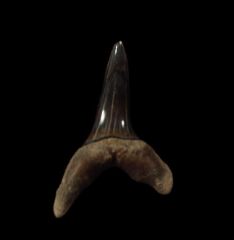
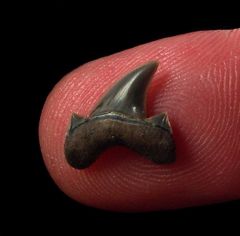
Learn More - Macrorhizodus nolfi$0.00
A very rare, early Macrorhizodus nolfi upper jaw, anterior tooth from Aktulagay, western Kazakhstan. Macrorhizodus nolfi is a Lamnidae shark and an early Mako shark (Isurus praecursor) relative in this early Eocene deposit. These teeth exhibit very good color, gloss, and preservation. A rare, early Eocene Macrorhizodus nolfi tooth. No repair. Authenticity guaranteed.
K571 SIZE: 1-3/8"
Note - Adding 18 Kazakh Auriculatus or transition teeth in April 2020. --> Link to Kazakh Auriculatus teeth.
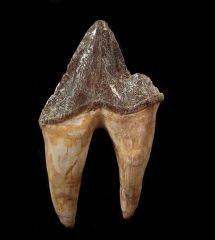
Learn More - Pappocetus lugardi (Ancient whale)$1,750.00
An Ultra Rare, Extra Large Pappocetus lugardi (Andrews, 1920) pre-molar tooth from Morocco. Pappocetus was in the Protocetidae family of ancient whales . Note - molar tooth design is one of the distinguishing features for indentifying this species. This material is a new find and represents one of the earliest transition forms of the whale. Pappocetus is a protocetid (see discussion below) and a large amphibious aquatic carnivore. Pappocetus is also an ancestor of the Basilosaurus. This material is complete and without repair. Crack fill only on some pieces. This is an opportunity to own an incredibly rare specimen from an early evolutionary stage of the modern whale. A fantastic collector's specimen. Authenticity guaranteed.
M2107 Size: 4-1/4" (straight line) (2-1/2" Width at base of crown)
Mid. Eocene (Bartonian) age (40 MYA)
Gueran, (25 km SE of Boujdour), Boujdour Basin
West Sahara, Morocco
Learn More - Pappocetus lugardi (Ancient whale)$1,350.00
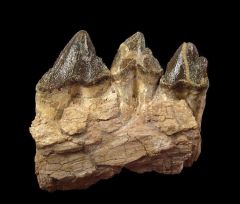
An Ultra Rare, Extra Large Pappocetus lugardi (Andrews, 1920) jaw section with 3 complete molars from Morocco. Pappocetus was in the Protocetidae family of ancient whales. Note – the molars demonstrate how massive Pappocetus teeth compared to the later primitive whales! The root thickness doubles on one side and the crown gains depth as well. This material is a new find and represents one of the earliest transition forms of the whale. Pappocetus is a protocetid (see discussion below) and a large amphibious aquatic carnivore. Pappocetus is also an ancestor of the Basilosaurus.. This material is complete and without repair. Crack fill only on some pieces. This is an opportunity to own an incredibly rare specimen from an early evolutionary stage of the modern whale. A fantastic collector's specimen. Authenticity guaranteed.
M2103 Size: 3-3/4" (W - straight line) (3-1/2" height)
Mid. Eocene (Bartonian) age (40 MYA)
Gueran, (25 km SE of Boujdour), Boujdour Basin
West Sahara, Morocco
Learn More - Pappocetus lugardi (Ancient whale)$1,450.00
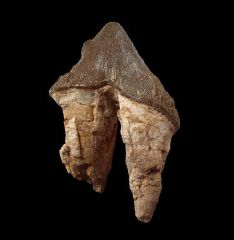
An Ultra Rare, Huge Pappocetus lugardi (Andrews, 1920) pre-molar tooth from Morocco. Pappocetus was in the Protocetidae family of ancient whales . Note - this tooth (the last "pre-molar") demonstrates how massive Pappocetus teeth compared to the later primitive whales! The root thickness doubles on one side and the crown gains depth as well.This material is a new find and represents one of the earliest transition forms of the whale. Pappocetus is a protocetid (see discussion below) and a large amphibious aquatic carnivore. Pappocetus is also an ancestor of the Basilosaurus. This material is complete and without repair. Crack fill only on some pieces. This is an opportunity to own an incredibly rare specimen from an early evolutionary stage of the modern whale. A fantastic collector's specimen. Authenticity guaranteed.
M2108 Size: 4-3/4" (straight line) (3" Width at base of crown & ~1-1/2" depth)
Mid. Eocene (Bartonian) age (40 MYA)
Gueran, (25 km SE of Boujdour), Boujdour Basin
West Sahara, Morocco
Learn More - Otodus pavlovi$0.00
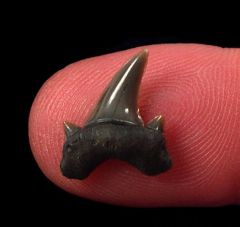
A very rare, early Otodus pavlovi upper jaw, lateral tooth from Aktulagay, western Kazakhstan. Otodus pavlovi was the smaller Otodus shark species present in this early Eocene deposit. The side cusps are large and complete. Exhibits no serrations. These teeth exhibit very good color, gloss, and preservation. No repair. Authenticity guaranteed. Perfect tooth.
K532 SIZE: 11/16"
Note - Adding 18 Kazakh Auriculatus or transition teeth in April 2020. --> Link to Kazakh Auriculatus teeth.
Learn More - Otodus pavlovi$0.00
A very rare, early Otodus pavlovi upper jaw, lateral tooth from Aktulagay, western Kazakhstan. Otodus pavlovi was the smaller Otodus shark species present in this early Eocene deposit. The side cusps are large and complete. Exhibits no serrations. These teeth exhibit very good color, gloss, and preservation. No repair. Authenticity guaranteed. Perfect tooth.
K531 SIZE: 13/16"
Note - Adding 18 Kazakh Auriculatus or transition teeth in April 2020. --> Link to Kazakh Auriculatus teeth.
Learn More - Otodus obliquus (not serrated)$95.00
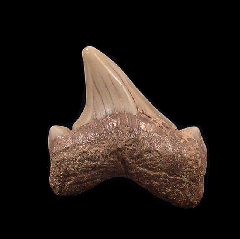
A very rare, early Otodus obliquus anterior tooth from Kzil-Orda Region, Kazakhstan. Otodus obliquus is the ancestor to O. auriculatus (see detailed discussion below) which leads to Megalodon. The bourlette is large and complete. Exhibits no serrations. The starting species to serrated Otodus teeth. These teeth exhibit very good color, gloss, and preservation. A rare, early Eocene (Ypresian) Auriculatus transition tooth. A very challenging tooth to find when building a Megalodon evolutionary set! No repair. Authenticity guaranteed. Note - This western Kazakhstan site is one of the few places in the world where the Otodus obliquus to Otodus auriculatus transition can be found in adjacent early Eocene formation units.
K561 SIZE: 1-1/16"
Note - Adding 24 Kazakh Auriculatus or transition teeth in July 2024. --> Link to Kazakh Auriculatus teeth.
Learn More - Otodus obliquus (not serrated)$135.00
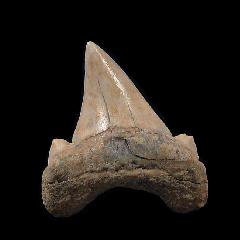
A very rare, early Otodus obliquus anterior tooth from Kzil-Orda Region, Kazakhstan. Otodus obliquus is the ancestor to O. auriculatus (see detailed discussion below) which leads to Megalodon. The bourlette is large and complete. Exhibits no serrations. The starting species to serrated Otodus teeth. These teeth exhibit very good color, gloss, and preservation. A rare, early Eocene (Ypresian) Auriculatus transition tooth. A very challenging tooth to find when building a Megalodon evolutionary set! No repair. Authenticity guaranteed. Note - This western Kazakhstan site is one of the few places in the world where the Otodus obliquus to Otodus auriculatus transition can be found in adjacent early Eocene formation units.
K562 SIZE: 1-1/4"
Note - Adding 24 Kazakh Auriculatus or transition teeth in July 2024. --> Link to Kazakh Auriculatus teeth.
Learn More - Otodus obliquus (not serrated)$200.00
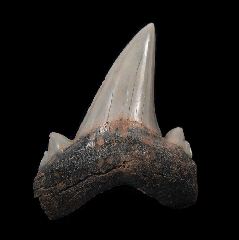
A very rare, early Otodus obliquus anterior tooth from Kzil-Orda Region, Kazakhstan. Otodus obliquus is the ancestor to O. auriculatus (see detailed discussion below) which leads to Megalodon. The bourlette is large and complete. Exhibits no serrations. The starting species to serrated Otodus teeth. These teeth exhibit very good color, gloss, and preservation. A rare, early Eocene (Ypresian) Auriculatus transition tooth. A very challenging tooth to find when building a Megalodon evolutionary set! No repair. Authenticity guaranteed. Note - This western Kazakhstan site is one of the few places in the world where the Otodus obliquus to Otodus auriculatus transition can be found in adjacent early Eocene formation units.
K561 SIZE: 1-1/4"
Note - Adding 24 Kazakh Auriculatus or transition teeth in July 2024. --> Link to Kazakh Auriculatus teeth.
Learn More