Search results for: 'novu de coral site 2020 ursu'
- Did you mean
- novu de coral site 2001 ursu
- novu de coral site 2020 urus
- Related search terms
- novu me of new post by enabl lamna nasus
- novu me of new postag by enabl lamna nasus
- site out enabl cohesive devices
- site out enabl cohesive derives
- site 2 bedroom good rd epsom
- Hexanchus gigas - Chile$475.00
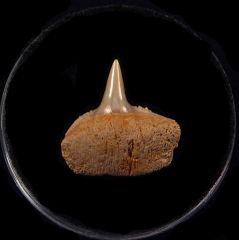
An Ultra Rare, Hexanchus griseus symphyseal tooth from the Caldera Basin of Chile. This is complete lower jaw symphyseal tooth. A rare male shark. Superb preservation and color. Nine plus very sharp and one primary cusp surrounded by many small pathologic cusps. An excellent complete root. Authenticity guaranteed. Museum Quality collector's tooth. Unfortunately there are no more teeth coming from this site. This is a piece from an old collection.
C402L Size: 13/16" W (13/16" H)
Note - Adding 22 new Chilean Hexanchus teeth in May 2021 -> Link to Hexanchus Teeth
Learn More - Alopias grandis - Virginia$0.00
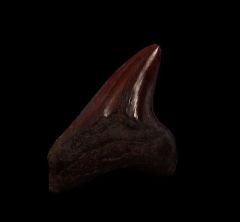
A rare, High Quality Alopias grandis shark tooth, the extinct Giant Thresher, from Pamunkey River, Virginia. Nice red color. Excellent preservation and condition. These teeth are not commonly found and seen. A rare collectors' tooth in high quality condition. Try finding one of these teeth! Authenticity guaranteed. A red site tooth.
VA43 SIZE: 1-5/8"
Posting 22 scarce Virginia shark teeth in September 2021. Link to Virginia teeth.
Learn More - Otodus aksuaticus (Partial serrated)$450.00
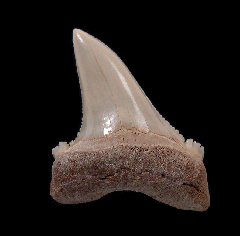
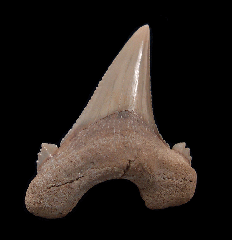
A very rare, early Otodus aksuaticus upper jaw, lateral tooth from Kzil-Orda, Kazakhstan. A transitional tooth leading to O. auriculatus (see detailed discussion below) which leads to Megalodon. A July Fossil of the Month. The bourlette is complete. This tooth exhibits small serrations along the lower 1/3 of the crown and micro serrations to the tip. These teeth exhibit excellent color, gloss, and preservation. A rare, early (Ypresian) Eocene Auriculatus transition tooth. A very challenging tooth to find when building a Megalodon evolutionary set! No repair or restoration. Authenticity guaranteed. This western Kazakhstan site is one of the few places in the world where the Otodus obliquus to Otodus auriculatus transition can be found in adjacent geologic layers.
K547 SIZE: 1-15/16"
Note - Adding 24 Kazakh Auriuclatus or transition teeth in July 2024. --> Link to Kazakh Auriculatus teeth.
Learn More - Otodus aksuaticus (Partial serrated)$425.00
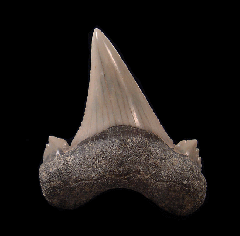
A very rare, early Otodus aksuaticus lateral tooth from Kzil-Orda, Kazakhstan. A transitional tooth leading to O. auriculatus (see detailed discussion below) which leads to Megalodon. A July Fossil of the Month.The bourlette is complete. This tooth exhibits small serrations along the lower 1/2 of the crown and micro serrations to the tip. These teeth exhibit excellent color, gloss, and preservation. A rare, early (Ypresian) Eocene Auriculatus transition tooth. A very challenging tooth to find when building a Megalodon evolutionary set! No repair or restoration. Authenticity guaranteed. This western Kazakhstan site is one of the few places in the world where the Otodus obliquus to Otodus auriculatus transition can be found in adjacent geologic layers.
K544 SIZE: 1-3/4"
Note - Adding 24 Kazakh Auriuclatus or transition teeth in July 2024. --> Link to Kazakh Auriculatus teeth.
Learn More - Otodus aksuaticus (Partial serrated)$550.00
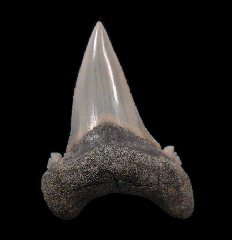
A very rare, early Otodus aksuaticus lateral tooth from Kzil-Orda, Kazakhstan. A transitional tooth leading to O. auriculatus (see detailed discussion below) which leads to Megalodon. A July Fossil of the Month. The bourlette is complete. This tooth exhibits small serrations along the lower 1/2 of the crown and micro serrations to the tip. These teeth exhibit excellent color, gloss, and preservation. A rare, early (Ypresian) Eocene Auriculatus transition tooth. A very challenging tooth to find when building a Megalodon evolutionary set! No repair or restoration. Authenticity guaranteed. This western Kazakhstan site is one of the few places in the world where the Otodus obliquus to Otodus auriculatus transition can be found in adjacent geologic layers.
K542 SIZE: 2-1/8"
Note - Adding 24 Kazakh Auriuclatus or transition teeth in July 2024. --> Link to Kazakh Auriculatus teeth.
Learn More - Otodus aksuaticus (Partial serrated)$525.00
A very rare, early Otodus aksuaticus anterior tooth from Kzil-Orda, Kazakhstan. A transitional tooth leading to O. auriculatus (see detailed discussion below) which leads to Megalodon. A July Fossil of the Month. The bourlette is complete. This tooth exhibits small serrations along the lower 1/2 of the crown and micro serrations to the tip. These teeth exhibit excellent color, gloss, and preservation. A rare, early (Ypresian) Eocene Auriculatus transition tooth. A very challenging tooth to find when building a Megalodon evolutionary set! No repair or restoration. Authenticity guaranteed. This western Kazakhstan site is one of the few places in the world where the Otodus obliquus to Otodus auriculatus transition can be found in adjacent geologic layers.
K542 SIZE: 2-3/16"
Note - Adding 24 Kazakh Auriuclatus or transition teeth in July 2024. --> Link to Kazakh Auriculatus teeth.
Learn More - Cave Hyena jaw$0.00
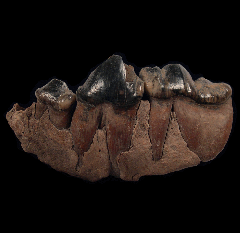
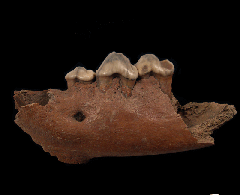
A rare well preserved, Cave Hyena jaw section with three teeth (Crocuta crocuta spelaea) from the Yakutsk Region, Siberia. The Cave Hyena is also known as the Ice Age Spotted Hyena. These extra large hyenas lived in the mountain caves from central Europe to Russia. Excellent teeth with good color. No repair or restoration. Authenticity guaranteed. You can own a rare and wonderful story piece from the Ice Age!
Name: Crocuta crocuta spelaea Age: Late Pleistocene Location: Yakutsk Region, Siberia
R530 SIZE: 3-1/2" Length ; 2-1/8" Wide
Note: Adding 6 new Ice Age fossils in January 2023. Link -> Cave Hyena Fossils
Learn More - Cave Hyena jaw$0.00
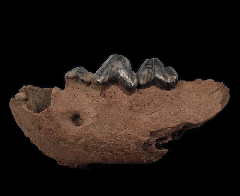
A rare well preserved, Cave Hyena jaw section with three teeth (Crocuta crocuta spelaea) from the Yakutsk Region, Siberia. The Cave Hyena is also known as the Ice Age Spotted Hyena. These extra large hyenas lived in the mountain caves from central Europe to Russia. Excellent teeth with good color. No repair or restoration. Authenticity guaranteed. You can own a rare and wonderful story piece from the Ice Age!
Name: Crocuta crocuta spelaea Age: Late Pleistocene Location: Yakutsk Region, Siberia
R529 SIZE: 3-3/4" Length ; 2-3/8" Wide
Note: Adding 6 new Ice Age fossils in January 2023. Link -> Cave Hyena Fossils
Learn More - Cave Hyena jaw$0.00
A rare exceptionally preserved, Cave Hyena jaw section with three teeth (Crocuta crocuta spelaea) from the Yakutsk Region, Siberia. The Cave Hyena is also known as the Ice Age Spotted Hyena. These extra large hyenas lived in the mountain caves from central Europe to Russia. Excellent teeth with excellent color. No repair or restoration. Authenticity guaranteed. You can own a rare and wonderful story piece from the Ice Age!
Name: Crocuta crocuta spelaea Age: Late Pleistocene Location: Yakutsk Region, Siberia
R528 SIZE: 4-3/4" Length ; 2-1/4" Wide
Note: Adding 6 new Ice Age fossils in January 2023. Link -> Cave Hyena Fossils
Learn More - Cave Hyena jaw$0.00
A rare exceptionally preserved, Cave Hyena jaw section with three teeth (Crocuta crocuta spelaea) from the Yakutsk Region, Siberia. The Cave Hyena is also known as the Ice Age Spotted Hyena. These extra large hyenas lived in the mountain caves from central Europe to Russia. Excellent teeth with excellent color. No repair or restoration. Authenticity guaranteed. You can own a rare and wonderful story piece from the Ice Age!
Name: Crocuta crocuta spelaea Age: Late Pleistocene Location: Yakutsk Region, Siberia
R527 SIZE: 5-1/2" Length ; 2-3/8" Wide
Note: Adding 6 new Ice Age fossils in January 2023. Link -> Cave Hyena Fossils
Learn More - Carcharocles megalodon$0.00
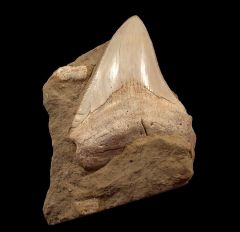
An Ultra Rare, Top Quality 5" Sharktooth Hill Megalodon tooth found in the Round Mountain Silt near Bakersfield, California. A location that produces very few Megalodon teeth and one of the toughest Megs to locate. A November 2020 Fossil of the Month. This tooth is still embeded in its original Round Mountain silt matrix. Highest quality enamel with a super rare, natural solid WHITE color. This tooth is truly white, and the color is not due to mineralization or sun bleaching. The bourlette is a white color and complete. The serrations are extra large and 100% complete (please note that 1/8" of the tip was professionally restored). The root is nicely articulated and complete. Also note the large grooves on the root ends - a Miocene trait. This is a middle Miocene Meg - very unique! 100% natural. No repair or restoration other the very tip. You will not see these middle Miocene Sharktooth Hill Megs from Bakersfield, California very often. One of the rarest Megs - naturally white colored and from Sharktooth Hill! Authenticity guaranteed. Museum Quality. An exceptional collector piece that came out of a 25 year old old collection! A fantastic display from the old Ernst Whale site.
ST451 BoP Size: 5" (3-5/8" W)
Note - Adding four Sharktooth Hill Meg teeth in November 2020. Link to Sharktooth Hill Meg Teeth.
Learn More - Pristiophorous lanceolatus$75.00
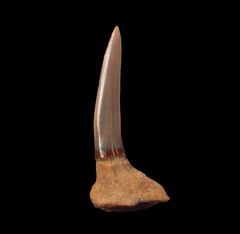
A Top Quality, Pristiophorous lanceolatus, Saw shark rostal tooth from the Bahia Iglesa Fm. of Chile. The crown is exceptionally clean and sharp. This Saw shark - Pristiophorous lanceolatus is a from late Miocene deposit. Beautiful color and fantastic preservation! Near maximum size. Authenticity guaranteed. You don't see quality Neogene Saw shark rostal teeth very often. Check out my new Blog - The Best of Chile - Shark Teeth https://www.buriedtreasurefossils.com/blog/post/the-best-of-chile-fossil-shark-teeth/
C507 SIZE: 1-5/8"
Note - Posting 6 new Pristiophorous rostal teeth in Mar. 2020 -> Chilean Saw Shark Teeth
Learn More