Search results for: 'Ande'
- Related search terms
- Andee Silver - Baby I Need Your Loving
- andesita margin liticos
- andesita marin liticos
- andes巧克力
- anders wide
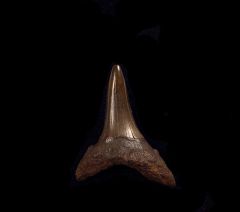
- Carcharias cuspidata$7.50
An EXCELLENT Carcharias shark tooth from the copper red site. Lateral position. Exceptional color. Good preservation and condition. These are Miocene age from the Pungo River Fm., Hertford Co., NC.
Learn More
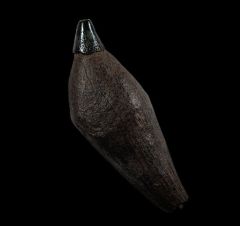
NC435 SIZE: 1-1/8" - Scaldicetus - Sperm Whale$175.00
A Top Quality, Extra Large Sperm whale tooth, Scaldicetus sp., from the ACE river basin, So. Carolina. A Miocene age whale tooth. This tooth has a wonderful spiked enamel crown and a large, nearly complete round root. The tip of the crown has a small natural wear facet - quite common for these teeth. This tooth shows excellent detail - very well preserved. The root is extra wide and nicely articulated. A very well preserved specimen with no river wear! An excellent BIG Sperm whale tooth. You do not see many Sperm whale teeth in Top Quality condition. Authenticity guaranteed.
SC1225 Size: 5-1/16" (1-3/4" W)
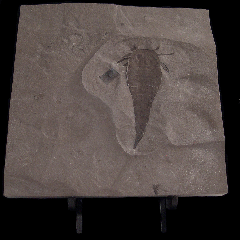
Learn More - Eurypterus lacustris$0.00
A Top Quality Eurypterus lacustris, the "Sea Scorpion", from Buffalo, New York. A November Fossil of the Month. This is a spooky looking arthropod that are related to arachnids, such as, the Horseshoe crab. It was found in the Williamsville Fm., Bertie Group of western New York and it is Silurian age (430 mya). A complete specimen that is nicely displayed on shale matirx. Specimen comes with a custom stand and ID plaque. Looks great in every fossil collection. One on my favorite fossils. Authenticity guaranteed. An exceptional old collection display piece!
EU01 Specimen Size: 5-1/2" Plate size: 10" x 10-1/4"
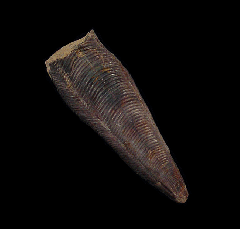
Learn More - Paraconularia crustala$0.00
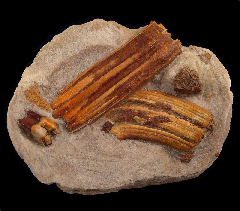
A Paraconularia crustala, a Conulariid, from Holdenville, Oklahoma. Conulariid, is a genus named for the Latin word conulus or cone. This fossil is shaped like a rectangular cone. The fossil is made up of rows of calcium phosphate rods which is the same material that a fossil shark is made of. This creature was placed Cnidaria phylum in the Animal kingdom, and its relatives include the corals, anemones, and jellyfish. Exceptional preservation. This is a Wewoka Fm., Pennsylvanian Period fossil (300 MYA). Authenticity guaranteed. A very unique display piece!
Y073 SIZE: 1-7/8" (3/4" Thick)
Note - Posting 6 new "Other" fossils in January 2024. Link to Other Fossils
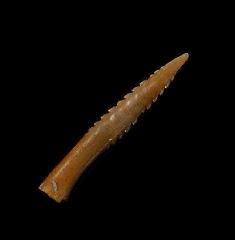
Learn More - Ikamauius ensifer (Sawshark) - New Zealand$125.00
An ultra rare, Top Quality Ikamauius ensifer (Sawshark) rostal tooth from the Oamaru, Campbells Bay, New Zealand. This is a very unique Pristophoridae Sawshark species that is barbed on all sides, and it is only found in New Zealand. Incredible orange color and preservation. Complete tooth. This tooth is Middle Miocene from the Gee Greensand Fm. A rare collector's Ikamauius ensifer rostal tooth. No repair or restoration. Authenticity guaranteed. New Zealand fossil shark teeth are impossible to source. This is a great specimen from an old collection.
NZ04 Size: 13/16"
Note - Adding 26 Australian - New Zealand shark teeth in May 2024 Link to Australian - New Zealand shark teeth
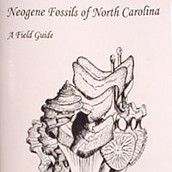
Learn More - Neogene Fossils of North Carolina By Chandler & Timmerman$20.00
My recommendation for the collector's first reference guide to identify their Miocene - Pliocene age collection pieces. A must for the Lee Creek fossil collector - shark teeth and other fossils.
BB08 Size: 5-1/2" x 8-1/2"
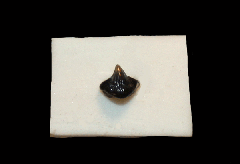
Learn More - Ganopristus leptodon$40.00
A Top Quality Ganopristus leptodon oral tooth, an extinct Sawfish shark, from the ENCI quarry, Maastricht, the Netherlands. Fantastic gray color and preservation. Cretaceous - Maastrichian age. Excellent tip. An excellent collector's tooth. Authenticity guaranteed. Perfect tooth.
N431 SIZE: 1/8"
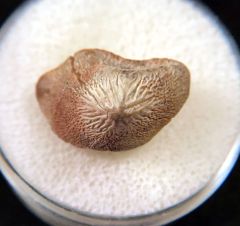
Learn More - Ptychodus mortoni$35.00
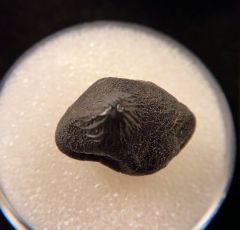
A scarce primitive shark tooth, Ptychodus mortoni, from Upper Cretaceous of New Mexico. The Ptychodus shark possessed crusher teeth preyed on mollusks and other shelled animals. These teeth are from Sandoval Co., New Mexico. Authenticity guaranteed.
NM001 SIZE: 13/16"
Learn More - Ptychodus mortoni$40.00
A scarce primitive shark tooth, Ptychodus mortoni, from Upper Cretaceous of New Mexico. The Ptychodus shark possessed crusher teeth preyed on mollusks and other shelled animals. These teeth are from Sandoval Co., New Mexico. Authenticity guaranteed.
NM002 SIZE: 3/4"
Learn More - Mastodon$0.00
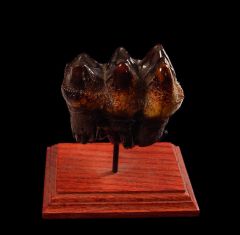
A Gem Quality Miocene-Pliocene Mastodon molar from Florida. Incredible color (red, gold & brown) and detail. An August Fossil of the Month. An extinct elephant ancestor that inhabited North America during the late Miocene to late Pliocene. This molar is a recently erupted tooth with a small amount of cusp wear. Excellent articulation. A good root section. This is an exceptionally well fossilized Mastodon specimen. Note - Comes complete with the steel and oak base stand shown. Weighs 1.5 bs. No damage. No repair. An exceptional, color collector's Mastodon tooth. Authenticity guaranteed.
X610 BoP2 Size: 3-1/4" x 2-3/4" W x 3" H
Name: Mastodon
Age: Miocene - Pliocene
Location: Northern Florida
Learn More - Glyptodon reticulatus$395.00
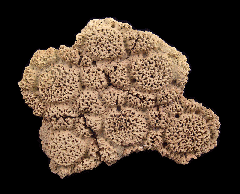
A rare LARGE, well preserved Glyptodon reticulatus scute from the Pampean region, Uruguay. A March Fossil of the Month. Glyptodon was the largest of the the oversized armadillos with a extremely thick shell. It evolved in the Pliocene and became extinct at the end of the Pleistocene in South America. This large scute is complete with no wear. Well fossilized. No repair or restoration. Authenticity guaranteed. Note - International buyers will pay a shipping supplement to free shipping. Items weighs 1.3 lbs.
X801 Size: 5-1/2" x 4-1/2" x 1-1/2"
Name: Glyptodon reticulatus
Age: Pleistocene
Location: Pampean region, Uruguay
Note - Posting 26 mammal and reptile fossils in March 2024. Link to Other Mammals
Learn More - Equus sp. - Florida$250.00
Two well preserved horse teeth (Equus sp. ) and a deer tooth (Odocoileus sp.) from Okeechobee, Florida. The horse arrived in North America during the late Pliocene and became extinct at the end of the Pleistocene. Deer arrived in No. America in the mid-Miocene. These teeth reside on their original hard sandstone matrix. Lots of prep time required to expose these teeth. Very well fossilized specimens. No repair or restoration. Authenticity guaranteed. A great display piece!
XH13 Size: 3-1/2" (horse) ; 15/16" (deer) ; Matrix size: 5-1/4" x 4-1/2"
Name: Equus sp. & Odocoileus sp.
Age: Pleistocene
Location: Okeechobee, Florida
Note - Posting 13 horse fossils in April 2024. Link to Horse Fossils
Learn More