Search results for: 'ancep silver bony i noted your like'
- Related search terms
- like good
- like paleozo first planus fish good
- like planus first planus fish good
- like planus few planus fisher good
- like polk few planus fisheuri good
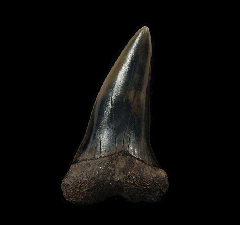
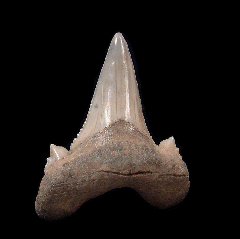
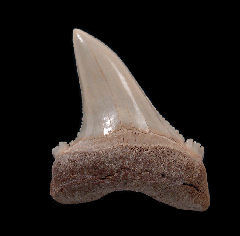
- Carcharomodus escheri$265.00
A LARGE, rare Top Quality Carcharomodus escheri, a "serrated Mako" shark tooth - upper jaw anterior tooth from the "De Kuilen" sand pit, Mill, The Netherlands. The Carcharomodus escheri was named as a new genus in 2015 based upon a crenulated cutting edge ("wavy serrations"), slender & distally inclined crown, and side cusplets. This tooth has excellent color and preservation. Sharp cutting edge. The age is late Miocene (approx. 6-8 million years ago). An excellent rare collector's tooth. Authenticity guaranteed. A difficult tooth to source.
N001 SIZE: 2"
Note - Adding 17 Netherlands Carcharomodus escheri teeth in July 2023. Link to Netherlands Escheri teeth
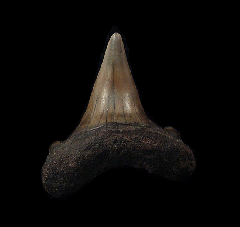
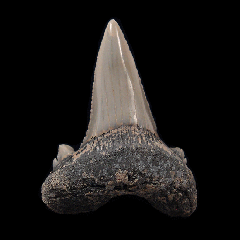
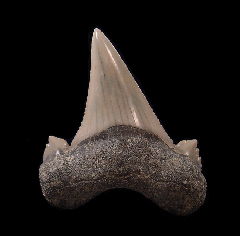
Learn More - Carcharomodus escheri$125.00
A rare High Quality Carcharomodus escheri, a "serrated Mako" shark tooth - lower jaw anterior tooth from the "De Kuilen" sand pit, Mill, The Netherlands. The Carcharomodus escheri was named as a new genus in 2015 based upon a crenulated cutting edge ("wavy serrations"), slender & duistally inclined crown, and side cusplets. This tooth has good color and preservation. Sharp cutting edge. Two side cusplets. The age is late Miocene (approx. 6-8 million years ago). An excellent rare collector's tooth. Authenticity guaranteed. A difficult tooth to source.
N011 SIZE: 1-1/4"
Note - Adding 17 Netherlands Carcharomodus escheri teeth in July 2023. Link to Netherlands Escheri teeth
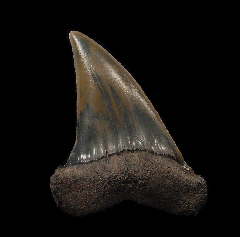
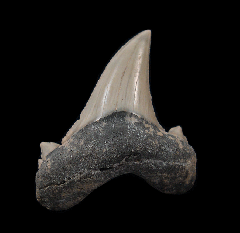
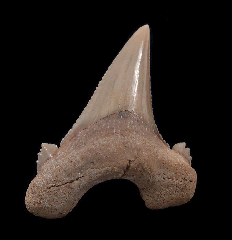
Learn More - Carcharomodus escheri$295.00
A LARGE, rare Top Quality Carcharomodus escheri, a "serrated Mako" shark tooth - upper jaw anterior tooth from the "De Kuilen" sand pit, Mill, The Netherlands. The Carcharomodus escheri was named as a new genus in 2015 based upon a crenulated cutting edge ("wavy serrations"), slender & distally inclined crown, and side cusplets. This tooth has excellent color and preservation. Sharp cutting edge. Two side cusplets. The age is late Miocene (approx. 6-8 million years ago). An excellent rare collector's tooth. Authenticity guaranteed. A difficult tooth to source.
N002 SIZE: 2"
Note - Adding 17 Netherlands Carcharomodus escheri teeth in July 2023. Link to Netherlands Escheri teeth
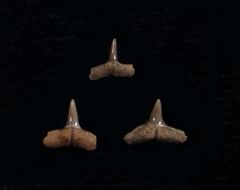
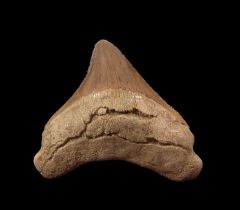
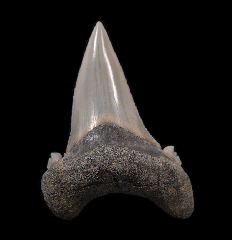
Learn More - Carcharhinus macloti$12.50
A Top Quality, LARGE Carcharhinus macloti tooth, the Hardnose shark, from Lee Creek. Lower jaw teeth from the Miocenne Pungo River Formation. Excellent preservation and color. A more difficult species to locate in Lee Creek. Note - item is sold as a single tooth.
LC775 SIZE: 1/4"
Learn More - Otodus aksuaticus (Partial serrated)$325.00
A very rare, early Otodus aksuaticus anterior tooth from Kzil-Orda, Kazakhstan. A transitional tooth leading to O. auriculatus (see detailed discussion below) which leads to Megalodon. The bourlette is complete. This tooth exhibits small serrations along the lower 1/2 of the crown and micro serrations to the tip. These teeth exhibit excellent color, gloss, and preservation. A rare, early (Ypresian) Eocene Auriculatus transition tooth. A very challenging tooth to find when building a Megalodon evolutionary set! No repair or restoration. Authenticity guaranteed. This western Kazakhstan site is one of the few places in the world where the Otodus obliquus to Otodus auriculatus transition can be found in adjacent geologic layers.
K546 SIZE: 1-9/16"
Note - Adding 24 Kazakh Auriuclatus or transition teeth in July 2024. --> Link to Kazakh Auriculatus teeth.
Learn More - Otodus aksuaticus (Partial serrated)$350.00
A very rare, early Otodus aksuaticus anterior tooth from Kzil-Orda, Kazakhstan. A transitional tooth leading to O. auriculatus (see detailed discussion below) which leads to Megalodon. The bourlette is complete. This tooth exhibits small serrations along the lower 1/2 of the crown and micro serrations to the tip. These teeth exhibit excellent color, gloss, and preservation. A rare, early (Ypresian) Eocene Auriculatus transition tooth. A very challenging tooth to find when building a Megalodon evolutionary set! No repair or restoration. Authenticity guaranteed. This western Kazakhstan site is one of the few places in the world where the Otodus obliquus to Otodus auriculatus transition can be found in adjacent geologic layers.
K545 SIZE: 1-3/4"
Note - Adding 24 Kazakh Auriuclatus or transition teeth in July 2024. --> Link to Kazakh Auriculatus teeth.
Learn More - Otodus aksuaticus (Partial serrated)$425.00
A very rare, early Otodus aksuaticus lateral tooth from Kzil-Orda, Kazakhstan. A transitional tooth leading to O. auriculatus (see detailed discussion below) which leads to Megalodon. The bourlette is complete. This tooth exhibits small serrations along the lower 1/3 of the crown and micro serrations to the tip. These teeth exhibit excellent color, gloss, and preservation. A rare, early (Ypresian) Eocene Auriculatus transition tooth. A very challenging tooth to find when building a Megalodon evolutionary set! No repair or restoration. Authenticity guaranteed. This western Kazakhstan site is one of the few places in the world where the Otodus obliquus to Otodus auriculatus transition can be found in adjacent geologic layers.
K543 SIZE: 1-7/8"
Note - Adding 24 Kazakh Auriuclatus or transition teeth in July 2024. --> Link to Kazakh Auriculatus teeth.
Learn More - Carcharocles megalodon$0.00
An Ultra Rare, High Quality Sharktooth Hill Megalodon tooth found in the Round Mountain Silt near Bakersfield, California. A location that produces very few Megalodon teeth and one of the toughest Megs to locate. Good quality enamel with a great light tan color. The bourlette is a near white color and complete. The serrations are sharp and near complete with a rounded tip. The root is nicely articulated and complete. Also note the large groove on the root ends - a Miocene trait. This is a middle Miocene Meg - very unique! 100% natural. No repair or restoration. You will not see these middle Miocene Sharktooth Hill Megs from Bakersfield, California very often. One of the rarest Megs! Authenticity guaranteed. A great collector piece that came out of a 25 year old old collection!
ST454 Size: 2-3/8"
Note - Adding four Sharktooth Hill Meg teeth in November 2020. Link to Sharktooth Hill Meg Teeth.
Learn More - Otodus aksuaticus (Partial serrated)$450.00
A very rare, early Otodus aksuaticus upper jaw, lateral tooth from Kzil-Orda, Kazakhstan. A transitional tooth leading to O. auriculatus (see detailed discussion below) which leads to Megalodon. A July Fossil of the Month. The bourlette is complete. This tooth exhibits small serrations along the lower 1/3 of the crown and micro serrations to the tip. These teeth exhibit excellent color, gloss, and preservation. A rare, early (Ypresian) Eocene Auriculatus transition tooth. A very challenging tooth to find when building a Megalodon evolutionary set! No repair or restoration. Authenticity guaranteed. This western Kazakhstan site is one of the few places in the world where the Otodus obliquus to Otodus auriculatus transition can be found in adjacent geologic layers.
K547 SIZE: 1-15/16"
Note - Adding 24 Kazakh Auriuclatus or transition teeth in July 2024. --> Link to Kazakh Auriculatus teeth.
Learn More - Otodus aksuaticus (Partial serrated)$425.00
A very rare, early Otodus aksuaticus lateral tooth from Kzil-Orda, Kazakhstan. A transitional tooth leading to O. auriculatus (see detailed discussion below) which leads to Megalodon. A July Fossil of the Month.The bourlette is complete. This tooth exhibits small serrations along the lower 1/2 of the crown and micro serrations to the tip. These teeth exhibit excellent color, gloss, and preservation. A rare, early (Ypresian) Eocene Auriculatus transition tooth. A very challenging tooth to find when building a Megalodon evolutionary set! No repair or restoration. Authenticity guaranteed. This western Kazakhstan site is one of the few places in the world where the Otodus obliquus to Otodus auriculatus transition can be found in adjacent geologic layers.
K544 SIZE: 1-3/4"
Note - Adding 24 Kazakh Auriuclatus or transition teeth in July 2024. --> Link to Kazakh Auriculatus teeth.
Learn More - Otodus aksuaticus (Partial serrated)$550.00
A very rare, early Otodus aksuaticus lateral tooth from Kzil-Orda, Kazakhstan. A transitional tooth leading to O. auriculatus (see detailed discussion below) which leads to Megalodon. A July Fossil of the Month. The bourlette is complete. This tooth exhibits small serrations along the lower 1/2 of the crown and micro serrations to the tip. These teeth exhibit excellent color, gloss, and preservation. A rare, early (Ypresian) Eocene Auriculatus transition tooth. A very challenging tooth to find when building a Megalodon evolutionary set! No repair or restoration. Authenticity guaranteed. This western Kazakhstan site is one of the few places in the world where the Otodus obliquus to Otodus auriculatus transition can be found in adjacent geologic layers.
K542 SIZE: 2-1/8"
Note - Adding 24 Kazakh Auriuclatus or transition teeth in July 2024. --> Link to Kazakh Auriculatus teeth.
Learn More - Otodus aksuaticus (Partial serrated)$525.00
A very rare, early Otodus aksuaticus anterior tooth from Kzil-Orda, Kazakhstan. A transitional tooth leading to O. auriculatus (see detailed discussion below) which leads to Megalodon. A July Fossil of the Month. The bourlette is complete. This tooth exhibits small serrations along the lower 1/2 of the crown and micro serrations to the tip. These teeth exhibit excellent color, gloss, and preservation. A rare, early (Ypresian) Eocene Auriculatus transition tooth. A very challenging tooth to find when building a Megalodon evolutionary set! No repair or restoration. Authenticity guaranteed. This western Kazakhstan site is one of the few places in the world where the Otodus obliquus to Otodus auriculatus transition can be found in adjacent geologic layers.
K542 SIZE: 2-3/16"
Note - Adding 24 Kazakh Auriuclatus or transition teeth in July 2024. --> Link to Kazakh Auriculatus teeth.
Learn More