Search results for: 'how to eagle international transition in hair book application'
- Related search terms
- how to enable international transaction in habib book application
- how to enabled international transaction in habib book application
- book site vs none damag good preview
- book scute vs none damag good preview
- book scute vs none damag good preview/
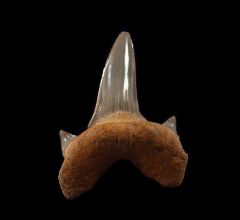
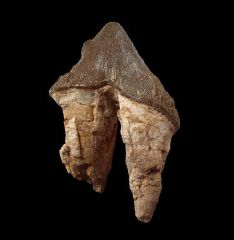
- Cretodus crassidens$225.00
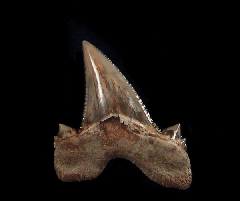
A Top Quality Cretodus crassidens, an extinct Mackerel shark, tooth from Dallas Co., Texas. An excellent example of this Lower Cretaceous Eagle Ford Fm. tooth. These massive teeth have a design that includes a large / heavy root with high root face, a narrow crown width, and broad side cusps. This is the big shark tooth in Texas Cretaceous deposits which can reach 2.6". This is a lateral tooth with perfect side cusps. Authenticity guaranteed. Near perfect tooth with a small tip nick. I don't see many of these teeth.
T182 SIZE: 1-5/8"
Note - Adding 100+ new Texas shark teeth in October 2021. Link to Texas shark teeth
Learn More - Otodus obliquus (not serrated)$95.00
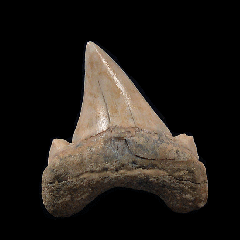
A very rare, early Otodus obliquus anterior tooth from Kzil-Orda Region, Kazakhstan. Otodus obliquus is the ancestor to O. auriculatus (see detailed discussion below) which leads to Megalodon. The bourlette is large and complete. Exhibits no serrations. The starting species to serrated Otodus teeth. These teeth exhibit very good color, gloss, and preservation. A rare, early Eocene (Ypresian) Auriculatus transition tooth. A very challenging tooth to find when building a Megalodon evolutionary set! No repair. Authenticity guaranteed. Note - This western Kazakhstan site is one of the few places in the world where the Otodus obliquus to Otodus auriculatus transition can be found in adjacent early Eocene formation units.
K561 SIZE: 1-1/16"
Note - Adding 24 Kazakh Auriculatus or transition teeth in July 2024. --> Link to Kazakh Auriculatus teeth.
Learn More - Otodus obliquus (not serrated)$135.00
A very rare, early Otodus obliquus anterior tooth from Kzil-Orda Region, Kazakhstan. Otodus obliquus is the ancestor to O. auriculatus (see detailed discussion below) which leads to Megalodon. The bourlette is large and complete. Exhibits no serrations. The starting species to serrated Otodus teeth. These teeth exhibit very good color, gloss, and preservation. A rare, early Eocene (Ypresian) Auriculatus transition tooth. A very challenging tooth to find when building a Megalodon evolutionary set! No repair. Authenticity guaranteed. Note - This western Kazakhstan site is one of the few places in the world where the Otodus obliquus to Otodus auriculatus transition can be found in adjacent early Eocene formation units.
K562 SIZE: 1-1/4"
Note - Adding 24 Kazakh Auriculatus or transition teeth in July 2024. --> Link to Kazakh Auriculatus teeth.
Learn More - Otodus obliquus (not serrated)$200.00
A very rare, early Otodus obliquus anterior tooth from Kzil-Orda Region, Kazakhstan. Otodus obliquus is the ancestor to O. auriculatus (see detailed discussion below) which leads to Megalodon. The bourlette is large and complete. Exhibits no serrations. The starting species to serrated Otodus teeth. These teeth exhibit very good color, gloss, and preservation. A rare, early Eocene (Ypresian) Auriculatus transition tooth. A very challenging tooth to find when building a Megalodon evolutionary set! No repair. Authenticity guaranteed. Note - This western Kazakhstan site is one of the few places in the world where the Otodus obliquus to Otodus auriculatus transition can be found in adjacent early Eocene formation units.
K561 SIZE: 1-1/4"
Note - Adding 24 Kazakh Auriculatus or transition teeth in July 2024. --> Link to Kazakh Auriculatus teeth.
Learn More - Orthoceras sp.$95.00
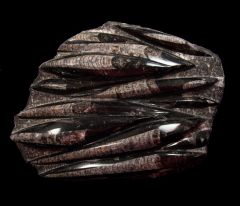
A LARGE, incredible polished Orthoceras plate showing the intricate internal chamber structure from Morocco. These are Devonian age squid-like creatures. Gorgeous jet black and white colors. Eleven Orthoceras specimens exposed. Largest Orthoceras is 11" in length. A museum quality Orthoceras plate. An incredible display piece! Note: Large and heavy Orthoceras plates will require a supplemental international shipping charge. This items weighs 12.75 lbs. to ship. Please request quote.
M2022 Plate size: 13-1/2" x 9"
Note - Adding five Orthoceras specimens in October 2022. Link to Othoceras plates
Learn More - Otodus aksuaticus (Serrated)$0.00
A GEM, very rare Otodus aksuaticus tooth with gray color. Excellent transitional tooth with small serrations covering 3/4 of the crown and side cusps. Found in Tushbiar, Mangyshlak, W. Kazakhstan. This is a GEM quality tooth, but it a pit in the bourlette area. Kazakhstan is one of the few places on earth where the transition series from Ototdus (non-serrated) to Auriculatus (fully serrated) can be found.
K554 SIZE: 1-1/8"+
Learn More - Pappocetus lugardi (Ancient whale)$1,350.00
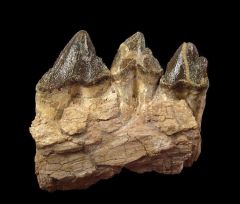
An Ultra Rare, Extra Large Pappocetus lugardi (Andrews, 1920) jaw section with 3 complete molars from Morocco. Pappocetus was in the Protocetidae family of ancient whales. Note – the molars demonstrate how massive Pappocetus teeth compared to the later primitive whales! The root thickness doubles on one side and the crown gains depth as well. This material is a new find and represents one of the earliest transition forms of the whale. Pappocetus is a protocetid (see discussion below) and a large amphibious aquatic carnivore. Pappocetus is also an ancestor of the Basilosaurus.. This material is complete and without repair. Crack fill only on some pieces. This is an opportunity to own an incredibly rare specimen from an early evolutionary stage of the modern whale. A fantastic collector's specimen. Authenticity guaranteed.
M2103 Size: 3-3/4" (W - straight line) (3-1/2" height)
Mid. Eocene (Bartonian) age (40 MYA)
Gueran, (25 km SE of Boujdour), Boujdour Basin
West Sahara, Morocco
Learn More - Pappocetus lugardi (Early whale)$0.00
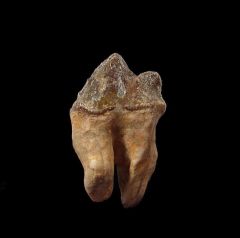
An Ultra Rare, Extra Large Pappocetus lugardi (Andrews, 1920) molar tooth from Morocco. Note - molar tooth design is one of the distinguishing features for indentifying this species.The molars demonstrate how massive Pappocetus teeth compared to the later primitive whales! The root thickness doubles on one side and the crown gains depth as well. This material is a new find and represents one of the earliest transition forms of the whale. Pappocetus is a protocetid (see discussion below) and a large amphibious aquatic carnivore. Pappocetus is also an ancestor of the Basilosaurus. This material is complete and without repair. Crack fill only on some pieces. This is an opportunity to own an incredibly rare specimen from an early evolutionary stage of the modern whale. A fantastic collector's specimen. Authenticity guaranteed.
M2106 Size: 2-1/2" (straight line) (1-3/8" Width at base of crown)
Mid. Eocene (Bartonian) age (40 MYA)
Gueran, (25 km SE of Boujdour), Boujdour Basin
West Sahara, Morocco
Learn More - Pappocetus lugardi (Ancient whale)$1,450.00
An Ultra Rare, Huge Pappocetus lugardi (Andrews, 1920) pre-molar tooth from Morocco. Pappocetus was in the Protocetidae family of ancient whales . Note - this tooth (the last "pre-molar") demonstrates how massive Pappocetus teeth compared to the later primitive whales! The root thickness doubles on one side and the crown gains depth as well.This material is a new find and represents one of the earliest transition forms of the whale. Pappocetus is a protocetid (see discussion below) and a large amphibious aquatic carnivore. Pappocetus is also an ancestor of the Basilosaurus. This material is complete and without repair. Crack fill only on some pieces. This is an opportunity to own an incredibly rare specimen from an early evolutionary stage of the modern whale. A fantastic collector's specimen. Authenticity guaranteed.
M2108 Size: 4-3/4" (straight line) (3" Width at base of crown & ~1-1/2" depth)
Mid. Eocene (Bartonian) age (40 MYA)
Gueran, (25 km SE of Boujdour), Boujdour Basin
West Sahara, Morocco
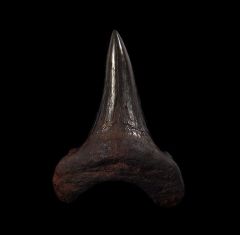
Learn More - Otodus obliquus (Auriculatus ancestor)$0.00
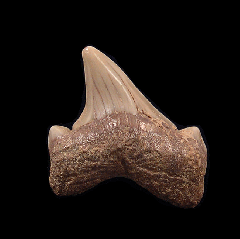
A very rare, Otodus obliquus tooth from the copper-red site of No. Carolina. The crown has no serrations. Typical Otodus side cusps. Complete root. Early Eocene - Ypresian age. A very rare collector's tooth. Very few Otodus teeth found at this site!
NC251 SIZE: 2-3/16"Note - Adding 9 early NC red site early Rics, transition teeth, and later Rics in June 2020. Link to NC Auriculatus teeth
Learn More - Macrorhizodus nolfi$0.00
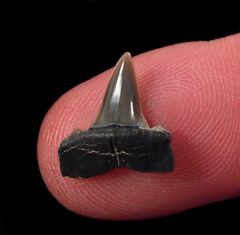
A very rare, early Macrorhizodus nolfi upper jaw, lateral tooth from Aktulagay, western Kazakhstan. Macrorhizodus nolfi is a Lamnidae shark and an early Mako shark (Isurus praecursor) relative in this early Eocene deposit. The side cusps are complete. No repair. Authenticity guaranteed. Perfect tooth.
K572 SIZE: 3/4"
Note - Adding 18 Kazakh Auriculatus or transition teeth in April 2020. --> Link to Kazakh Auriculatus teeth.
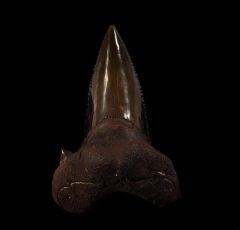
Learn More - Otodus auriculatus (Early Eocene form)$0.00
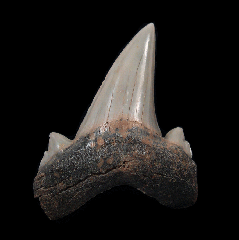
A very rare, Otodus auriculatus tooth from the copper-red site of No. Carolina. The crown has coarse serrations. The side cusps are typical of the Otodus obliquus. Complete root. Early Eocene - Ypresian age. A very rare collector's tooth. Very few Otodus auriculatus teeth (early form) found at this site!
NC253 SIZE: 2-1/2"Note - Adding 9 early NC red site early Rics, transition teeth, and later Rics in June 2020. Link to NC Auriculatus teeth
Learn More