Search results for: 'site 2 bedroom guid rd epsom'
- Did you mean
- site 2 bedroom good rd epsom
- Related search terms
- site out enabl cohesive devices
- site out enabl cohesive derives
- site 2 bedroom good rd epsom
- site 2 bedroom goods rd epsom
- site 2 bedroom goods rd epsom//
- Otodus megalodon$0.00
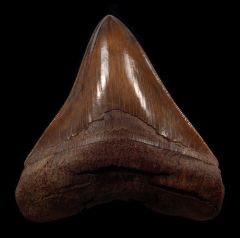
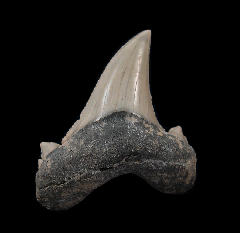
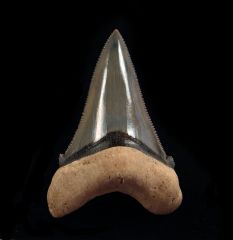
The October 2015 Week #2 FOTM is a rare, TOP QUALITY North Carolina Carcharocles megalodon. An excellent tooth from the copper-red site. It has an incredible copper-red colored crown. The enamel is the highest possible quality with small hydration cracks. A nice dark brown bourlette. Exceptional serrations and tip - one serration missing. Incredible condition for a big NC Meg. An excellent dark brown root, extra wide and slight damage on the reverse. Fantastic triangular shape. A gorgeous North Carolina copper-red Megalodon shark tooth. An exceptional collector's tooth. Note - you rarely see a copper-red Megalodon shark tooth that has a top quality crown, root and serrations - a top 1% tooth from this site! One of the finest quality copper-red Big Megalodon tooth that I have seen! NO repair! The BEST of the BEST. My largest remaining top quality copper-red Megalodon tooth!
NC017 SIZE: 5-1/8" (4-9/16" W)
Learn More - Otodus obliquus (not serrated)$95.00
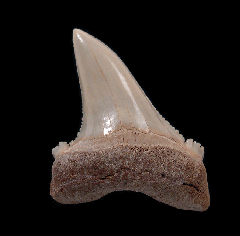
A very rare, early Otodus obliquus anterior tooth from Kzil-Orda Region, Kazakhstan. Otodus obliquus is the ancestor to O. auriculatus (see detailed discussion below) which leads to Megalodon. The bourlette is large and complete. Exhibits no serrations. The starting species to serrated Otodus teeth. These teeth exhibit very good color, gloss, and preservation. A rare, early Eocene (Ypresian) Auriculatus transition tooth. A very challenging tooth to find when building a Megalodon evolutionary set! No repair. Authenticity guaranteed. Note - This western Kazakhstan site is one of the few places in the world where the Otodus obliquus to Otodus auriculatus transition can be found in adjacent early Eocene formation units.
K561 SIZE: 1-1/16"
Note - Adding 24 Kazakh Auriculatus or transition teeth in July 2024. --> Link to Kazakh Auriculatus teeth.
Learn More - Otodus obliquus (not serrated)$200.00
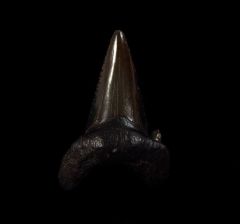
A very rare, early Otodus obliquus anterior tooth from Kzil-Orda Region, Kazakhstan. Otodus obliquus is the ancestor to O. auriculatus (see detailed discussion below) which leads to Megalodon. The bourlette is large and complete. Exhibits no serrations. The starting species to serrated Otodus teeth. These teeth exhibit very good color, gloss, and preservation. A rare, early Eocene (Ypresian) Auriculatus transition tooth. A very challenging tooth to find when building a Megalodon evolutionary set! No repair. Authenticity guaranteed. Note - This western Kazakhstan site is one of the few places in the world where the Otodus obliquus to Otodus auriculatus transition can be found in adjacent early Eocene formation units.
K561 SIZE: 1-1/4"
Note - Adding 24 Kazakh Auriculatus or transition teeth in July 2024. --> Link to Kazakh Auriculatus teeth.
Learn More - Otodus mugodzharicus (Partial serrated)$0.00
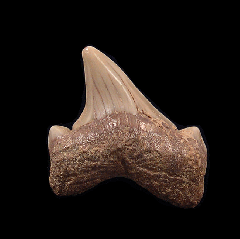
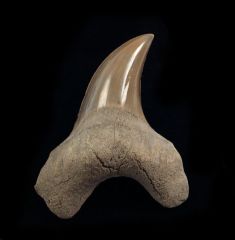
A very rare, early Otodus mugodzharicus upper jaw, lateral tooth from Aktulagay, western Kazakhstan. A transitional tooth leading to C. auriculatus (see detailed discussion below) which leads to Megalodon. A November Fossil of the Month.The bourlette is complete. Tooth exhibits "wavy serrated" edges similar to the Isurus escheri tooth. These teeth exhibit very good color, gloss, and preservation. A rare, early Eocene Auriculatus transition tooth. A very challenging tooth to find when building a Megalodon evolutionary set! No repair. Authenticity guaranteed. This western Kazakhstan site is one of the few places in the world where the Otodus to Auriculatus transition can be found in adjacent layers. Note - This is my last offering of Aktluagay teeth.
K552 SIZE: 1-9/16"
Note - Adding 19 Kazakh Auriuclatus or transition teeth in November 2021. --> Link to Kazakh Auriculatus teeth.
Learn More - Otodus aksuaticus (Partial serrated)$425.00
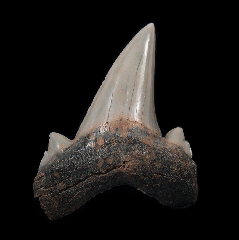
A very rare, early Otodus aksuaticus lateral tooth from Kzil-Orda, Kazakhstan. A transitional tooth leading to O. auriculatus (see detailed discussion below) which leads to Megalodon. The bourlette is complete. This tooth exhibits small serrations along the lower 1/3 of the crown and micro serrations to the tip. These teeth exhibit excellent color, gloss, and preservation. A rare, early (Ypresian) Eocene Auriculatus transition tooth. A very challenging tooth to find when building a Megalodon evolutionary set! No repair or restoration. Authenticity guaranteed. This western Kazakhstan site is one of the few places in the world where the Otodus obliquus to Otodus auriculatus transition can be found in adjacent geologic layers.
K543 SIZE: 1-7/8"
Note - Adding 24 Kazakh Auriuclatus or transition teeth in July 2024. --> Link to Kazakh Auriculatus teeth.
Learn More - Otodus aksuaticus (Partial serrated)$450.00
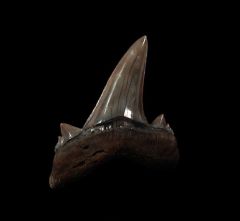
A very rare, early Otodus aksuaticus upper jaw, lateral tooth from Kzil-Orda, Kazakhstan. A transitional tooth leading to O. auriculatus (see detailed discussion below) which leads to Megalodon. A July Fossil of the Month. The bourlette is complete. This tooth exhibits small serrations along the lower 1/3 of the crown and micro serrations to the tip. These teeth exhibit excellent color, gloss, and preservation. A rare, early (Ypresian) Eocene Auriculatus transition tooth. A very challenging tooth to find when building a Megalodon evolutionary set! No repair or restoration. Authenticity guaranteed. This western Kazakhstan site is one of the few places in the world where the Otodus obliquus to Otodus auriculatus transition can be found in adjacent geologic layers.
K547 SIZE: 1-15/16"
Note - Adding 24 Kazakh Auriuclatus or transition teeth in July 2024. --> Link to Kazakh Auriculatus teeth.
Learn More - Otodus auriculatus (Early Eocene form)$0.00
A very rare, Otodus auriculatus tooth from the copper-red site of No. Carolina. The crown has coarse serrations. The side cusps are typical of the Otodus obliquus. Complete root. Early Eocene - Ypresian age. A very rare collector's tooth. Very few Otodus auriculatus teeth (early form) found at this site!
NC255 SIZE: 1-11/16"Note - Adding 9 early NC red site early Rics, transition teeth, and later Rics in June 2020. Link to NC Auriculatus teeth
Learn More - Parotodus benedeni$0.00
A very rare, TOP QUALITY Parotodus benedeni tooth from Lee Creek mine, No. Carolina. AN EXCEPTIONAL, Rare Collector's tooth! The BEST of the BEST! When was the last time you saw a top quality, large LC Beni? A very special, rare collector's tooth. My last one!
LC108 Size: 2-5/8"
Learn More - Carcharocles angustidens$0.00
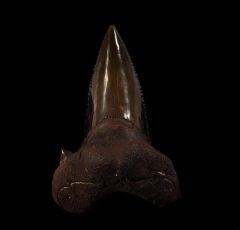
A GEM dark gray Summerville Carcharocles angustidens, a C-megalodon tooth predecessor - "spike-like" Anterior tooth. It has an incredible dark gray colored crown with an exceptional black bourlette. A gorgeous Summerville Angustidens. An exceptional collector's tooth. Excellent eye appeal! NO repair! The BEST of the BEST!
SC512 Size: 2-1/4"
Learn More - Zilchovaspis rogusa$1,150.00
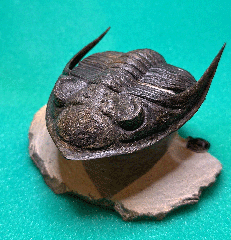
A "Flying" Top Quality, EXTRA LARGE Zilchovaspis rogusa trilobite from Morocco. A November Fossil of the Month. It has German controlled preparation and retains all natural color and detail. The bottom of this trilobite has been cleaned out and it sits on an 1" matrix pedestal. Preparation easily took many dozens of hours to clean this specimen. Incredible prep work! All natural. A Lower Devonian trilobite. One of my favorite Devonian species. Authenticity guaranteed. Note - Specimen weighs 1.2 pounds and a supplemental international shipping surcharge will be applied tp Free Shipping. The largest Zilchovaspis rogusa trilobite that I have seen. A massive trilobite!
XM72 Size: 4-1/2" straightline ; 6" on curve (2-3/4" wide)
Adding 9 quality Moroccan trilobites in November 2025. Link to Moroccan trilobites.
Learn More - Otodus sokolovi - Kazakhstan$0.00
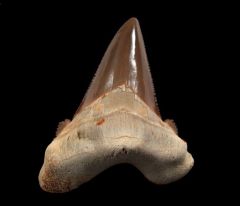
A very rare, EXTRA LARGE Otodus sokolovi upper jaw, anterior tooth from Kert, Mangyshlak, western Kazakhstan. A November Fossil of the Month. This location produces top quality teeth with brown colored enamel. The extra large bourlette that is complete. Nice extra coarse serrations and killer, large side cusps with very irregular serrations. The root is very thivh (~1-1/8") and complete.These teeth exhibit exceptional color, gloss, and preservation. Lower Schorym Formation - Bartonian - 40 MYA. This is a rare, late Eocene "Auriculatus" tooth also known as Otodus sokolovi! No repair or restoration. Authenticity guaranteed. I haven't seen these BIG Kazakh teeth since 2003! My last O. sokolovi teeth to offer.
K501 BoP SIZE: 3-7/16"
Note - Adding 19 Kazakh Auriculatus or transition teeth in November 2021. --> Link to Kazakh Auriculatus teeth.
Learn More - Otodus auriculatus (Early Eocene form)$0.00
A very rare, Otodus auriculatus tooth from the copper-red site of No. Carolina. The crown has coarse serrations. The side cusps are typical of the Otodus obliquus. Complete root. Early Eocene - Ypresian age. A very rare collector's tooth. Very few Otodus auriculatus teeth (early form) found at this site!
NC253 SIZE: 2-1/2"Note - Adding 9 early NC red site early Rics, transition teeth, and later Rics in June 2020. Link to NC Auriculatus teeth
Learn More