Search results for: 'colorado peg patholog 11 year old site'
- Related search terms
- pegasus enabl 14 50 33 w5 parvus
- pegasus enabl 16 50 33 w5 parvus
- site out enabl cohesive devices
- site out enabl cohesive derives
- pegasus enabl 10 50 33 w5 parvus
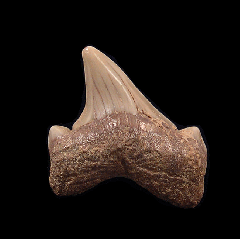
- Otodus obliquus (not serrated)$95.00
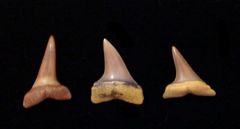
A very rare, early Otodus obliquus anterior tooth from Kzil-Orda Region, Kazakhstan. Otodus obliquus is the ancestor to O. auriculatus (see detailed discussion below) which leads to Megalodon. The bourlette is large and complete. Exhibits no serrations. The starting species to serrated Otodus teeth. These teeth exhibit very good color, gloss, and preservation. A rare, early Eocene (Ypresian) Auriculatus transition tooth. A very challenging tooth to find when building a Megalodon evolutionary set! No repair. Authenticity guaranteed. Note - This western Kazakhstan site is one of the few places in the world where the Otodus obliquus to Otodus auriculatus transition can be found in adjacent early Eocene formation units.
K561 SIZE: 1-1/16"
Note - Adding 24 Kazakh Auriculatus or transition teeth in July 2024. --> Link to Kazakh Auriculatus teeth.
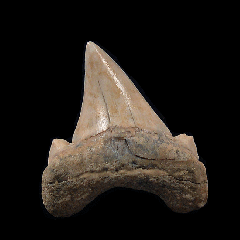
Learn More - Otodus obliquus (not serrated)$135.00
A very rare, early Otodus obliquus anterior tooth from Kzil-Orda Region, Kazakhstan. Otodus obliquus is the ancestor to O. auriculatus (see detailed discussion below) which leads to Megalodon. The bourlette is large and complete. Exhibits no serrations. The starting species to serrated Otodus teeth. These teeth exhibit very good color, gloss, and preservation. A rare, early Eocene (Ypresian) Auriculatus transition tooth. A very challenging tooth to find when building a Megalodon evolutionary set! No repair. Authenticity guaranteed. Note - This western Kazakhstan site is one of the few places in the world where the Otodus obliquus to Otodus auriculatus transition can be found in adjacent early Eocene formation units.
K562 SIZE: 1-1/4"
Note - Adding 24 Kazakh Auriculatus or transition teeth in July 2024. --> Link to Kazakh Auriculatus teeth.
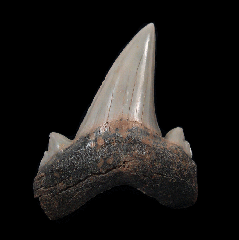
Learn More - Otodus obliquus (not serrated)$200.00
A very rare, early Otodus obliquus anterior tooth from Kzil-Orda Region, Kazakhstan. Otodus obliquus is the ancestor to O. auriculatus (see detailed discussion below) which leads to Megalodon. The bourlette is large and complete. Exhibits no serrations. The starting species to serrated Otodus teeth. These teeth exhibit very good color, gloss, and preservation. A rare, early Eocene (Ypresian) Auriculatus transition tooth. A very challenging tooth to find when building a Megalodon evolutionary set! No repair. Authenticity guaranteed. Note - This western Kazakhstan site is one of the few places in the world where the Otodus obliquus to Otodus auriculatus transition can be found in adjacent early Eocene formation units.
K561 SIZE: 1-1/4"
Note - Adding 24 Kazakh Auriculatus or transition teeth in July 2024. --> Link to Kazakh Auriculatus teeth.
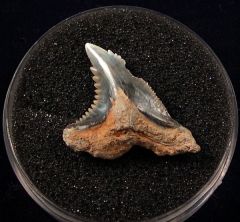
Learn More - Hemipristis serra (Sumatra)$17.50
A rare Hemipristis serra tooth, the Snaggletooth shark, from Sumatra, Indonesia. These teeth were deposited in the Telisa formation - a shallow marine environment during the middle Miocene (approx. 15 million years ago.) A very unique collector's tooth. Authenticity guaranteed.
D032 SIZE: 1-1/8"
Note - 8 new Sumatran Hemipristis teeth added in January 2018. Link to Sumatran teeth.
Learn More - Carcharodon carcharias$525.00
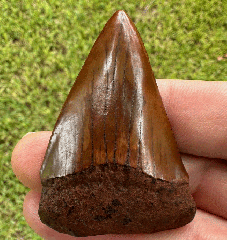
A rare LARGE, Top Quality red site Carcharodon carcharias tooth from the Meherrin River, No Carolina. Rare, rich copper-red color with high gloss. High quality enamel. Great preservation and condition - sharp serrations and tip. No repair or restoration. Exceptional color! An excellent, rare BIG Great White collector's tooth! Authenticity guaranteed.
NC204 SIZE: 2-9/16" (1-3/4" wide)
Note - Adding 5 copper-red Great White teeth in August 2025. --> Link to copper-red Great White
Learn More - Carcharocles megalodon$145.00
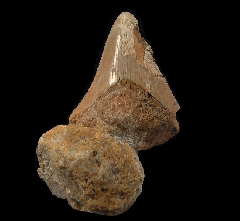
A Scarce Megalodon tooth from Dakhla area, Western Sahara, Morocco. This tooth is attached to a piece of sandstone matrix with a quartz crystal pocket at the base - very unusual! These Megalodon teeth are great for gifts, class room, or starting your fossil shark tooth or Megalodon collection. These Megs are Miocene age - about 14 MYA. No repair or restoration. Authenticity guaranteed. You don't see many of these Moroccan Meg teeth today since the site is closed.
M080 SIZE: 2-3/4"
Adding 13 Moroccan Megalodon teeth in October 2023. Link to Moroccan Megalodon teeth
Learn More - Isurus desori$25.00
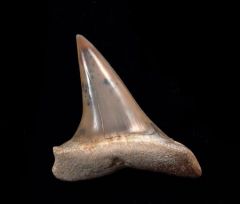
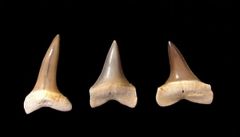
A GEM classic upper jaw lateral I. desori tooth with a great color. Very clean edges. Perfect teeth.
P382 SIZE: 1-1/16"
Learn More - Isurus desori$30.00
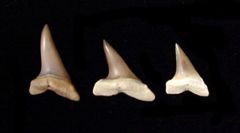
An excellent set of three, classic upper jaw I. desori teeth with a great color. Very clean edges. Perfect teeth. Sold as a set of 3 teeth.
P419 SIZE: ~1"
Learn More - Isurus desori$30.00
An excellent set of three, classic upper jaw I. desori teeth with a great color. Very clean edges. Perfect teeth.
P427 SIZE: ~1"
Learn More - Isurus desori$30.00
An excellent set of three, classic upper jaw I. desori teeth with a great color. Very clean edges. Perfect teeth.
P428 SIZE: ~1"
Learn More - Sphyraena striata (Barracuda)$15.00
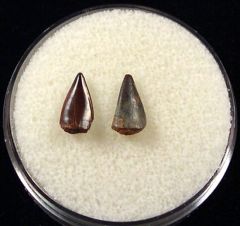
A rare Sphyraena striata (Barracuda) tooth from Sumatra, Indonesia. These teeth were deposited in the Telisa formation - a shallow marine environment during the middle Miocene (approx. 15 million years ago.) A very unique collector's tooth. D161 is the top quality tooth on the left. Authenticity guaranteed.
D161 (Left) SIZE: 5/16"+
Note - 6 new Sumatran Sphyraena striata teeth added in January 2018. Link to Sumatran teeth.
Learn More - Sphyraena striata (Barracuda)$5.00
A rare Sphyraena striata (Barracuda) tooth from Sumatra, Indonesia. These teeth were deposited in the Telisa formation - a shallow marine environment during the middle Miocene (approx. 15 million years ago.) A very unique collector's tooth. D162 is the good quality tooth on the right. Authenticity guaranteed.
D162 (Right) SIZE: 5/16"
Note - 6 new Sumatran Sphyraena striata teeth added in January 2018. Link to Sumatran teeth.
Learn More