Search results for: 'boni form 2'
- Did you mean
- book form 2
- Related search terms
- form megalodon shark tooth fossil southeastern united stands
- form sa01 mastodon tooth/Megalodon teeth - So. Carolina Top Quality Meg teeth over 5 inches
- form megalodon shark tooth fossil southeastern united stands//
- form à vapeur
- Formalism in Ethics and Non-formal Ethics of Values: A New Attempt Toward the Foundation of an Ethical Personalism Max Scheler
- Carcharodon hubbelli$595.00
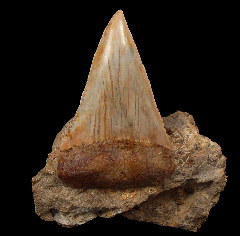
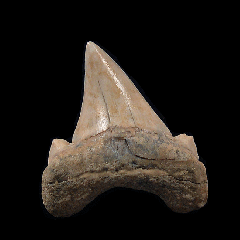
An EXTRA LARGE, rare TOP QUALITY, Great White shark transition tooth, Carcharodon hubbelli. An upper jaw anterior tooth on its original phosphorite matrix. This C. hubbelli tooth has medium to small serrations at the base of the cutting edge that disappear towards the tip. This tooth has an excellent tan colored crown and tan root. Fantastic color! No repair or restoration. Authenticity guaranteed. An exceptional Great White transition form! It will be extremely difficult to locate Carcharodon hubbelli since there is no new supply. An excellent display piece.
C202T SIZE: 2-11/16"
Note - Adding 7 new C. hubbelli (GW transition) teeth in September 2025 Link to GW Transition Teeth
Learn More - Carcharodon hubbelli$650.00
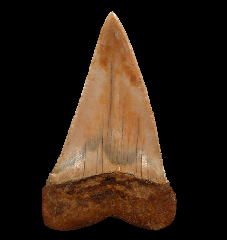
An EXTRA LARGE, rare TOP QUALITY, Great White shark transition tooth, Carcharodon hubbelli. An upper jaw anterior tooth. A September Fossil of the Month. This C. hubbelli tooth has medium to small serrations at the base of the cutting edge that disappear towards the tip. This tooth has an excellent tan colored crown and tan root. Fantastic color! No repair or restoration. Authenticity guaranteed. An exceptional Great White transition form! It will be extremely difficult to locate Carcharodon hubbelli since there is no new supply. An excellent display piece.
C201T SIZE: 2-5/8"
Note - Adding 7 new C. hubbelli (GW transition) teeth in September 2025 Link to GW Transition Teeth
Learn More - Priscacara liops$0.00
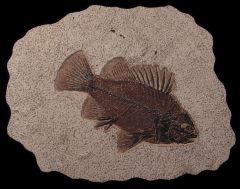
An Extra Large, Top Quality Priscacara (Cockerellites) liops fish from the 18" layer, Green River Fm., Lincoln Co. Wyoming. The Priscacara liops is an extinct Perch from the Eocene age (50 MYA). This piece is from the 18 Inch Layer which is extremely hard and difficult to prepare. It also provides the most detailed, highly preserved fossils. Exceptional preservation and preparation. No repair. All natural. Plate size is 7" x 9". Note - this fish has a free form matrix cut and a backer board with hanger. This Priscaccara is ready to hang! An excellent display piece! Museum Quality. Authenticity guaranteed.
X482 BoP SIZE: 6"
Learn More - Otodus obliquus (Auriculatus ancestor)$0.00
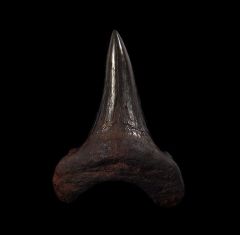
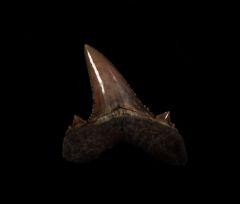
A very rare, Otodus obliquus tooth from the copper-red site of No. Carolina. The crown has no serrations. Typical Otodus side cusps. Complete root. Early Eocene - Ypresian age. A very rare collector's tooth. Very few Otodus teeth found at this site!
NC251 SIZE: 2-3/16"Note - Adding 9 early NC red site early Rics, transition teeth, and later Rics in June 2020. Link to NC Auriculatus teeth
Learn More - Stromatolite sp.$0.00
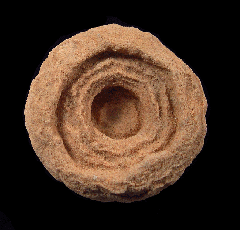
A Stromatolite sp. from Saf-Saf. Morocco. A possible Stromatolite algae mound from Morcco. Stromatolites are structures formed by colonies of blue green algae (or cyanobacteria). This is a Cretaceous Stromatolite. A very interesting display piece!
Y075 SIZE: 2-1/2" x 1-7/8" Height
Note - Posting 6 "other" fossils in January 2024. Link to Other Fossils
Learn More - Otodus mugodzharicus (Partial serrated)$0.00
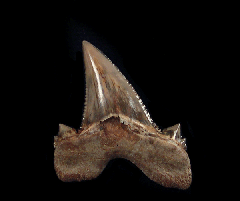
A very rare, early Otodus mugodzharicus upper jaw, lateral tooth from Aktulagay, western Kazakhstan. A transitional tooth leading to C. auriculatus (see detailed discussion below) which leads to Megalodon. The bourlette is complete. Tooth exhibits very fine serrations along the lower 1/3 of crown and micro serrations to the tip. These teeth exhibit very good color, gloss, and preservation. A rare, early Eocene Auriculatus transition tooth. A very challenging tooth to find when building a Megalodon evolutionary set! No repair. Authenticity guaranteed. Note - This western Kazakhstan site is one of the few places in the world where the Otodus to Auriculatus transition can be found in adjacent layers.
K554 SIZE: 1-1/4"
Note - Adding 18 Kazakh Auriuclatus or transition teeth in April 2020. --> Link to Kazakh Auriculatus teeth.
Learn More - Otodus obliquus (not serrated)$135.00
A very rare, early Otodus obliquus anterior tooth from Kzil-Orda Region, Kazakhstan. Otodus obliquus is the ancestor to O. auriculatus (see detailed discussion below) which leads to Megalodon. The bourlette is large and complete. Exhibits no serrations. The starting species to serrated Otodus teeth. These teeth exhibit very good color, gloss, and preservation. A rare, early Eocene (Ypresian) Auriculatus transition tooth. A very challenging tooth to find when building a Megalodon evolutionary set! No repair. Authenticity guaranteed. Note - This western Kazakhstan site is one of the few places in the world where the Otodus obliquus to Otodus auriculatus transition can be found in adjacent early Eocene formation units.
K562 SIZE: 1-1/4"
Note - Adding 24 Kazakh Auriculatus or transition teeth in July 2024. --> Link to Kazakh Auriculatus teeth.
Learn More - Physogaleus contortus$12.50
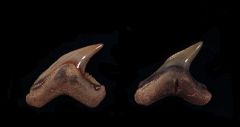
An excellent Physogaleus contortus tooth from the Oligocene of Seminole Co., Florida. F737 is the tooth on the left.
F737 (Left) SIZE: 3/4"
Learn More - Kayserops sp.$225.00
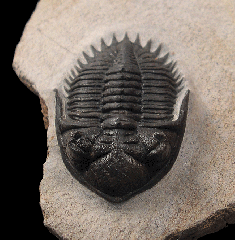
An Top Quality Kayserops sp. trilobite. Preparation is German directed with all original colors and no restoration. Excellent preservation and condition. Beautifil black shell. Excellent detail in the compound eyes. This specimen is fully exposed on a pedestal of original matrix. A Middle Devonian (380 mya) from the Djebel Issoumour area, Atlas Mts., Morocco. Authenticity guaranteed. An incredible amount of preparation was required for this fantastic display piece.
XM38 Size: 2-1/4" (1-3/8 wide)
Adding 31 quality Moroccan trilobites in April 2025. Link to Moroccan trilobites.
Learn More - Otodus aksuaticus (Serrated)$0.00
A GEM, very rare Otodus aksuaticus tooth with gray color. Excellent transitional tooth with small serrations covering 3/4 of the crown and side cusps. Found in Tushbiar, Mangyshlak, W. Kazakhstan. This is a GEM quality tooth, but it a pit in the bourlette area. Kazakhstan is one of the few places on earth where the transition series from Ototdus (non-serrated) to Auriculatus (fully serrated) can be found.
K554 SIZE: 1-1/8"+
Learn More - Pappocetus lugardi (Ancient whale)$1,450.00
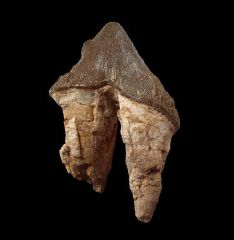
An Ultra Rare, Huge Pappocetus lugardi (Andrews, 1920) pre-molar tooth from Morocco. Pappocetus was in the Protocetidae family of ancient whales . Note - this tooth (the last "pre-molar") demonstrates how massive Pappocetus teeth compared to the later primitive whales! The root thickness doubles on one side and the crown gains depth as well.This material is a new find and represents one of the earliest transition forms of the whale. Pappocetus is a protocetid (see discussion below) and a large amphibious aquatic carnivore. Pappocetus is also an ancestor of the Basilosaurus. This material is complete and without repair. Crack fill only on some pieces. This is an opportunity to own an incredibly rare specimen from an early evolutionary stage of the modern whale. A fantastic collector's specimen. Authenticity guaranteed.
M2108 Size: 4-3/4" (straight line) (3" Width at base of crown & ~1-1/2" depth)
Mid. Eocene (Bartonian) age (40 MYA)
Gueran, (25 km SE of Boujdour), Boujdour Basin
West Sahara, Morocco
Learn More - Carcharodon hastalis - NC Red Site$0.00
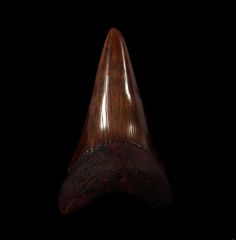
An Ultra Rare, EXTRA LARGE copper-red I. hastalis tooth from the Meherrin River, No. Carolina. An April Fossil of the Month. A rare copper red color with exceptional gloss. Highest quality enamel. Excellent preservation and condition - sharp edges - very clean. This tooth is the "broad form" of the I. hastalis which appears to a Yorktown Fm., Pliocene age tooth. No repair or restoration. Exceptional color! An excellent, rare collector's tooth! Museum Quality. Authenticity guaranteed.
NC302 BoP2 SIZE: 36"
Note - Adding 12 copper-red Hastalis Mako teeth in May 2020. --> Link to copper-red Makos
Learn More