Search results for: 'clam bear lower franc teeth fossils'
- Related search terms
- bear good cave in texanus river
- france good slimpants when
- france good slimpants wolf
- bear good ca01 in texanus rather
- bear good ca05 in texanus river
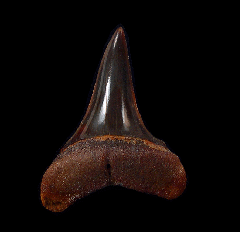
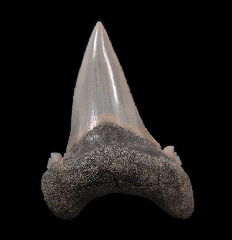
- Carcharodon hastalis - Peru$85.00
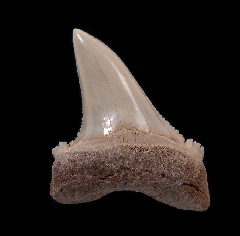
A colorful, Top Quality Carcharodon hastalis tooth from the Ica region of Peru. An incredible red colored crown and a red brown root. Fantastic color! Sharp cutting edges. Excellent definition and preservation. An excellent lower jaw tooth. No repair. Authenticity guaranteed. An excellent colorful collector's Mako tooth. The red teeth are the most difficult to locate.
P320 SIZE: 1-1/4"
Adding 17 Carcharodon hastalis teeth in May 2024. Link to Peruvian Hastalis teeth.
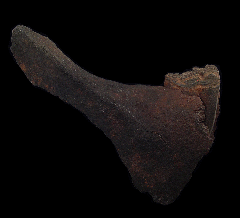
Learn More - Equus sp. - Florida$47.50
A LARGE, well preserved horse lower jaw section (Equus sp. ) from northern Florida. The horse arrived in North America during the late Pliocene and became extinct at the end of the Pleistocene. Lower jaw section with tooth. Very well fossilized specimen. No repair or restoration. Authenticity guaranteed.
XH03 Size: 5-1/2"
Name: Equus sp.
Age: Pleistocene
Location: Northern Florida
Note - Posting 13 horse fossils in April 2024. Link to Horse Fossils
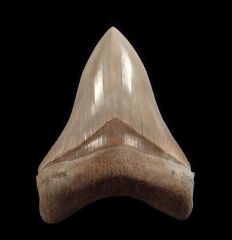
Learn More - Otodus megalodon$0.00
A TOP QUALITY, 4-5/8" Classic Lee Creek Megalodon tooth - an lower jaw PRINCIPAL ANTERIOR tooth. This Meg has an incredible light tan colored crown with an excellent brown bourlette. Highest quality enamel. Excellent color! The bourlette is excellent and near perfect. The serrations are large and razor sharp - essentially perfect with an exceptional tip serration. Excellent serrations - razor sharp! The root is an excellent tan color and absolutely complete. Excellent anterior symmetry! This Megalodon was found in the Pungo Formation, Lee Creek mine, NC (Miocene age = 15 MYA). One of the finest examples of a classic lower jaw anterior Lee Creek Megs considering the shape, color, and preservation. An exceptional collector's tooth from the old days at Lee Creek mine! NO repair! The BEST of the BEST! One of my favorites.
LC055 Size: 4-5/8" (3-1/2" W)
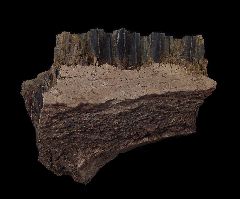
Learn More - Hadrosaur - Maxilla (upper jaw)$1,250.00
A Top Quality Hadrosaur maxilla (upper jaw) section from the late Cretaceous (Horseshoe Canyon Fm.) of North America. This jaw section contains 10 exposed teeth. This hadrosaur or "duck-bill" dinosaur was found in the Horseshoe Canyon Formation in Alberta. The maxilla possessed 100s teeth that were in rows of teeth which acted as conveyor belt to maintain a chewing surface to cut and grind their food. This specimen is a section of the lower jaw includes ten rows of teeth. Bone quality is excellent. No restoration. Legally collected on private land in the Horseshoe Canyon Fm., Alberta, Canada. An excellent collector's quality Edmontosaurus maxilla section from a rare location. Authenticity guaranteed. Disposition number #000028-0000029.
DH33 SIZE: 4" x 3-1/2"
Note - Adding 22 Hadrosaur /Edmontosaurus bones & claws in April 2022. Link to Edmontosaurus fossils catalog
Learn More - Brittle Stars$0.00
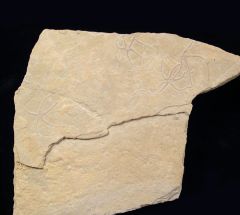
A MUSEUM QUALITY group of three Ophiopetra lithographica, a Brittle Star. The largest is 1" in length. Incredible detail. Excellent preservation and excellent preparation. Matrix size is 3-1/4" x 3". This Brittle star is from Hienheim, Bavaria, Germany. Upper Jurassic (Lower Tithonian). Rare! A top quality collector's piece.
GR104 SIZE: 1"
Learn More - Otodus aksuaticus (Partial serrated)$450.00
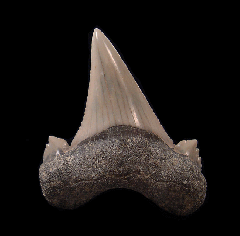
A very rare, early Otodus aksuaticus upper jaw, lateral tooth from Kzil-Orda, Kazakhstan. A transitional tooth leading to O. auriculatus (see detailed discussion below) which leads to Megalodon. A July Fossil of the Month. The bourlette is complete. This tooth exhibits small serrations along the lower 1/3 of the crown and micro serrations to the tip. These teeth exhibit excellent color, gloss, and preservation. A rare, early (Ypresian) Eocene Auriculatus transition tooth. A very challenging tooth to find when building a Megalodon evolutionary set! No repair or restoration. Authenticity guaranteed. This western Kazakhstan site is one of the few places in the world where the Otodus obliquus to Otodus auriculatus transition can be found in adjacent geologic layers.
K547 SIZE: 1-15/16"
Note - Adding 24 Kazakh Auriuclatus or transition teeth in July 2024. --> Link to Kazakh Auriculatus teeth.
Learn More - Otodus aksuaticus (Partial serrated)$425.00
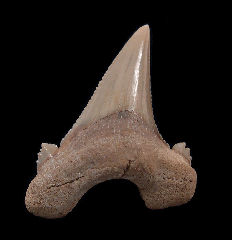
A very rare, early Otodus aksuaticus lateral tooth from Kzil-Orda, Kazakhstan. A transitional tooth leading to O. auriculatus (see detailed discussion below) which leads to Megalodon. A July Fossil of the Month.The bourlette is complete. This tooth exhibits small serrations along the lower 1/2 of the crown and micro serrations to the tip. These teeth exhibit excellent color, gloss, and preservation. A rare, early (Ypresian) Eocene Auriculatus transition tooth. A very challenging tooth to find when building a Megalodon evolutionary set! No repair or restoration. Authenticity guaranteed. This western Kazakhstan site is one of the few places in the world where the Otodus obliquus to Otodus auriculatus transition can be found in adjacent geologic layers.
K544 SIZE: 1-3/4"
Note - Adding 24 Kazakh Auriuclatus or transition teeth in July 2024. --> Link to Kazakh Auriculatus teeth.
Learn More - Otodus aksuaticus (Partial serrated)$550.00
A very rare, early Otodus aksuaticus lateral tooth from Kzil-Orda, Kazakhstan. A transitional tooth leading to O. auriculatus (see detailed discussion below) which leads to Megalodon. A July Fossil of the Month. The bourlette is complete. This tooth exhibits small serrations along the lower 1/2 of the crown and micro serrations to the tip. These teeth exhibit excellent color, gloss, and preservation. A rare, early (Ypresian) Eocene Auriculatus transition tooth. A very challenging tooth to find when building a Megalodon evolutionary set! No repair or restoration. Authenticity guaranteed. This western Kazakhstan site is one of the few places in the world where the Otodus obliquus to Otodus auriculatus transition can be found in adjacent geologic layers.
K542 SIZE: 2-1/8"
Note - Adding 24 Kazakh Auriuclatus or transition teeth in July 2024. --> Link to Kazakh Auriculatus teeth.
Learn More - Otodus aksuaticus (Partial serrated)$525.00
A very rare, early Otodus aksuaticus anterior tooth from Kzil-Orda, Kazakhstan. A transitional tooth leading to O. auriculatus (see detailed discussion below) which leads to Megalodon. A July Fossil of the Month. The bourlette is complete. This tooth exhibits small serrations along the lower 1/2 of the crown and micro serrations to the tip. These teeth exhibit excellent color, gloss, and preservation. A rare, early (Ypresian) Eocene Auriculatus transition tooth. A very challenging tooth to find when building a Megalodon evolutionary set! No repair or restoration. Authenticity guaranteed. This western Kazakhstan site is one of the few places in the world where the Otodus obliquus to Otodus auriculatus transition can be found in adjacent geologic layers.
K542 SIZE: 2-3/16"
Note - Adding 24 Kazakh Auriuclatus or transition teeth in July 2024. --> Link to Kazakh Auriculatus teeth.
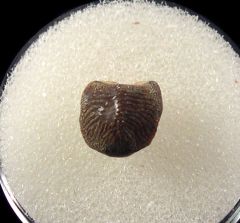
Learn More - Ptychodus anonymus$45.00
A Top Quality Ptychodus anonymus, an extinct durophagous (shell-crushing) shark, tooth from Johnson Co., Texas. An excellent example of this Upper Cretaceous Arcadia Park Fm. tooth. These massive teeth have a design with transverse ridges extending across the cusp face. Authenticity guaranteed. Perfect tooth.
T085 SIZE: 3/8"
Note - Adding 100+ new Texas shark teeth in October 2021. Link to Texas shark teeth
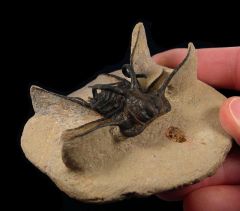
Learn More - Dicranurus monstrosus$0.00
A well prepared, rare spiny Dicranurus monstrosus trilobite on original matrix. Incredible detail and completeness. The huge spines are fully preserved and exposed. A Lower Devonian trilobite (410 mya). A very rare species! A high quality specimen. Collected in Laatchana, Alnif area , Atlas Mts., Morocco. Authenticity guaranteed. One of my favorite species.
XM46 Size: 2-1/2"
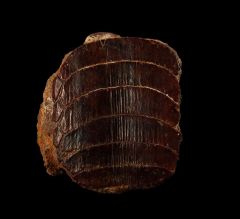
Learn More - Aetomylaeus sp.$325.00
An exceptional Aetomylaeus sp., an Eagle ray, mouth plate from Caldera area of Chile. An excellent plate of pavement teeth from the lower jaw. The specimen resides on its original phosphorite matrix. This plate has exceptional preservation, fantastic dark red colors, and exceptionally clean. Note - the bottom side of this specimen is covered with matrix. An incredible late Miocene Eagle ray mouth plate from the Bahia Inglesa Fm. Museum Quality. Authenticity guaranteed. Unfortunately there are no more teeth coming from this site. An excellent display piece!
C952 SIZE: 2-5/8" (2-5/16" Wide)
Note - Adding 4 Chilean Ray mouth plates in April 2022. -> Link to Chilean rays.
Learn More