Search results for: 'dung site fossil calip e'
- Did you mean
- du01 site fossil calip e
- Related search terms
- site out enabl cohesive devices
- site out enabl cohesive derives
- dung seven enabl liops
- dung seven enabl liops/
- dung seven enabl liops//
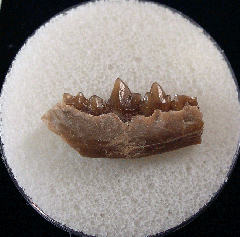
- Hesperocyon gregarius - Extinct Dog-like Canid$55.00
An extinct early Dog-like Canid jaw (Hesperocyon gregarius) from Sioux Co., Nebraska. Hesperocyon gregarius was one of many mammals that thrived in the Early Oligocene in North America. Found in the Brule Fm. (Rupelian) 33 - 30 million years ago. A very well preserved specimen. No repair or restoration. Authenticity guaranteed. This item comes witha 2"x 2" floating frame display.
WR43 Size: 1-1/8"
Name: Hesperocyon gregarius
Age: Oligocene
Location: Sioux Co., Nebraska
Note - Posting 49 Oligocene Mammal fossils in January 2025. Link to Oligocene Mammal Fossils
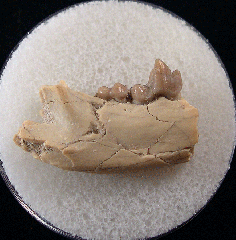
Learn More - Hesperocyon gregarius - Extinct Dog-like Canid$60.00
An extinct early Dog-like Canid jaw (Hesperocyon gregarius) from Sioux Co., Nebraska. Hesperocyon gregarius was one of many mammals that thrived in the Early Oligocene in North America. Found in the Brule Fm. (Rupelian) 33 - 30 million years ago. A very well preserved specimen. No repair or restoration. Authenticity guaranteed. This item comes witha 2"x 2" floating frame display.
WR42 Size: 1-3/16"
Name: Hesperocyon gregarius
Age: Oligocene
Location: Sioux Co., Nebraska
Note - Posting 49 Oligocene Mammal fossils in January 2025. Link to Oligocene Mammal Fossils
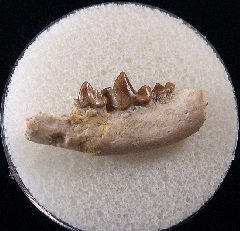
Learn More - Hesperocyon gregarius - Extinct Dog-like Canid$60.00
An extinct early Dog-like Canid jaw (Hesperocyon gregarius) from Sioux Co., Nebraska. Hesperocyon gregarius was one of many mammals that thrived in the Early Oligocene in North America. Found in the Brule Fm. (Rupelian) 33 - 30 million years ago. A very well preserved specimen. No repair or restoration. Authenticity guaranteed. This item comes witha 2"x 2" floating frame display.
WR41 Size: 1-1/4"
Name: Hesperocyon gregarius
Age: Oligocene
Location: Sioux Co., Nebraska
Note - Posting 49 Oligocene Mammal fossils in January 2025. Link to Oligocene Mammal Fossils
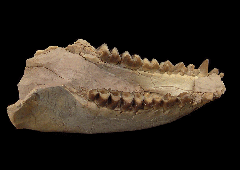
Learn More - Merycoidodon culbertson - Extinct Oreodont$250.00
An extinct extinct Oreodont jaw (Merycoidodon culbertson) from Converse Co., Wyoming. Merycoidodon culbertson was one of many mammals that thrived in the Early Oligocene in North America. Found in the Brule Fm. (Rupelian) 33 - 30 million years ago. A very well preserved specimen. No repair or restoration. Authenticity guaranteed.
WR61 Size: 4-5/8" long x 1-1/4" wide x 1-1/2" height
Name: Merycoidodon culbertson
Age: Oligocene
Location: Converse Co., Wyoming
Note - Posting 49 Oligocene Mammal fossils in January 2025. Link to Oligocene Mammal Fossils
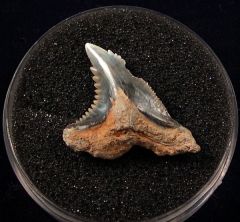
Learn More - Hemipristis serra (Sumatra)$17.50
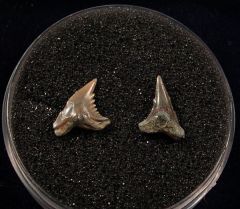
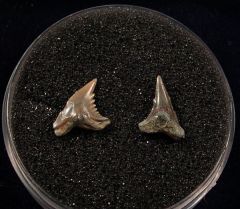
A rare Hemipristis serra tooth, the Snaggletooth shark, from Sumatra, Indonesia. These teeth were deposited in the Telisa formation - a shallow marine environment during the middle Miocene (approx. 15 million years ago.) A very unique collector's tooth. Authenticity guaranteed.
D032 SIZE: 1-1/8"
Note - 8 new Sumatran Hemipristis teeth added in January 2018. Link to Sumatran teeth.
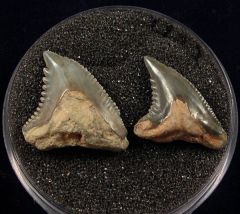
Learn More - Hemipristis serra (Sumatra)$12.50
A rare Hemipristis serra tooth, the Snaggletooth shark, from Sumatra, Indonesia. These teeth were deposited in the Telisa formation - a shallow marine environment during the middle Miocene (approx. 15 million years ago.) A very unique collector's tooth. Authenticity guaranteed. D033 is the tooth on the left.
D033 (Left) SIZE: 15/16"
Note - 8 new Sumatran Hemipristis teeth added in January 2018. Link to Sumatran teeth.
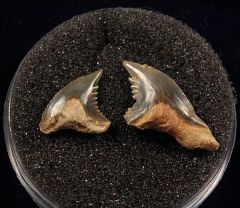
Learn More - Hemipristis serra (Sumatra)$8.00
A rare Hemipristis serra tooth, the Snaggletooth shark, from Sumatra, Indonesia. These teeth were deposited in the Telisa formation - a shallow marine environment during the middle Miocene (approx. 15 million years ago.) A very unique collector's tooth. Authenticity guaranteed. D035 is the tooth on the left.
D035 (Left) SIZE: 5/8"
Note - 8 new Sumatran Hemipristis teeth added in January 2018. Link to Sumatran teeth.
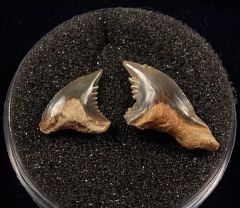
Learn More - Hemipristis serra (Sumatra)$10.00
A rare Hemipristis serra tooth, the Snaggletooth shark, from Sumatra, Indonesia. These teeth were deposited in the Telisa formation - a shallow marine environment during the middle Miocene (approx. 15 million years ago.) A very unique collector's tooth. Authenticity guaranteed. D036 is the tooth on the right.
D036 (right) SIZE: 15/16"
Note - 8 new Sumatran Hemipristis teeth added in January 2018. Link to Sumatran teeth.
Learn More - Hemipristis serra (Sumatra)$8.00
A rare Hemipristis serra tooth, the Snaggletooth shark, from Sumatra, Indonesia. These teeth were deposited in the Telisa formation - a shallow marine environment during the middle Miocene (approx. 15 million years ago.) A very unique collector's tooth. Authenticity guaranteed. D037 is the tooth on the left.
D037 (left) SIZE: 1/2
Note - 8 new Sumatran Hemipristis teeth added in January 2018. Link to Sumatran teeth.
Learn More - Hemipristis serra (Sumatra)$8.00
A rare Hemipristis serra tooth, the Snaggletooth shark, from Sumatra, Indonesia. These teeth were deposited in the Telisa formation - a shallow marine environment during the middle Miocene (approx. 15 million years ago.) A very unique collector's tooth. Authenticity guaranteed. D038 is the tooth on the right.
D038 (right) SIZE: 1/2"
Note - 8 new Sumatran Hemipristis teeth added in January 2018. Link to Sumatran teeth.
Learn More - Carcharoides totuserratus$0.00
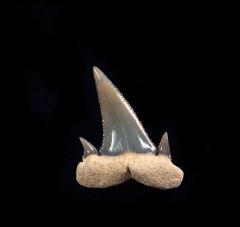
A GEM Carcharoides totuserratus, a rare and exotic Lamniforme fossil shark tooth. The best that you will find. Miocene age from Argentina. For the rare tooth collector! The BEST of the BEST!
A001 Size: 7/8"
Learn More - Otodus sokolovi - Kazakhstan$0.00
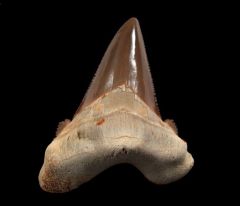
A very rare, EXTRA LARGE Otodus sokolovi upper jaw, anterior tooth from Kert, Mangyshlak, western Kazakhstan. A November Fossil of the Month. This location produces top quality teeth with brown colored enamel. The extra large bourlette that is complete. Nice extra coarse serrations and killer, large side cusps with very irregular serrations. The root is very thivh (~1-1/8") and complete.These teeth exhibit exceptional color, gloss, and preservation. Lower Schorym Formation - Bartonian - 40 MYA. This is a rare, late Eocene "Auriculatus" tooth also known as Otodus sokolovi! No repair or restoration. Authenticity guaranteed. I haven't seen these BIG Kazakh teeth since 2003! My last O. sokolovi teeth to offer.
K501 BoP SIZE: 3-7/16"
Note - Adding 19 Kazakh Auriculatus or transition teeth in November 2021. --> Link to Kazakh Auriculatus teeth.
Learn More