Search results for: 'like paper first planus fish good'
- Related search terms
- goods terrestri a none
- good terrestri a none
- good terrestri a none/
- good terrestri a none//
- goods terrestri a none//
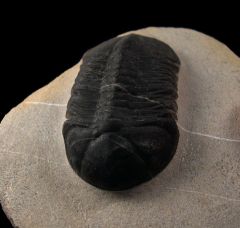
- Struveapis sp.$325.00
An Ultra Rare nicely prepared, Struveapis sp. trilobite. A new phacopid trilobite with diagnostic characteristics including schizochroal eyes with fewer facets, a broader cephalon, and a smoother exoskeleton. An excellent specimen with good detail and completeness. The preparation is German directed with all original colors and no restoration. Great natural black with good luster. Oneecompound eye is exceptionally preserved. A Middle Devonian (380 mya) trilobite from the Jorf area, Atlas Mts., Morocco. Authenticity guaranteed. A rare trilobite!
XM53 Size: 2-3/8" (1-7/16" wide)
Note - Adding 6 new Trilobites in November 2022. --> Link to Moroccan Trilobites
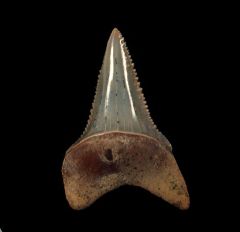
Learn More - Carcharodon carcharias$165.00
A Top Quality Great White shark tooth - lower jaw anterior tooth from Chile. A BLUE site tooth. This tooth has a rich blue colored crown, a distinct gum line, and a brown root. Incredible color! Highest quality enamel with little hydration cracks and no peeling. Serrations are large with a good tip serration. Excellent preservation - note nutrient hole on root. An EXCELLENT color collector's tooth. No repair or restoration. Authenticity guaranteed.
C228 Size: 1-11/16"
Note - Adding 32 Chilean Great White teeth in June 2021 Link to Great White shark teeth
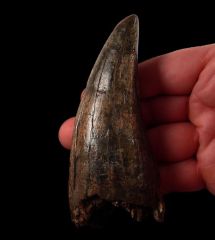
Learn More - Tyrannosaurus rex$0.00
A HUGE, High Quality Tyrannosaurus rex tooth from a very large adult Rex. A June 2020 Fossil of the Month. This massive Rex crown measures 4-9/16" (straight up) or 4-7/8" (straight line) or 5"+ (on curve) and has a big root (2" Wide). The enamel is good quality with some root etchings and natural cracks. Good brown color. The serrations are worn, but visible. The tip is good. Cracks are stabilized with some crack fill. No breaks - possibly one. A natural tooth from a BIG Rex! Note - most teeth of this size that you see are heavy restored and sometimes two teeth are put together! This tooth has original enamel from tip to base. One giant crown. T-Rex was the apex during the late Cretaceous with massive teeth capable of crushing its prey. See the detailed description to determine how to tell a real T-Rex tooth! Legally collected on privately deeded land in the Hell Creek Fm., Powder River Co., Montana. Authenticity guaranteed. Note - a Riker frame is included. You rarely see teeth over 3". This tooth is all about the size. You have to hold it in your hand to appreciate a tooth of this size. This is massive tooth from the "King of the Tyrants"!
DT01 BoP SIZE: 4-7/8" (2" W x 1-1/8" H)
Link to T. rex teeth --> T. rex teeth
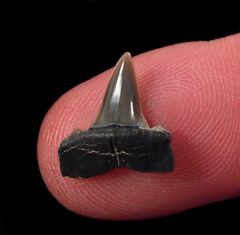
Learn More - Macrorhizodus nolfi$0.00
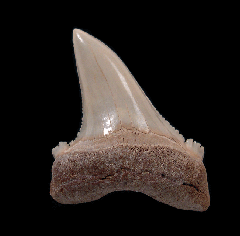
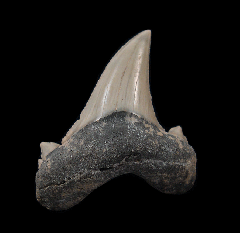
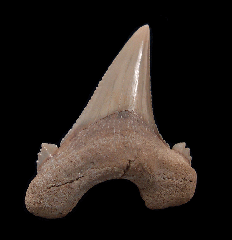
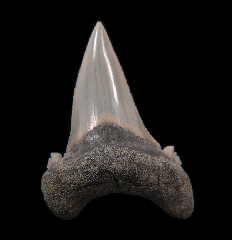
A very rare, early Macrorhizodus nolfi upper jaw, lateral tooth from Aktulagay, western Kazakhstan. Macrorhizodus nolfi is a Lamnidae shark and an early Mako shark (Isurus praecursor) relative in this early Eocene deposit. The side cusps are complete. No repair. Authenticity guaranteed. Perfect tooth.
K572 SIZE: 3/4"
Note - Adding 18 Kazakh Auriculatus or transition teeth in April 2020. --> Link to Kazakh Auriculatus teeth.
Learn More - Otodus aksuaticus (Partial serrated)$450.00
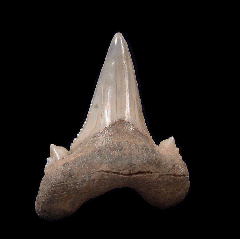
A very rare, early Otodus aksuaticus upper jaw, lateral tooth from Kzil-Orda, Kazakhstan. A transitional tooth leading to O. auriculatus (see detailed discussion below) which leads to Megalodon. A July Fossil of the Month. The bourlette is complete. This tooth exhibits small serrations along the lower 1/3 of the crown and micro serrations to the tip. These teeth exhibit excellent color, gloss, and preservation. A rare, early (Ypresian) Eocene Auriculatus transition tooth. A very challenging tooth to find when building a Megalodon evolutionary set! No repair or restoration. Authenticity guaranteed. This western Kazakhstan site is one of the few places in the world where the Otodus obliquus to Otodus auriculatus transition can be found in adjacent geologic layers.
K547 SIZE: 1-15/16"
Note - Adding 24 Kazakh Auriuclatus or transition teeth in July 2024. --> Link to Kazakh Auriculatus teeth.
Learn More - Otodus aksuaticus (Partial serrated)$325.00
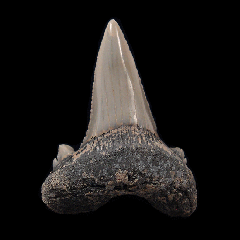
A very rare, early Otodus aksuaticus anterior tooth from Kzil-Orda, Kazakhstan. A transitional tooth leading to O. auriculatus (see detailed discussion below) which leads to Megalodon. The bourlette is complete. This tooth exhibits small serrations along the lower 1/2 of the crown and micro serrations to the tip. These teeth exhibit excellent color, gloss, and preservation. A rare, early (Ypresian) Eocene Auriculatus transition tooth. A very challenging tooth to find when building a Megalodon evolutionary set! No repair or restoration. Authenticity guaranteed. This western Kazakhstan site is one of the few places in the world where the Otodus obliquus to Otodus auriculatus transition can be found in adjacent geologic layers.
K546 SIZE: 1-9/16"
Note - Adding 24 Kazakh Auriuclatus or transition teeth in July 2024. --> Link to Kazakh Auriculatus teeth.
Learn More - Otodus aksuaticus (Partial serrated)$350.00
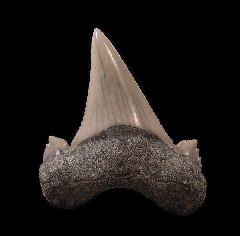
A very rare, early Otodus aksuaticus anterior tooth from Kzil-Orda, Kazakhstan. A transitional tooth leading to O. auriculatus (see detailed discussion below) which leads to Megalodon. The bourlette is complete. This tooth exhibits small serrations along the lower 1/2 of the crown and micro serrations to the tip. These teeth exhibit excellent color, gloss, and preservation. A rare, early (Ypresian) Eocene Auriculatus transition tooth. A very challenging tooth to find when building a Megalodon evolutionary set! No repair or restoration. Authenticity guaranteed. This western Kazakhstan site is one of the few places in the world where the Otodus obliquus to Otodus auriculatus transition can be found in adjacent geologic layers.
K545 SIZE: 1-3/4"
Note - Adding 24 Kazakh Auriuclatus or transition teeth in July 2024. --> Link to Kazakh Auriculatus teeth.
Learn More - Otodus aksuaticus (Partial serrated)$425.00
A very rare, early Otodus aksuaticus lateral tooth from Kzil-Orda, Kazakhstan. A transitional tooth leading to O. auriculatus (see detailed discussion below) which leads to Megalodon. A July Fossil of the Month.The bourlette is complete. This tooth exhibits small serrations along the lower 1/2 of the crown and micro serrations to the tip. These teeth exhibit excellent color, gloss, and preservation. A rare, early (Ypresian) Eocene Auriculatus transition tooth. A very challenging tooth to find when building a Megalodon evolutionary set! No repair or restoration. Authenticity guaranteed. This western Kazakhstan site is one of the few places in the world where the Otodus obliquus to Otodus auriculatus transition can be found in adjacent geologic layers.
K544 SIZE: 1-3/4"
Note - Adding 24 Kazakh Auriuclatus or transition teeth in July 2024. --> Link to Kazakh Auriculatus teeth.
Learn More - Otodus aksuaticus (Partial serrated)$425.00
A very rare, early Otodus aksuaticus lateral tooth from Kzil-Orda, Kazakhstan. A transitional tooth leading to O. auriculatus (see detailed discussion below) which leads to Megalodon. The bourlette is complete. This tooth exhibits small serrations along the lower 1/3 of the crown and micro serrations to the tip. These teeth exhibit excellent color, gloss, and preservation. A rare, early (Ypresian) Eocene Auriculatus transition tooth. A very challenging tooth to find when building a Megalodon evolutionary set! No repair or restoration. Authenticity guaranteed. This western Kazakhstan site is one of the few places in the world where the Otodus obliquus to Otodus auriculatus transition can be found in adjacent geologic layers.
K543 SIZE: 1-7/8"
Note - Adding 24 Kazakh Auriuclatus or transition teeth in July 2024. --> Link to Kazakh Auriculatus teeth.
Learn More - Otodus aksuaticus (Partial serrated)$550.00
A very rare, early Otodus aksuaticus lateral tooth from Kzil-Orda, Kazakhstan. A transitional tooth leading to O. auriculatus (see detailed discussion below) which leads to Megalodon. A July Fossil of the Month. The bourlette is complete. This tooth exhibits small serrations along the lower 1/2 of the crown and micro serrations to the tip. These teeth exhibit excellent color, gloss, and preservation. A rare, early (Ypresian) Eocene Auriculatus transition tooth. A very challenging tooth to find when building a Megalodon evolutionary set! No repair or restoration. Authenticity guaranteed. This western Kazakhstan site is one of the few places in the world where the Otodus obliquus to Otodus auriculatus transition can be found in adjacent geologic layers.
K542 SIZE: 2-1/8"
Note - Adding 24 Kazakh Auriuclatus or transition teeth in July 2024. --> Link to Kazakh Auriculatus teeth.
Learn More - Otodus aksuaticus (Partial serrated)$525.00
A very rare, early Otodus aksuaticus anterior tooth from Kzil-Orda, Kazakhstan. A transitional tooth leading to O. auriculatus (see detailed discussion below) which leads to Megalodon. A July Fossil of the Month. The bourlette is complete. This tooth exhibits small serrations along the lower 1/2 of the crown and micro serrations to the tip. These teeth exhibit excellent color, gloss, and preservation. A rare, early (Ypresian) Eocene Auriculatus transition tooth. A very challenging tooth to find when building a Megalodon evolutionary set! No repair or restoration. Authenticity guaranteed. This western Kazakhstan site is one of the few places in the world where the Otodus obliquus to Otodus auriculatus transition can be found in adjacent geologic layers.
K542 SIZE: 2-3/16"
Note - Adding 24 Kazakh Auriuclatus or transition teeth in July 2024. --> Link to Kazakh Auriculatus teeth.
Learn More - Sphyrna mokarran (Great Hammerhead)$45.00
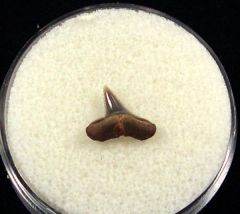
A rare Sphyrna mokarran tooth, the Great Hammerhead shark, from Sumatra, Indonesia. These teeth were deposited in the Telisa formation - a shallow marine environment during the middle Miocene (approx. 15 million years ago.) A unique collector's tooth. These teeth are finely serrated. D044 is the top quality tooth. Authenticity guaranteed.
D044 SIZE: 7/16"
Note - 6 new Sumatran Hammerhead teeth added in January 2018. Link to Sumatran teeth.
Learn More