Search results for: 'group guide we planu root 34'
- Did you mean
- group guide we planu rose 34
- Related search terms
- root bottom good
- root good levi stylemi horn eating
- planu to good de
- planus to good de
- planu to good de/
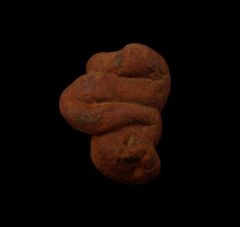
- Coprolite (Fossil dung)$30.00
A Top Quality mammal coprolite (fossil dung). So detailed that is it hard to believe. Incredible preservation. It is Miocene age (approx. 20 million years ago) from the Wilkes Fm., Toledo, Washington. A very unique and fantastic gift item. Authenticity guaranteed. And they don't stink!
X011 SIZE: 1-5/8" x 1-5/16"
Note - 8 new coprolite fossils added in December 2025. Link to coprolites.
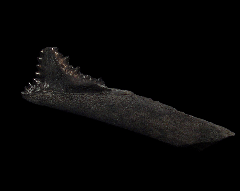
Learn More - Edestus heinrichi$70.00
A very rare, Top Quality Edestus heinrichi shark tooth, from Herrin, Illinois. This is a Paleozoic shark that lived in swamps that our now underground coal deposits. Excellent preservation, serrations, and serration detail. The Edestus shark would have an upper and lower tooth whorl that are vertically opposed. Research showed that they could use their opposing teeth in a scissor-like motion or a vertical whipping motion to cut prey. It is the first animal to cut vertically. A very strange looking and unique acting shark. Shark recreation image is credited to Julio Lacerdo. These rare teeth are Pennsylvanian age from Illinois. No repair or restoration. Authenticity guaranteed.
I23 SIZE: 1-7/8" w/ root (7/8" crown)
Adding 22 Edestus shark specimens in July 2025. Link to Edestus shark.
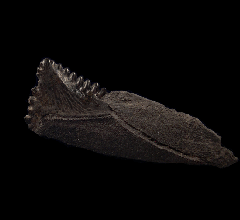
Learn More - Edestus heinrichi$145.00
A very rare, Top Quality Edestus heinrichi shark tooth, from Herrin, Illinois. This is a Paleozoic shark that lived in swamps that our now underground coal deposits. Excellent preservation, serrations, and serration detail. The Edestus shark would have an upper and lower tooth whorl that are vertically opposed. Research showed that they could use their opposing teeth in a scissor-like motion or a vertical whipping motion to cut prey. It is the first animal to cut vertically. A very strange looking and unique acting shark. Shark recreation image is credited to Julio Lacerdo. These rare teeth are Pennsylvanian age from Illinois. No repair or restoration. Authenticity guaranteed.
I18 SIZE: 2-1/2" w/ root (1-1/4"crown)
Adding 22 Edestus shark teeth in July 2025. Link to Edestus shark.
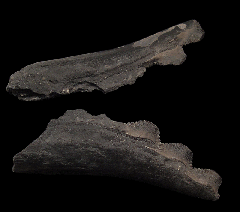
Learn More - Edestus heinrichi$950.00
An ultra rare, Top Quality Edestus heinrichi associted pair of whorls, from Herrin, Illinois. A July Fossil of the Month. This is a Paleozoic shark that lived in swamps that our now underground coal deposits. An ultra rare assoiiated pair of tooth whorls. Note - the crown tips are naturally rounded (polished) which thought to be due to wear from the vertical whipping motion used to slice prey. Excellent preservation, serrations, and serration detail. The Edestus shark would have an upper and lower tooth whorl that are vertically opposed. Research showed that they could use their opposing teeth in a scissor-like motion or a vertical whipping motion to cut prey. It is the first animal to cut vertically. A very strange looking and unique acting shark. Shark recreation image is credited to Julio Lacerdo. These rare teeth are Pennsylvanian age from Illinois. No repair or restoration. Authenticity guaranteed. This is the first associated whorl pait that I have seen.
I02 SIZE: 5" & 4-3/4" w/ root (1-1/4"+ crowns)
Adding 22 Edestus shark teeth in July 2025. Link to Edestus shark.
Learn More - Edestus heinrichi$195.00
A very rare, Top Quality Edestus heinrichi shark tooth, from Herrin, Illinois. This is a Paleozoic shark that lived in swamps that our now underground coal deposits. An incredible brown colored specimen - very unusual. Excellent preservation, serrations, and serration detail. The Edestus shark would have an upper and lower tooth whorl that are vertically opposed. Research showed that they could use their opposing teeth in a scissor-like motion or a vertical whipping motion to cut prey. It is the first animal to cut vertically. A very strange looking and unique acting shark. Shark recreation image is credited to Julio Lacerdo. These rare teeth are Pennsylvanian age from Illinois. No repair or restoration. Authenticity guaranteed.
I10 SIZE: 3-1/2" w/ root (1-5/8" crown)
Adding 22 Edestus shark teeth in July 2025. Link to Edestus shark.
Learn More - Hexanchus gigas - Chile$0.00
The PERFECT Hexanchus tooth from the Caldera Basin of Chile. This is complete lower jaw tooth from an adult shark. Superb preservation and color. Incredible crown and root surfaces. Matrix free. Nine very sharp and complete primary cusps. An excellent root - very unique & difficult to find! Perfect tooth. A Museum Quality collector's tooth. Authenticity guaranteed. The finest quality Hexanchus teeth that I have seen!
C406L BoP Size: 1-1/2" W (1-1/16" Height)
Note - Adding 6 Hexanchus lower jaw teeth in February 2018. Link to Chilean Hexanchus teeth.
Learn More - Otodus auriculatus (Early Eocene form)$0.00
A very rare, Otodus auriculatus tooth from the copper-red site of No. Carolina. The crown has coarse serrations. The side cusps are typical of the Otodus obliquus. Complete root. Early Eocene - Ypresian age. A very rare collector's tooth. Very few Otodus auriculatus teeth (early form) found at this site!
NC253 SIZE: 2-1/2"Note - Adding 9 early NC red site early Rics, transition teeth, and later Rics in June 2020. Link to NC Auriculatus teeth
Learn More - Otodus auriculatus (Early Eocene form)$0.00
A very rare, Otodus auriculatus tooth from the copper-red site of No. Carolina. The crown has coarse serrations. The side cusps are typical of the Otodus obliquus. Complete root. Early Eocene - Ypresian age. A very rare collector's tooth. Very few Otodus auriculatus teeth (early form) found at this site!
NC254 SIZE: 2-1/16"Note - Adding 9 early NC red site early Rics, transition teeth, and later Rics in June 2020. Link to NC Auriculatus teeth
Learn More - Otodus auriculatus (Early Eocene form)$0.00
A very rare, Otodus auriculatus tooth from the copper-red site of No. Carolina. The crown has coarse serrations. The side cusps are typical of the Otodus obliquus. Complete root. Early Eocene - Ypresian age. A very rare collector's tooth. Very few Otodus auriculatus teeth (early form) found at this site!
NC255 SIZE: 1-11/16"Note - Adding 9 early NC red site early Rics, transition teeth, and later Rics in June 2020. Link to NC Auriculatus teeth
Learn More - Carcharodon hastalis - Bone Valley$165.00
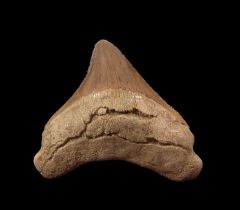
A Top Quality, Pathologic Bone Valley Mako shark tooth from Polk County, Florida with great color! Commonly referred to as Isurus hastalis, but renamed to Carcharodon hastalis as a Great White shark ancestor. This tooth shows a wavy cutting edge and an extra cutting edge formed on the the display side of crown (see 3rd photo). Highest quality enamel. An excellent colored crown. Excellent color! Sharp cutting edges. An excellent tan root - extra wide. Great eye appeal. A rare Bone Valley color collector's Mako tooth. No repair or restoration. Authenticity guaranteed. You don't see these Mako teeth very often!
F105 SIZE: 1-13/16" (1-5/8" W)
Note - Adding 8 new BV Isurus hastalis teeth in April 2005. -> Link to BV Isurus hastalis teeth
Learn More - Carcharocles megalodon$0.00
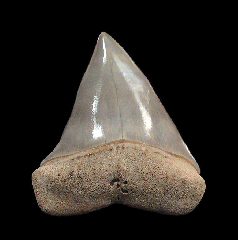
An Ultra Rare, High Quality Sharktooth Hill Megalodon tooth found in the Round Mountain Silt near Bakersfield, California. A location that produces very few Megalodon teeth and one of the toughest Megs to locate. Good quality enamel with a great light tan color. The bourlette is a near white color and complete. The serrations are sharp and near complete with a rounded tip. The root is nicely articulated and complete. Also note the large groove on the root ends - a Miocene trait. This is a middle Miocene Meg - very unique! 100% natural. No repair or restoration. You will not see these middle Miocene Sharktooth Hill Megs from Bakersfield, California very often. One of the rarest Megs! Authenticity guaranteed. A great collector piece that came out of a 25 year old old collection!
ST454 Size: 2-3/8"
Note - Adding four Sharktooth Hill Meg teeth in November 2020. Link to Sharktooth Hill Meg Teeth.
Learn More - Eurypterus lacustris$0.00
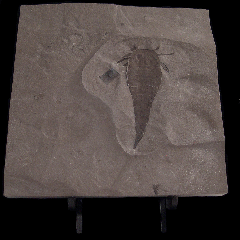
A Top Quality Eurypterus lacustris, the "Sea Scorpion", from Buffalo, New York. A November Fossil of the Month. This is a spooky looking arthropod that are related to arachnids, such as, the Horseshoe crab. It was found in the Williamsville Fm., Bertie Group of western New York and it is Silurian age (430 mya). A complete specimen that is nicely displayed on shale matirx. Specimen comes with a custom stand and ID plaque. Looks great in every fossil collection. One on my favorite fossils. Authenticity guaranteed. An exceptional old collection display piece!
EU01 Specimen Size: 5-1/2" Plate size: 10" x 10-1/4"
Learn More