Search results for: '1990 vw post 1 during youtube'
- Did you mean
- 1860 vw postag 1 dung youtube
- 1860 vw post 1 dung youtube
- Related search terms
- postag recent do good camel no youtube
- postag recent do good cone no youtube
- postag recent do good cave no youtube
- postag recent do good ca02 no youtube
- postag recent do good cani no youtube
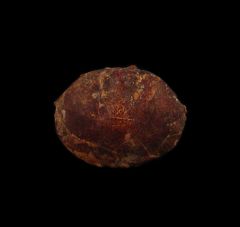
- Fossil Crab$35.00
A rare fossil crab from Sumatra, Indonesia. This crab was deposited in the Telisa formation - a shallow marine environment during the middle Miocene (approx. 15 million years ago.) A very unique collector's fossil. D201 is the high quality crab. Largest one found. Authenticity guaranteed.
D201 SIZE: 1-5/8" x 1"
Note - 4 new Sumatran fossil crabs added in January 2018. Link to Sumatran teeth.
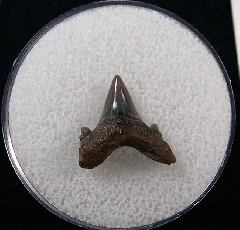
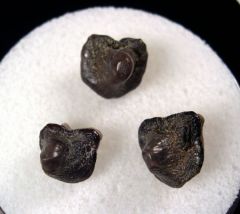
Learn More - Orodus sp.$0.00
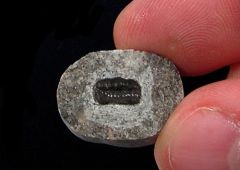
Orodus sp.; an Extinct Hybodont shark; complete specimen. An extraordinary collector's tooth!
Z099 SIZE: 5/16"
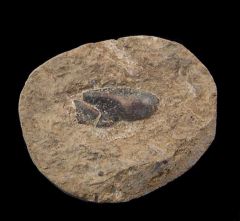
Learn More - Petalodus alleghaniensis$0.00
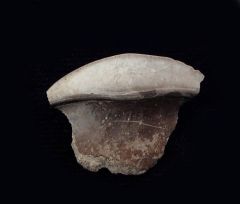
Petalodus alleghaniensis; an Extinct Petalodont shark
A nice Posterior tooth. Beautifully articulated. Matrix free. An excellent collector's piece from an old collection!
Age: Pennsylvanian (300 mya) ; Stanton Fm. (Missourian)
Location: Louisville, Cass Co., Nebraska
Z138 SIZE: 3/4" x 15/16" W
Learn More - Peripristis semicircularis$0.00
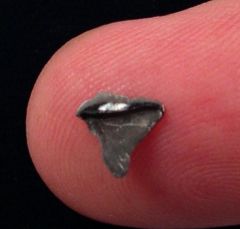
Peripristis semicircularis ; an Extinct Petalodont sharkA very rare, well preserved GEM posterior tooth. A complete tooth - crown & root - extremely rare! Beautifully articulated. Matrix free - incredibly rare. An exceptional collector's piece from an old collection! The best available! Reverse Photo.
Age: Pennsylvanian (300 mya) ; Stanton Fm. (Missourian)
Location: Louisville, Cass Co., NebraskaZ149 SIZE: 5/16"
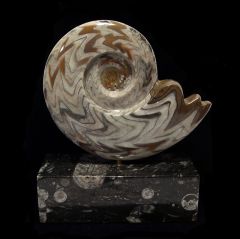
Learn More - Goniatities sp. , an early Ammonite relative$0.00
An exceptional, EXTRA LARGE polished ammonite showing the intricate internal chamber structure. The Ammonite is incredibly large at 9-1/2"! The rock matrix is a beautiful material and the Ammonite cavities are mineral filled! The ammonite is beautifully polished on all sides and is displayed using a natural rectangular matrix stand with large Orthoceras . Exceptional preservation and detail. An incredible display item. The largest Moroccan ammonite that I have seen! Best of the BEST.
Name: Goniatities sp. , Age: Devonian (350 MM years ago), Location: Atlas Mt., Morocco
Note - the base is 8-3/4" x 4" x 3". Overall height with base is 11". International shipping cost will be calculated. Please request quote.
M2020 Size: 9-1/2"
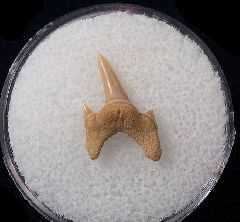
Learn More - Trigonotodus tusbairicus$60.00
A rare, Top Quality Trigonotodus tusbairicus shark tooth, a Thresher shark, from Caps-Kulj, West Kazakhstan. Fantastic color and condition. Excellent side cusps. The top of the root (rear view) has a strong enameloid build up. An incredible Eocene (Bartonian) age tooth. No repair or restoration. Authenticity guaranteed. One of the finest localities for Eocene age shark teeth! You will enjoy the quality of the Kazakh teeth.
K883 Size: 9/16"
Posting 4 Kazakh Trigonotodus tusbairicus shark teeth in July 2024. Link to Kazakh Trigonotodus teeth.
Learn More - Poeciliodus sp.$0.00
Poeciliodus sp.; an Extinct Bradydont shark
A rare crusher tooth from the Paleozoic era. Exceptional preservation and excellent surface articulation. An exceptional collector's piece from an old collection!
Age: Pennsylvanian (300 mya) ; Lane Shale Fm. (Missourian)
Location: Johnson Co., Kansas
Z141 SIZE: 5/8"
Learn More - Archaeolamna kolbaensis - Cretaceous$55.00
The Kolbay Collection. A Top Quality Archaeolamna kolbaensis tooth from Kolbay, W. Kazakhstan. Great color and condition. An excellent Middle Cretaceous (U. Albian - 102 MYA) age tooth. No repair or restoration. Authenticity guaranteed. You will enjoy the quality of the Kazakh teeth. A special piece from an old collection.
K1424 SIZE: 5/8"
Posting 5 Archaeolamna kolbaensis teeth in Agust 2024. Link to Kazakh Archaeolamna teeth
Learn More -
- Otodus mugodzharicus (Partial serrated)$0.00
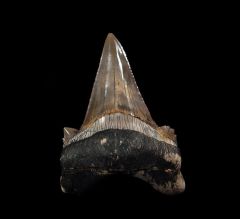
A very rare, early Otodus mugodzharicus upper jaw, anterior tooth from Aktulagay, western Kazakhstan. A transitional tooth leading to C. auriculatus (see detailed discussion below) which leads to Megalodon. The bourlette is complete. Tooth exhibits fine and wavy serrations along the lower 1/3 of crown and no serrations the tip. These teeth exhibit very good color, gloss, and preservation. A rare, early Eocene Auriculatus transition tooth. A very challenging tooth to find when building a Megalodon evolutionary set! No repair. Authenticity guaranteed. Note - This western Kazakhstan site is one of the few places in the world where the Otodus to Auriculatus transition can be found in adjacent layers.
K551 SIZE: 2-1/8"
Note - Adding 18 Kazakh Auriculatus or transition teeth in April 2020. --> Link to Kazakh Auriculatus teeth.
Learn More - Otodus obliquus (not serrated)$135.00
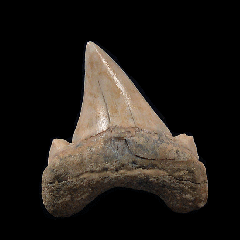
A very rare, early Otodus obliquus anterior tooth from Kzil-Orda Region, Kazakhstan. Otodus obliquus is the ancestor to O. auriculatus (see detailed discussion below) which leads to Megalodon. The bourlette is large and complete. Exhibits no serrations. The starting species to serrated Otodus teeth. These teeth exhibit very good color, gloss, and preservation. A rare, early Eocene (Ypresian) Auriculatus transition tooth. A very challenging tooth to find when building a Megalodon evolutionary set! No repair. Authenticity guaranteed. Note - This western Kazakhstan site is one of the few places in the world where the Otodus obliquus to Otodus auriculatus transition can be found in adjacent early Eocene formation units.
K562 SIZE: 1-1/4"
Note - Adding 24 Kazakh Auriculatus or transition teeth in July 2024. --> Link to Kazakh Auriculatus teeth.
Learn More - Otodus obliquus (not serrated)$200.00
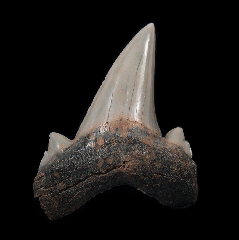
A very rare, early Otodus obliquus anterior tooth from Kzil-Orda Region, Kazakhstan. Otodus obliquus is the ancestor to O. auriculatus (see detailed discussion below) which leads to Megalodon. The bourlette is large and complete. Exhibits no serrations. The starting species to serrated Otodus teeth. These teeth exhibit very good color, gloss, and preservation. A rare, early Eocene (Ypresian) Auriculatus transition tooth. A very challenging tooth to find when building a Megalodon evolutionary set! No repair. Authenticity guaranteed. Note - This western Kazakhstan site is one of the few places in the world where the Otodus obliquus to Otodus auriculatus transition can be found in adjacent early Eocene formation units.
K561 SIZE: 1-1/4"
Note - Adding 24 Kazakh Auriculatus or transition teeth in July 2024. --> Link to Kazakh Auriculatus teeth.
Learn More