Search results for: 'primari site four minor'
- Did you mean
- prima site four minor
- Related search terms
- site out enabl cohesive devices
- site out enabl cohesive derives
- minor peru good
- site 2 bedroom good rd epsom
- minor good planus white shark cone
- Alopias grandis : No. Carolina$0.00
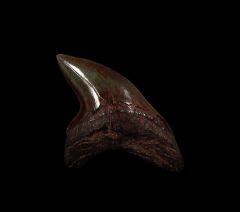
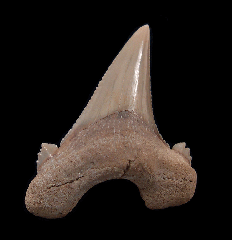
A High Quality Rare Alopias grandis shark tooth, an extinct GiantThresher shark, from the Meherrin River copper red site in No. Carolina. An excellent tooth with copper-red colors. Very good preservation and condition. This tooth is middle Miocene age, Hertford Co., NC. No repair or restoration. Authenticity guaranteed. A rare collectors' tooth. Try finding one of these teeth! I have seen less than six in 30 years.
NC503 SIZE: 1-5/16"
Learn More - Alopias grandis - Virginia$0.00
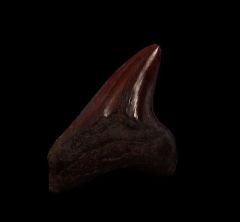
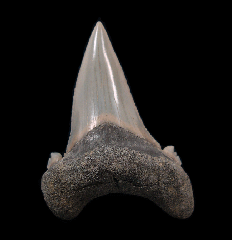
A rare, High Quality Alopias grandis shark tooth, the extinct Giant Thresher, from Pamunkey River, Virginia. Nice red color. Excellent preservation and condition. These teeth are not commonly found and seen. A rare collectors' tooth in high quality condition. Try finding one of these teeth! Authenticity guaranteed. A red site tooth.
VA43 SIZE: 1-5/8"
Posting 22 scarce Virginia shark teeth in September 2021. Link to Virginia teeth.
Learn More - Otodus aksuaticus (Partial serrated)$450.00
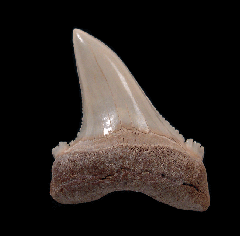
A very rare, early Otodus aksuaticus upper jaw, lateral tooth from Kzil-Orda, Kazakhstan. A transitional tooth leading to O. auriculatus (see detailed discussion below) which leads to Megalodon. A July Fossil of the Month. The bourlette is complete. This tooth exhibits small serrations along the lower 1/3 of the crown and micro serrations to the tip. These teeth exhibit excellent color, gloss, and preservation. A rare, early (Ypresian) Eocene Auriculatus transition tooth. A very challenging tooth to find when building a Megalodon evolutionary set! No repair or restoration. Authenticity guaranteed. This western Kazakhstan site is one of the few places in the world where the Otodus obliquus to Otodus auriculatus transition can be found in adjacent geologic layers.
K547 SIZE: 1-15/16"
Note - Adding 24 Kazakh Auriuclatus or transition teeth in July 2024. --> Link to Kazakh Auriculatus teeth.
Learn More - Otodus aksuaticus (Partial serrated)$425.00
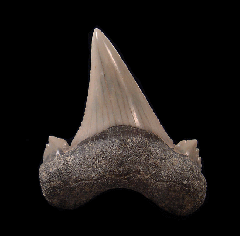
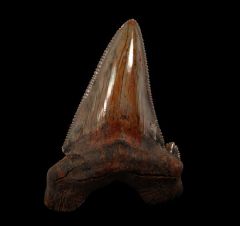
A very rare, early Otodus aksuaticus lateral tooth from Kzil-Orda, Kazakhstan. A transitional tooth leading to O. auriculatus (see detailed discussion below) which leads to Megalodon. A July Fossil of the Month.The bourlette is complete. This tooth exhibits small serrations along the lower 1/2 of the crown and micro serrations to the tip. These teeth exhibit excellent color, gloss, and preservation. A rare, early (Ypresian) Eocene Auriculatus transition tooth. A very challenging tooth to find when building a Megalodon evolutionary set! No repair or restoration. Authenticity guaranteed. This western Kazakhstan site is one of the few places in the world where the Otodus obliquus to Otodus auriculatus transition can be found in adjacent geologic layers.
K544 SIZE: 1-3/4"
Note - Adding 24 Kazakh Auriuclatus or transition teeth in July 2024. --> Link to Kazakh Auriculatus teeth.
Learn More - Otodus aksuaticus (Partial serrated)$550.00
A very rare, early Otodus aksuaticus lateral tooth from Kzil-Orda, Kazakhstan. A transitional tooth leading to O. auriculatus (see detailed discussion below) which leads to Megalodon. A July Fossil of the Month. The bourlette is complete. This tooth exhibits small serrations along the lower 1/2 of the crown and micro serrations to the tip. These teeth exhibit excellent color, gloss, and preservation. A rare, early (Ypresian) Eocene Auriculatus transition tooth. A very challenging tooth to find when building a Megalodon evolutionary set! No repair or restoration. Authenticity guaranteed. This western Kazakhstan site is one of the few places in the world where the Otodus obliquus to Otodus auriculatus transition can be found in adjacent geologic layers.
K542 SIZE: 2-1/8"
Note - Adding 24 Kazakh Auriuclatus or transition teeth in July 2024. --> Link to Kazakh Auriculatus teeth.
Learn More - Otodus aksuaticus (Partial serrated)$525.00
A very rare, early Otodus aksuaticus anterior tooth from Kzil-Orda, Kazakhstan. A transitional tooth leading to O. auriculatus (see detailed discussion below) which leads to Megalodon. A July Fossil of the Month. The bourlette is complete. This tooth exhibits small serrations along the lower 1/2 of the crown and micro serrations to the tip. These teeth exhibit excellent color, gloss, and preservation. A rare, early (Ypresian) Eocene Auriculatus transition tooth. A very challenging tooth to find when building a Megalodon evolutionary set! No repair or restoration. Authenticity guaranteed. This western Kazakhstan site is one of the few places in the world where the Otodus obliquus to Otodus auriculatus transition can be found in adjacent geologic layers.
K542 SIZE: 2-3/16"
Note - Adding 24 Kazakh Auriuclatus or transition teeth in July 2024. --> Link to Kazakh Auriculatus teeth.
Learn More - Otodus angustidens turgidus - Kazakhstan$0.00
A very rare, Angustidens tooth from Ungosa, Mangyshlak, western Kazakhstan. This location produces top quality teeth with different enamel colors. An extra large bourlette that is complete. Nice extra coarse serrations and smaller side cusps. The root is complete.These teeth exhibit exceptional color, gloss, and preservation. A super rare Lower Oligocene Angustidens tooth. Kujulus Formation, Rupelian age - 32 MYA. No repair. Authenticity guaranteed. I have only seen four Angustidens teeth from Kazakhstan!
K593 BoP SIZE: 2-9/16"
Note - Adding 4 Kazakh Angustidens teeth in November 2021. --> Link to Kazakh Angustidens teeth.
Learn More - Otodus angustidens turgidus - Kazakhstan$695.00
An ultra rare, EXTRA ALRGE Angustidens tooth from Ungosa, Mangyshlak, western Kazakhstan. This location produces top quality teeth with different enamel colors. An extra large bourlette that is complete. Nice extra coarse serrations and side cusps. The root is complete.These teeth exhibit exceptional color, gloss, and preservation. A super rare Lower Oligocene Angustidens tooth. Kujulus Formation, Rupelian age - 32 MYA. No repair. Authenticity guaranteed. I have only seen four Angustidens teeth from Kazakhstan!
K591 SIZE: 3-5/16"
Note - Adding 4 Kazakh Angustidens teeth in November 2021. --> Link to Kazakh Angustidens teeth.
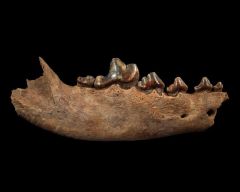
Learn More - Ice Age Gray Wolf - Canis lupus$450.00
A Top Quality fossil Gray Wolf (Canis lupus) jaw with six teeth from southern Germany. These large wolves lived in the mountain caves from central Europe to Russia during the Ice Age. This jaw contains two molars and four premolars. No repair or restoration. Authenticity guaranteed. You can own a rare and wonderful story piece from the Ice Age!
Name: Canis lupus Age: Late Pleistocene
Location: Franken, Bavaria, Germany
R573 SIZE: 5-3/8"
Note: Added 17 Ice Age / Cave Bear items in October 2024. Link -> Ice Age Fossils
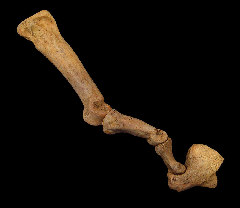
Learn More - Cave Leopard - Panthera pardus spelaea$825.00
A rare Top Quality fossil Cave Leopard toe (Panthera pardus spelaea) from Romania. An October Fossil of the Month The Cave Leopard lived in the mountain caves from central Europe to Russia during the Ice Age. A prefect four bone toe. No repair or restoration. Authenticity guaranteed. You can own a rare and wonderful story piece from the Ice Age.
Name: Panthera pardus spelaea Age: Late Pleistocene
Location: Carpathian Mountains, Romania
R592 SIZE: 8-7/8"
Note: Added 17 Ice Age / Cave Bear items in October 2024. Link -> Ice Age Fossils
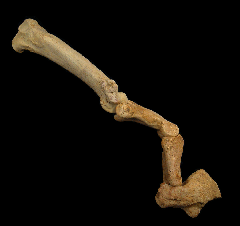
Learn More - Cave Leopard - Panthera pardus spelaea$850.00
A rare Top Quality fossil Cave Leopard toe tooth (Panthera pardus spelaea) from Romania. An October Fossil of the Month The Cave Leopard lived in the mountain caves from central Europe to Russia during the Ice Age. A perfect four bone toe. No repair or restoration. Authenticity guaranteed. You can own a rare and wonderful story piece from the Ice Age.
Name: Panthera pardus spelaea Age: Late Pleistocene
Location: Carpathian Mountains, Romania
R591 SIZE: 9-1/2"
Note: Added 17 Ice Age / Cave Bear items in October 2024. Link -> Ice Age Fossils
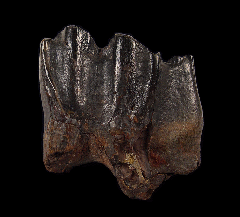
Learn More - Irish Elk - Megaloceras$0.00
A LARGE, well preserved Irish Elk (Megaloceras giganteus) from the Rhine River, Germany. The Irish Elk was an oversized Elk that evolved in the Pleistocene and became extinct at the end of the Pleistocene in Eurasia. This is a molar is complete with minor wear. Well fossilized. No repair or restoration. Authenticity guaranteed.
X806 Size: 2" x 2"
Name: Irish Elk molar (Megaloceras giganteus)
Age: Pleistocene
Location: Rhine River, Germany
Note - Posting 26 mammal and reptile fossils in March 2024. Link to Other Mammals
Learn More