Search results for: 'canada gloss arctos done mira'
- Related search terms
- canada good arctos done mira
- canada good arctos du01 mira
- canada good arctos dnm1 mira
- canada good arctos do02 mira
- canada good arctos do01 mira
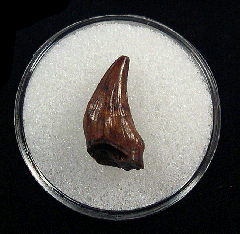
- Pachycephalosaurus$795.00
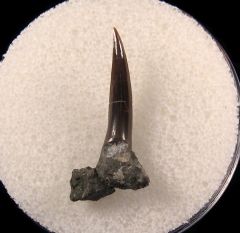
An EXTRA LARGE Ultra Rare, Top Quality Pachychephalosaurus wyomingensis premaxillary tooth from the late Cretaceous of northern North America. A February Fossil of the month. This tooth is often referred to as the Pachy "Fang". There are posterior serrations present on this tooth. There is also a small wear facet on the tooth (quite common). Pachychephalosaurus is the dinosaur which is famous for its large domed head surrounded by spikes. The enamel is excellent quality with great color and patina. No cracks or restoration. An ultra rare Pachy premax tooth! Legally collected on private land in the Hell Creek Fm., Powder River Co., Montana. An excellent collector's quality Pachychephalosaurus premaxillary tooth. Note - tooth comes with the gem case pictured. Authenticity guaranteed. My largest Pachy premaxillary tooth!
DP01 SIZE: 5/8"
Note - Adding 6 new Pachy spikes / teeth in February 2025.. Link to Pachy fossils catalog
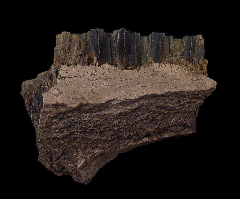
Learn More - Hadrosaur - Maxilla (upper jaw)$1,250.00
A Top Quality Hadrosaur maxilla (upper jaw) section from the late Cretaceous (Horseshoe Canyon Fm.) of North America. This jaw section contains 10 exposed teeth. This hadrosaur or "duck-bill" dinosaur was found in the Horseshoe Canyon Formation in Alberta. The maxilla possessed 100s teeth that were in rows of teeth which acted as conveyor belt to maintain a chewing surface to cut and grind their food. This specimen is a section of the lower jaw includes ten rows of teeth. Bone quality is excellent. No restoration. Legally collected on private land in the Horseshoe Canyon Fm., Alberta, Canada. An excellent collector's quality Edmontosaurus maxilla section from a rare location. Authenticity guaranteed. Disposition number #000028-0000029.
DH33 SIZE: 4" x 3-1/2"
Note - Adding 22 Hadrosaur /Edmontosaurus bones & claws in April 2022. Link to Edmontosaurus fossils catalog
Learn More - Otodus mugodzharicus (Partial serrated)$0.00
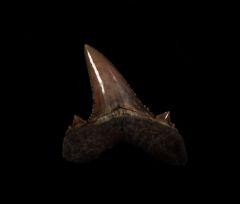
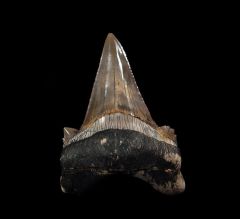
A very rare, early Otodus mugodzharicus upper jaw, posterior tooth from Aktulagay, western Kazakhstan. A transitional tooth leading to C. auriculatus (see detailed discussion below) which leads to Megalodon. The bourlette is complete. Tooth exhibits very fine serrations along the inner curve of the crown only. These teeth exhibit very good color, gloss, and preservation. A rare, early Eocene Auriculatus transition tooth. A very challenging tooth to find when building a Megalodon evolutionary set! No repair. Authenticity guaranteed. Note - This western Kazakhstan site is one of the few places in the world where the Otodus to Auriculatus transition can be found in adjacent layers.
K555 SIZE: 5/8"
Note - Adding 18 Kazakh Auriculatus or transition teeth in April 2020. --> Link to Kazakh Auriculatus teeth.
Learn More - Otodus sokolovi - Kazakhstan$0.00
A very rare, Otodus sokolovi upper jaw, anterior tooth from Kert, Mangyshlak, western Kazakhstan. A November Fossil of the Month. This location produces top quality teeth with brown colored enamel. The extra large bourlette that is complete. Nice extra coarse serrations and killer, large side cusps with very irregular serrations. The root is and complete.These teeth exhibit exceptional color, gloss, and preservation. Lower Schorym Formation - Bartonian - 40 MYA. This is a rare, late Eocene "Auriculatus" tooth also known as Otodus sokolovi! No repair or restoration. Authenticity guaranteed. I haven't seen these BIG Kazakh teeth since 2003! My last O. sokolovi teeth to offer.
K502 BoP SIZE: 2-3/4"
Note - Adding 19 Kazakh Auriculatus or transition teeth in November 2021. --> Link to Kazakh Auriculatus teeth.
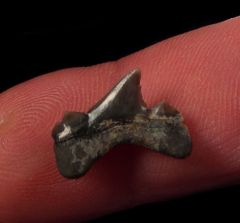
Learn More - Dykeius garethi$0.00
A Very Rare, EXTRA LARGE Top Quality Dykeius garethi tooth central cusp from Hornby Island, British Columbia, Canada. An August Fossil of the Month. This is a new genius of Frill shark from the Late Cretaceous deep water Northumberland Formation deposit. Another unique species of Chlamydoselachiform shark, the Frill shark. This is the largest Frill shark in the deposit with teeth over 1" tall (28.5 mm). These teeth exhibit classic Frill shark design with a central cusp flanked by two lateral cusps. Dykeius teeth are taller than wide. The crown is complete with the tip reattached. Highest quality enamel. No repair. A very difficult tooth to locate and an excellent collector's tooth. Authenticity guaranteed. This incredible specimen is from a 20 year old collection. An excellent Frill shark specimen!
CD97 SIZE: 7/8" Height
Note - Adding 64 Hornby Island deep water shark teeth. -> Link to all Hornby Island shark teeth.
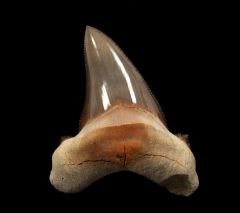
Learn More - Otodus chubutensis$0.00
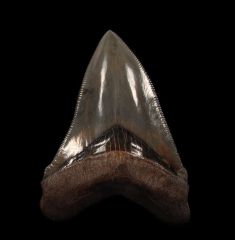
A GEM Chubutensis tooth from the Miocene of Georgia. A Gray and Tan colored Chub tooth with a root beer colored bourlette and a brown root. Fantastic colors! The enamel is the Highest Quality with mirror-like gloss and only a single small hydration crack. An exceptional bourlette with no peel and essentially perfect. Extra large, razor sharp serrations including an excellent tip serration. The root is nicely articulated and complete with no hydration cracks and excellent grooves on the root ends. This definitely an early Miocene tooth. Note - these Georgia Megs abd Chubs are fantastic - essentially no sign of wear and excellent perservation. An exceptional collector's Chubutensis tooth from Georgia. No repair. No restoration. Authenticity guaranteed. A Museum Quality Chub tooth. The PERFECT Georgia Chub tooth.
G107 BoP Size: 3-13/16"
Learn More - Otodus mugodzharicus (Partial serrated)$0.00
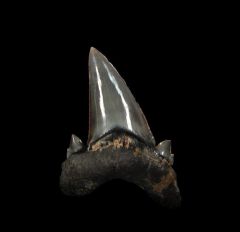
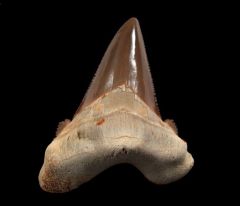
A very rare, early Otodus mugodzharicus upper jaw, lateral tooth from Aktulagay, western Kazakhstan. A transitional tooth leading to C. auriculatus (see detailed discussion below) which leads to Megalodon. The bourlette is complete. Tooth exhibits very fine serrations along the lower 1/3 of crown and micro serrations to the tip. These teeth exhibit very good color, gloss, and preservation. A rare, early Eocene Auriculatus transition tooth. A very challenging tooth to find when building a Megalodon evolutionary set! No repair. Authenticity guaranteed. Note - This western Kazakhstan site is one of the few places in the world where the Otodus to Auriculatus transition can be found in adjacent layers.
K554 SIZE: 1-1/4"
Note - Adding 18 Kazakh Auriuclatus or transition teeth in April 2020. --> Link to Kazakh Auriculatus teeth.
Learn More - Otodus mugodzharicus (Partial serrated)$0.00
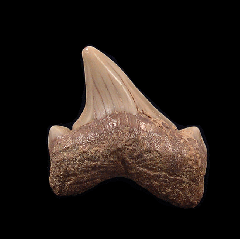
A very rare, early Otodus mugodzharicus upper jaw, lateral tooth from Aktulagay, western Kazakhstan. A transitional tooth leading to C. auriculatus (see detailed discussion below) which leads to Megalodon. The bourlette is complete. Tooth exhibits wavy serrations along the lower 1/3 of crown and small wavy serrations to the tip. These teeth exhibit very good color, gloss, and preservation. A rare, early Eocene Auriculatus transition tooth. A very challenging tooth to find when building a Megalodon evolutionary set! No repair. Authenticity guaranteed. Note - This western Kazakhstan site is one of the few places in the world where the Otodus to Auriculatus transition can be found in adjacent layers.
K553 SIZE: 1-1/2"
Note - Adding 18 Kazakh Auriuclatus or transition teeth in April 2020. --> Link to Kazakh Auriculatus teeth.
Learn More - Otodus mugodzharicus (Partial serrated)$0.00
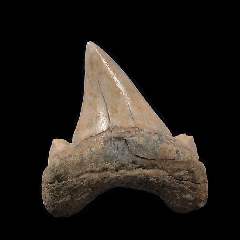
A very rare, early Otodus mugodzharicus upper jaw, anterior tooth from Aktulagay, western Kazakhstan. A transitional tooth leading to C. auriculatus (see detailed discussion below) which leads to Megalodon. The bourlette is complete. Tooth exhibits fine and wavy serrations along the lower 1/3 of crown and no serrations the tip. These teeth exhibit very good color, gloss, and preservation. A rare, early Eocene Auriculatus transition tooth. A very challenging tooth to find when building a Megalodon evolutionary set! No repair. Authenticity guaranteed. Note - This western Kazakhstan site is one of the few places in the world where the Otodus to Auriculatus transition can be found in adjacent layers.
K551 SIZE: 2-1/8"
Note - Adding 18 Kazakh Auriculatus or transition teeth in April 2020. --> Link to Kazakh Auriculatus teeth.
Learn More - Otodus sokolovi - Kazakhstan$0.00
A very rare, EXTRA LARGE Otodus sokolovi upper jaw, anterior tooth from Kert, Mangyshlak, western Kazakhstan. A November Fossil of the Month. This location produces top quality teeth with brown colored enamel. The extra large bourlette that is complete. Nice extra coarse serrations and killer, large side cusps with very irregular serrations. The root is very thivh (~1-1/8") and complete.These teeth exhibit exceptional color, gloss, and preservation. Lower Schorym Formation - Bartonian - 40 MYA. This is a rare, late Eocene "Auriculatus" tooth also known as Otodus sokolovi! No repair or restoration. Authenticity guaranteed. I haven't seen these BIG Kazakh teeth since 2003! My last O. sokolovi teeth to offer.
K501 BoP SIZE: 3-7/16"
Note - Adding 19 Kazakh Auriculatus or transition teeth in November 2021. --> Link to Kazakh Auriculatus teeth.
Learn More - Otodus obliquus (not serrated)$95.00
A very rare, early Otodus obliquus anterior tooth from Kzil-Orda Region, Kazakhstan. Otodus obliquus is the ancestor to O. auriculatus (see detailed discussion below) which leads to Megalodon. The bourlette is large and complete. Exhibits no serrations. The starting species to serrated Otodus teeth. These teeth exhibit very good color, gloss, and preservation. A rare, early Eocene (Ypresian) Auriculatus transition tooth. A very challenging tooth to find when building a Megalodon evolutionary set! No repair. Authenticity guaranteed. Note - This western Kazakhstan site is one of the few places in the world where the Otodus obliquus to Otodus auriculatus transition can be found in adjacent early Eocene formation units.
K561 SIZE: 1-1/16"
Note - Adding 24 Kazakh Auriculatus or transition teeth in July 2024. --> Link to Kazakh Auriculatus teeth.
Learn More - Otodus obliquus (not serrated)$135.00
A very rare, early Otodus obliquus anterior tooth from Kzil-Orda Region, Kazakhstan. Otodus obliquus is the ancestor to O. auriculatus (see detailed discussion below) which leads to Megalodon. The bourlette is large and complete. Exhibits no serrations. The starting species to serrated Otodus teeth. These teeth exhibit very good color, gloss, and preservation. A rare, early Eocene (Ypresian) Auriculatus transition tooth. A very challenging tooth to find when building a Megalodon evolutionary set! No repair. Authenticity guaranteed. Note - This western Kazakhstan site is one of the few places in the world where the Otodus obliquus to Otodus auriculatus transition can be found in adjacent early Eocene formation units.
K562 SIZE: 1-1/4"
Note - Adding 24 Kazakh Auriculatus or transition teeth in July 2024. --> Link to Kazakh Auriculatus teeth.
Learn More