Search results for: 'liops paleozo few planus fisheuri good'
- Related search terms
- goods terrestri a none
- good terrestri a none
- goods terrestri a none/
- good terrestri a none//
- liops root and apartments vienna enabl
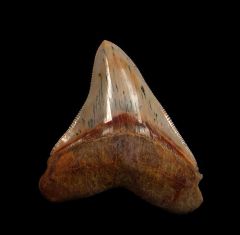
- Carcharocles megalodon$0.00
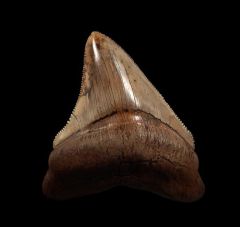
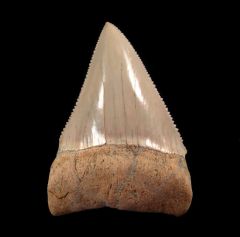
An Ultra Rare, Top Quality Sharktooth Hill Megalodon tooth from Pyramid Hill, Kern County, California. A location that produces very few Megalodon teeth and one of the toughest Megs to locate. A February Fossil of the Month. Highest quality enamel with a great brown and charcoal colors. The bourlette is a tan color and is nearly complete. The serrations are extra large & sharp and complete with a big tip serration. The root is nicely articulated and complete. Note the large grooves on the root ends - an early Miocene trait. This is a rare early Miocene (22 MYA) Meg from the Jewitt Sand Fm.- very unique! You never see these early Miocene Megs from Bakersfield, California. One of the rarest Megs! No repair or restoration. Authenticity guaranteed. A incredibly rare collector's piece that came out of a 25 year old old collection. My last Pyramid Hill / Jewitt Sand Fm. Meg tooth!
ST453 Size: 3-1/2"
Note - Adding two Sharktooth Hill area Meg teeth in February 2022. Link to Sharktooth Hill Meg Teeth.
Learn More - Otodus aksuaticus (Partial serrated)$325.00
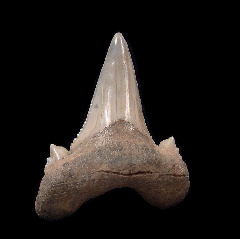
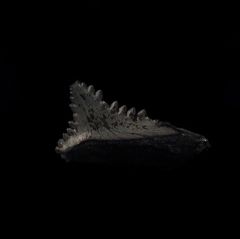
A very rare, early Otodus aksuaticus anterior tooth from Kzil-Orda, Kazakhstan. A transitional tooth leading to O. auriculatus (see detailed discussion below) which leads to Megalodon. The bourlette is complete. This tooth exhibits small serrations along the lower 1/2 of the crown and micro serrations to the tip. These teeth exhibit excellent color, gloss, and preservation. A rare, early (Ypresian) Eocene Auriculatus transition tooth. A very challenging tooth to find when building a Megalodon evolutionary set! No repair or restoration. Authenticity guaranteed. This western Kazakhstan site is one of the few places in the world where the Otodus obliquus to Otodus auriculatus transition can be found in adjacent geologic layers.
K546 SIZE: 1-9/16"
Note - Adding 24 Kazakh Auriuclatus or transition teeth in July 2024. --> Link to Kazakh Auriculatus teeth.
Learn More - Otodus aksuaticus (Partial serrated)$350.00
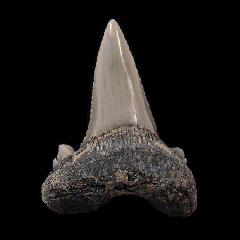
A very rare, early Otodus aksuaticus anterior tooth from Kzil-Orda, Kazakhstan. A transitional tooth leading to O. auriculatus (see detailed discussion below) which leads to Megalodon. The bourlette is complete. This tooth exhibits small serrations along the lower 1/2 of the crown and micro serrations to the tip. These teeth exhibit excellent color, gloss, and preservation. A rare, early (Ypresian) Eocene Auriculatus transition tooth. A very challenging tooth to find when building a Megalodon evolutionary set! No repair or restoration. Authenticity guaranteed. This western Kazakhstan site is one of the few places in the world where the Otodus obliquus to Otodus auriculatus transition can be found in adjacent geologic layers.
K545 SIZE: 1-3/4"
Note - Adding 24 Kazakh Auriuclatus or transition teeth in July 2024. --> Link to Kazakh Auriculatus teeth.
Learn More - Otodus aksuaticus (Partial serrated)$425.00
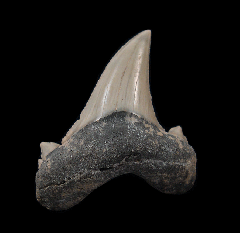
A very rare, early Otodus aksuaticus lateral tooth from Kzil-Orda, Kazakhstan. A transitional tooth leading to O. auriculatus (see detailed discussion below) which leads to Megalodon. The bourlette is complete. This tooth exhibits small serrations along the lower 1/3 of the crown and micro serrations to the tip. These teeth exhibit excellent color, gloss, and preservation. A rare, early (Ypresian) Eocene Auriculatus transition tooth. A very challenging tooth to find when building a Megalodon evolutionary set! No repair or restoration. Authenticity guaranteed. This western Kazakhstan site is one of the few places in the world where the Otodus obliquus to Otodus auriculatus transition can be found in adjacent geologic layers.
K543 SIZE: 1-7/8"
Note - Adding 24 Kazakh Auriuclatus or transition teeth in July 2024. --> Link to Kazakh Auriculatus teeth.
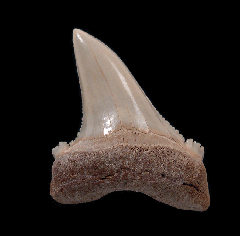
Learn More - Carcharodon carcharias$0.00
An ultra rare MONSTER, 3-3/16" Great White shark tooth - upper jaw anterior tooth from the Bahia Iglesa Fm., Chile. A March Fossil of the Month.This tooth is huge and extra wide (2-1/8"). It has a rich tan colored crown and a goden tan root. Fantantic color! Highest quality enamel with no hydration cracks or peeling. Serrations are exceptional - very large with a big tip serration. Excellent preservation - note nutrient hole on root. Note - the root appears to have two cracks and was most likely reattached without fill or restoration. A HUGE Chilean Great White collector's tooth and display. Authenticity guaranteed. Unfortunately there are no more teeth coming from this site. Note there are very few Chilean GW teeth over 3-1/8"! Check out my new Blog - The Best of Chile - Shark Teeth https://www.buriedtreasurefossils.com/blog/post/the-best-of-chile-fossil-shark-teeth/
C1201 Size: 3-3/16" (2-1/8" W)
Note - Link to Great White shark teeth
Learn More - Platyxystrodus sp.$0.00
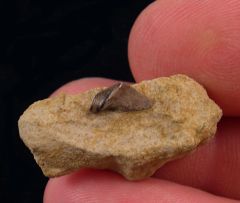
Crown is nicely articulated. A well preserved extra large specimen. Rare species. An excellent collector's tooth!
Age: Lower Carboniferous (320 MYA); Serpuchov Fm.
Location: Serpuchov, Russia
R256 SIZE: 3/8"
Learn More - Poecilodus sauctiludovici$0.00
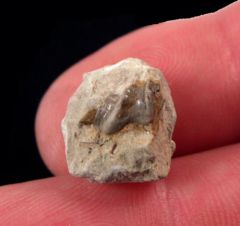
Extra large size. Crown is nicely articulated. A well preserved extra large specimen. Rare species. An excellent collector's tooth!
Age: Lower Carboniferous (320 MYA); Serpuchov Fm.
Location: Serpuchov, Russia
R036 SIZE: 3/8"+
Learn More - Polyacrodus sp.$0.00
Top of crown is nicely articulated. A well preserved extra large specimen. Matrix free. An excellent collector's tooth.
Age: Upper Carboniferous (295 MYA); Kasimov Fm.
Location: Achkasovo, Russia
R072 SIZE: 3/4"
Learn More - Symmorium sp.$0.00
An excellent unclassified Symmorium species. Multiple cusped crown with a large, flat based root. A well preserved extra large specimen. An excellent collector's tooth!
Age: Lower Carboniferous (320 MYA); Serpuchov Fm.
Location: Serpuchov, Russia
R046 SIZE: 1/8"
Learn More - Carcharocles megalodon$0.00
An Ultra Rare, GEM Quality Sharktooth Hill Megalodon tooth found in the Round Mountain silt near Bakersfield, California. A location that produces very few Megalodon teeth and one of the toughest Meg teeth to locate. A March 2021 Fossil of the Month. This colorful tooth was found in a "fire zone" site south of the Kern River. Highest quality enamel with a great tan and golden tan colors with charcoal highlights. The bourlette is a red color and 100% complete. The serrations are extra large and 100% complete with a great tip. The root is nicely articulated and complete. Also note the grooves on the root ends - a Miocene trait. This is a middle Miocene Meg - very unique! 100% natural. No repair or restoration. You will not see these middle Miocene Sharktooth Hill Megs from Bakersfield, California very often. One of the rarest Megs! Authenticity guaranteed. Museum Quality. An incredible color Meg collector piece! The BEST.
ST452 BoP Size: 3-7/8"
Note - Adding three Sharktooth Hill Meg teeth in March 2021. Link to Sharktooth Hill Meg Teeth.
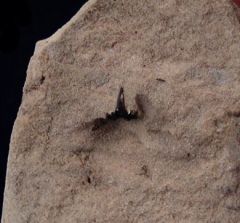
Learn More - Edestus minor$75.00
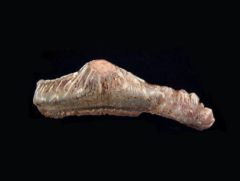
A very rare Edestus heinrichi shark tooth, from Herrin, Illinois. This is a Paleozoic shark that lived in swamps that our now underground coal deposits. Very good preservation with excellent serrations. The Edestus shark would have an upper and lower tooth whorl that are vertically opposed. Research showed that they could use their opposing teeth in a scissor-like motion to cut prey. It is the first animal to cut vertically. A very strange looking and unique acting shark. Shark recreation image is credited to Julio Lacerdo. These rare teeth are Pennsylvanian age from Illinois. No repair or restoration. Authenticity guaranteed.
I014 SIZE: 7/8"
Adding 15 Edestus shark specimens in April 2021. Link to Edestus shark.
Learn More - Otodus aksuaticus (Partial serrated)$450.00
A very rare, early Otodus aksuaticus upper jaw, lateral tooth from Kzil-Orda, Kazakhstan. A transitional tooth leading to O. auriculatus (see detailed discussion below) which leads to Megalodon. A July Fossil of the Month. The bourlette is complete. This tooth exhibits small serrations along the lower 1/3 of the crown and micro serrations to the tip. These teeth exhibit excellent color, gloss, and preservation. A rare, early (Ypresian) Eocene Auriculatus transition tooth. A very challenging tooth to find when building a Megalodon evolutionary set! No repair or restoration. Authenticity guaranteed. This western Kazakhstan site is one of the few places in the world where the Otodus obliquus to Otodus auriculatus transition can be found in adjacent geologic layers.
K547 SIZE: 1-15/16"
Note - Adding 24 Kazakh Auriuclatus or transition teeth in July 2024. --> Link to Kazakh Auriculatus teeth.
Learn More