Search results for: 'new latu white great white shark 3'
- Related search terms
- shark easel enabl intelligence four disaster response it stem
- shark enabled eagl intelligence form disaster response it stem
- shark enabled enabl intelligence form disaster response it star
- shark enabled enamel intelligence four disaster response it stand
- shark enameloid enabl intelligence four disaster response it stand
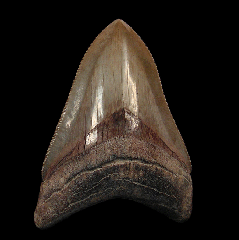
- Otodus megalodon$675.00
A Top Quality Megalodon tooth from Georgia - an upper jaw anterior tooth. The crown has excellent unique two-tone tan color. The enamel is the Highest Quality with small hydration cracks. A Large Brown colored bourlette which is complete. Extra large, razor sharp serrations including an excellent tip serration. The root is a dark tan color, nicely articulated, robust, and complete. This tooth is exhibits large serrations and small grooves on the root ends. These are traits of a Miocene age tooth. Incredible color! Note - these Georgia Megs are fantastic - essentially little sign of wear and excellent preservation. An excellent color collector's Megalodon tooth from Georgia. No repair. No restoration. Authenticity guaranteed. A top quality Georgia Meg tooth.
G112 Size: 4" (2-3/4" wide)
Note - Adding 15 new Georgia Megalodon teeth in June 2025. -> Link to Georgia Megalodon teeth
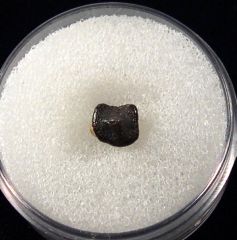
Learn More - Ptychodus whipplei$20.00
A Top Quality Ptychodus whipplei, an extinct durophagous (shell-crushing) shark, tooth from Ellis Co., Texas. An excellent example of this Upper Cretaceous Arcadia Park Fm. tooth. These massive teeth have a design with a very tall conical cusp with transverse ridges extending across the cusp face, but typically do not reach the margin. Authenticity guaranteed. Perfect tooth. A juvenile symphyseal tooth.
T031 SIZE: 3/16"
Note - Adding 100+ new Texas shark teeth in October 2021. Link to Texas shark teeth
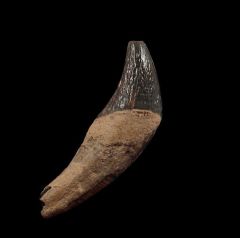
Learn More - Zygorhiza kochii (Archaeocete whale)$450.00
A TOP QUALITY, very rare Archaeocete whale, Zygorhiza kochii. A large incisor tooth. An exceptional brown colored crown. Nicely articulated. Large root - complete. This tooth has no repair. Note - enamel tip shows a small wear pattern on crown from grinding tough prey. Whales do not shed their teeth like the sharks so there teeth will wear with age. A large, top quality Archaeocete incisor tooth from So. Carolina. A very rare collector's tooth.
SC1331 SIZE: 3-1/4"
Note - 14 new Archaeocete whale teeth from So. Carolina added in November 2017. Our largest selection of top quality Archaeocete teeth ever! Archaeocete Whale catalog link.
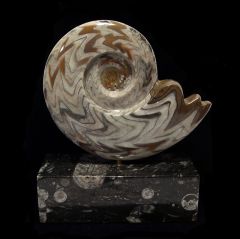
Learn More - Goniatities sp. , an early Ammonite relative$0.00
An exceptional, EXTRA LARGE polished ammonite showing the intricate internal chamber structure. The Ammonite is incredibly large at 9-1/2"! The rock matrix is a beautiful material and the Ammonite cavities are mineral filled! The ammonite is beautifully polished on all sides and is displayed using a natural rectangular matrix stand with large Orthoceras . Exceptional preservation and detail. An incredible display item. The largest Moroccan ammonite that I have seen! Best of the BEST.
Name: Goniatities sp. , Age: Devonian (350 MM years ago), Location: Atlas Mt., Morocco
Note - the base is 8-3/4" x 4" x 3". Overall height with base is 11". International shipping cost will be calculated. Please request quote.
M2020 Size: 9-1/2"
Learn More - Carcharodon hastalis - Pathologic$75.00
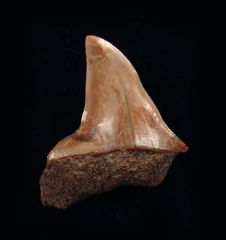
A rare, strange Top Quality Pathologic Carcharodon hastalis, Broad-tooth Mako, shark tooth - upper jaw anterior tooth from the Bahia Iglesa Fm. of Chile. The left root lobe folded behind the tooth and smashed into the back of the root. The crown has multiple waves. Excellent color and preservation. Complete tooth. Top quality. Authenticity guaranteed. A strange pathologic tooth. You don't this pathology often!
C316P Size: 1-3/4"
Learn More - Otodus mugodzharicus (Partial serrated)$0.00
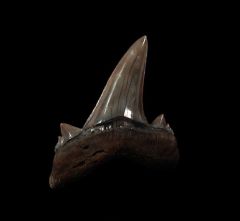
A very rare, early Otodus mugodzharicus upper jaw, posterior tooth from Aktulagay, western Kazakhstan. A transitional tooth leading to C. auriculatus (see detailed discussion below) which leads to Megalodon. The bourlette is complete. Tooth exhibits very fine serrations along the inner curve of the crown only. These teeth exhibit very good color, gloss, and preservation. A rare, early Eocene Auriculatus transition tooth. A very challenging tooth to find when building a Megalodon evolutionary set! No repair. Authenticity guaranteed. Note - This western Kazakhstan site is one of the few places in the world where the Otodus to Auriculatus transition can be found in adjacent layers.
K555 SIZE: 5/8"
Note - Adding 18 Kazakh Auriculatus or transition teeth in April 2020. --> Link to Kazakh Auriculatus teeth.
Learn More - Otodus mugodzharicus (Partial serrated)$0.00
A very rare, early Otodus mugodzharicus upper jaw, lateral tooth from Aktulagay, western Kazakhstan. A transitional tooth leading to C. auriculatus (see detailed discussion below) which leads to Megalodon. A November Fossil of the Month.The bourlette is complete. Tooth exhibits "wavy serrated" edges similar to the Isurus escheri tooth. These teeth exhibit very good color, gloss, and preservation. A rare, early Eocene Auriculatus transition tooth. A very challenging tooth to find when building a Megalodon evolutionary set! No repair. Authenticity guaranteed. This western Kazakhstan site is one of the few places in the world where the Otodus to Auriculatus transition can be found in adjacent layers. Note - This is my last offering of Aktluagay teeth.
K552 SIZE: 1-9/16"
Note - Adding 19 Kazakh Auriuclatus or transition teeth in November 2021. --> Link to Kazakh Auriculatus teeth.
Learn More - Otodus obliquus (not serrated)$95.00
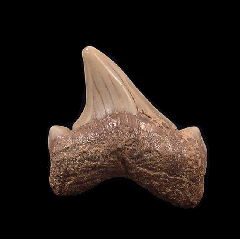
A very rare, early Otodus obliquus anterior tooth from Kzil-Orda Region, Kazakhstan. Otodus obliquus is the ancestor to O. auriculatus (see detailed discussion below) which leads to Megalodon. The bourlette is large and complete. Exhibits no serrations. The starting species to serrated Otodus teeth. These teeth exhibit very good color, gloss, and preservation. A rare, early Eocene (Ypresian) Auriculatus transition tooth. A very challenging tooth to find when building a Megalodon evolutionary set! No repair. Authenticity guaranteed. Note - This western Kazakhstan site is one of the few places in the world where the Otodus obliquus to Otodus auriculatus transition can be found in adjacent early Eocene formation units.
K561 SIZE: 1-1/16"
Note - Adding 24 Kazakh Auriculatus or transition teeth in July 2024. --> Link to Kazakh Auriculatus teeth.
Learn More - Otodus obliquus (not serrated)$135.00
A very rare, early Otodus obliquus anterior tooth from Kzil-Orda Region, Kazakhstan. Otodus obliquus is the ancestor to O. auriculatus (see detailed discussion below) which leads to Megalodon. The bourlette is large and complete. Exhibits no serrations. The starting species to serrated Otodus teeth. These teeth exhibit very good color, gloss, and preservation. A rare, early Eocene (Ypresian) Auriculatus transition tooth. A very challenging tooth to find when building a Megalodon evolutionary set! No repair. Authenticity guaranteed. Note - This western Kazakhstan site is one of the few places in the world where the Otodus obliquus to Otodus auriculatus transition can be found in adjacent early Eocene formation units.
K562 SIZE: 1-1/4"
Note - Adding 24 Kazakh Auriculatus or transition teeth in July 2024. --> Link to Kazakh Auriculatus teeth.
Learn More - Otodus aksuaticus (Partial serrated)$325.00
A very rare, early Otodus aksuaticus anterior tooth from Kzil-Orda, Kazakhstan. A transitional tooth leading to O. auriculatus (see detailed discussion below) which leads to Megalodon. The bourlette is complete. This tooth exhibits small serrations along the lower 1/2 of the crown and micro serrations to the tip. These teeth exhibit excellent color, gloss, and preservation. A rare, early (Ypresian) Eocene Auriculatus transition tooth. A very challenging tooth to find when building a Megalodon evolutionary set! No repair or restoration. Authenticity guaranteed. This western Kazakhstan site is one of the few places in the world where the Otodus obliquus to Otodus auriculatus transition can be found in adjacent geologic layers.
K546 SIZE: 1-9/16"
Note - Adding 24 Kazakh Auriuclatus or transition teeth in July 2024. --> Link to Kazakh Auriculatus teeth.
Learn More - Otodus aksuaticus (Partial serrated)$550.00
A very rare, early Otodus aksuaticus lateral tooth from Kzil-Orda, Kazakhstan. A transitional tooth leading to O. auriculatus (see detailed discussion below) which leads to Megalodon. A July Fossil of the Month. The bourlette is complete. This tooth exhibits small serrations along the lower 1/2 of the crown and micro serrations to the tip. These teeth exhibit excellent color, gloss, and preservation. A rare, early (Ypresian) Eocene Auriculatus transition tooth. A very challenging tooth to find when building a Megalodon evolutionary set! No repair or restoration. Authenticity guaranteed. This western Kazakhstan site is one of the few places in the world where the Otodus obliquus to Otodus auriculatus transition can be found in adjacent geologic layers.
K542 SIZE: 2-1/8"
Note - Adding 24 Kazakh Auriuclatus or transition teeth in July 2024. --> Link to Kazakh Auriculatus teeth.
Learn More - Hexanchus microdon$45.00
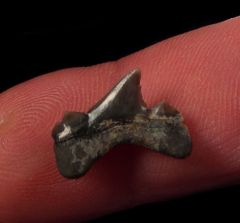
A Very Rare, Quality Hexanchus microdon upper jaw tooth from Hornby Island, British Columbia, Canada. This is a species from the Late Cretaceous deep water Northumberland Formation deposit. A species of Hexanchiforme shark. The crown is damaged and the root is damaged. High quality enamel. No repair. A very difficult tooth to locate and an excellent collector's tooth. Authenticity guaranteed. This incredible specimen is from a 20 year old collection.
CD55 SIZE: 1/4" +
Note - Adding 64 Hornby Island deep water shark teeth. -> Link to Hornby Island shark teeth.
Learn More