Search results for: 'not de coral site 2020 ursu'
- Did you mean
- not de coral site 2001 ursu
- not de coral site 2020 urus
- Related search terms
- site out enabl cohesive devices
- site out enabl cohesive derives
- notify me of new post by enabl lamna nasus
- not me of new post by enabl lamna nasus
- nothing pinus 3a enabl
- Cave Bear tooth$295.00
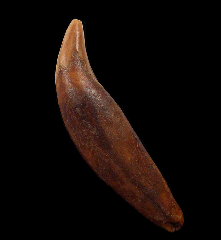
A Top Quality fossil Cave Bear (Urusus spelaeus) canine from the Drachen Hohle Cave, Austria. These large bears lived in the mountain caves from central Europe to Russia. An excellent cave bear tooth. You can own a rare and wonderful story piece from the Ice Age! No repair or restoration. Authenticity guaranteed. Near perfect tooth.
Name: Urusus spelaeus Age: Late Pleistocene
Location: Drachen Hohle Cave, near Graz, Austria
R501 SIZE: 3-7/8"
Note: Added 17 Ice Age / Cave Bear items in October 2024. Link -> Cave Bear Fossils
Learn More - Cave Bear jaw - Bite Marks$495.00
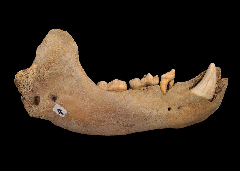
An exceptionally preserved, rare fossil Cave Bear jaw (Urusus spelaeus) with bite marks from Romania. A December Fossil of the Month. These large bears lived in the mountain caves from central Europe to Russia. An exceptional, large adult cave bear lower jaw. . You can own a rare and wonderful story piece from the Ice Age! No repair or restoration. Authenticity guaranteed. A rare jaw with puncture bite marks (see arrow).
Name: Urusus spelaeus Age: Late Pleistocene Location: Carpathian Mountains, Romania
R507 SIZE: 9"
Note: Added 17 new Ice Age / Cave Bear fossils in October 2024. Link -> Cave Bear Fossils
Learn More - Cave Bear jaw$425.00
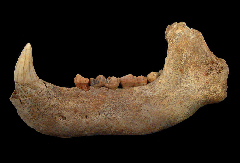
An exceptionally preserved, fossil Cave Bear jaw (Urusus spelaeus) from Romania. These large bears lived in the mountain caves from central Europe to Russia. An exceptional, large adult cave bear lower jaw. You can own a rare and wonderful story piece from the Ice Age! No repair or restoration. Authenticity guaranteed.
Name: Urusus spelaeus Age: Late Pleistocene Location: Carpathian Mountains, Romania
R506 SIZE: 9-1/2"
Note: Added 17 new Ice Age / Cave Bear fossils in October 2024. Link -> Cave Bear Fossils
Learn More - Cave Bear tooth$315.00
A Top Quality fossil Cave Bear (Urusus spelaeus) canine from the Drachen Hohle Cave, Austria. These large bears lived in the mountain caves from central Europe to Russia. An excellent cave bear tooth. You can own a rare and wonderful story piece from the Ice Age! No repair or restoration. Authenticity guaranteed. A perfect tooth. The Best quality Cave Bear canines!
Name: Urusus spelaeus Age: Late Pleistocene
Location: Drachen Hohle Cave, near Graz, Austria
R509 SIZE: 3-11/16"
Note: Posted 17 Ice Age Cave Bear fossils in October 2024. Link -> Cave Bear Fossils
Learn More - Otodus mugodzharicus (Partial serrated)$0.00
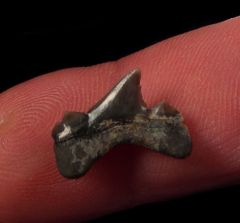
A very rare, early Otodus mugodzharicus upper jaw, posterior tooth from Aktulagay, western Kazakhstan. A transitional tooth leading to C. auriculatus (see detailed discussion below) which leads to Megalodon. The bourlette is complete. Tooth exhibits very fine serrations along the inner curve of the crown only. These teeth exhibit very good color, gloss, and preservation. A rare, early Eocene Auriculatus transition tooth. A very challenging tooth to find when building a Megalodon evolutionary set! No repair. Authenticity guaranteed. Note - This western Kazakhstan site is one of the few places in the world where the Otodus to Auriculatus transition can be found in adjacent layers.
K555 SIZE: 5/8"
Note - Adding 18 Kazakh Auriculatus or transition teeth in April 2020. --> Link to Kazakh Auriculatus teeth.
Learn More - Otodus auriculatus (Early Eocene form)$0.00
A very rare, Otodus auriculatus tooth from the copper-red site of No. Carolina. The crown has coarse serrations. The side cusps are typical of the Otodus obliquus. Complete root. Early Eocene - Ypresian age. A very rare collector's tooth. Very few Otodus auriculatus teeth (early form) found at this site!
NC253 SIZE: 2-1/2"Note - Adding 9 early NC red site early Rics, transition teeth, and later Rics in June 2020. Link to NC Auriculatus teeth
Learn More - Otodus auriculatus (Early Eocene form)$0.00
A very rare, Otodus auriculatus tooth from the copper-red site of No. Carolina. The crown has coarse serrations. The side cusps are typical of the Otodus obliquus. Complete root. Early Eocene - Ypresian age. A very rare collector's tooth. Very few Otodus auriculatus teeth (early form) found at this site!
NC254 SIZE: 2-1/16"Note - Adding 9 early NC red site early Rics, transition teeth, and later Rics in June 2020. Link to NC Auriculatus teeth
Learn More - Otodus auriculatus (Early Eocene form)$0.00
A very rare, Otodus auriculatus tooth from the copper-red site of No. Carolina. The crown has coarse serrations. The side cusps are typical of the Otodus obliquus. Complete root. Early Eocene - Ypresian age. A very rare collector's tooth. Very few Otodus auriculatus teeth (early form) found at this site!
NC255 SIZE: 1-11/16"Note - Adding 9 early NC red site early Rics, transition teeth, and later Rics in June 2020. Link to NC Auriculatus teeth
Learn More - Otodus mugodzharicus (Partial serrated)$0.00
A very rare, early Otodus mugodzharicus upper jaw, lateral tooth from Aktulagay, western Kazakhstan. A transitional tooth leading to C. auriculatus (see detailed discussion below) which leads to Megalodon. The bourlette is complete. Tooth exhibits very fine serrations along the lower 1/3 of crown and micro serrations to the tip. These teeth exhibit very good color, gloss, and preservation. A rare, early Eocene Auriculatus transition tooth. A very challenging tooth to find when building a Megalodon evolutionary set! No repair. Authenticity guaranteed. Note - This western Kazakhstan site is one of the few places in the world where the Otodus to Auriculatus transition can be found in adjacent layers.
K554 SIZE: 1-1/4"
Note - Adding 18 Kazakh Auriuclatus or transition teeth in April 2020. --> Link to Kazakh Auriculatus teeth.
Learn More - Otodus mugodzharicus (Partial serrated)$0.00
A very rare, early Otodus mugodzharicus upper jaw, lateral tooth from Aktulagay, western Kazakhstan. A transitional tooth leading to C. auriculatus (see detailed discussion below) which leads to Megalodon. The bourlette is complete. Tooth exhibits wavy serrations along the lower 1/3 of crown and small wavy serrations to the tip. These teeth exhibit very good color, gloss, and preservation. A rare, early Eocene Auriculatus transition tooth. A very challenging tooth to find when building a Megalodon evolutionary set! No repair. Authenticity guaranteed. Note - This western Kazakhstan site is one of the few places in the world where the Otodus to Auriculatus transition can be found in adjacent layers.
K553 SIZE: 1-1/2"
Note - Adding 18 Kazakh Auriuclatus or transition teeth in April 2020. --> Link to Kazakh Auriculatus teeth.
Learn More - Otodus mugodzharicus (Partial serrated)$0.00
A very rare, early Otodus mugodzharicus upper jaw, anterior tooth from Aktulagay, western Kazakhstan. A transitional tooth leading to C. auriculatus (see detailed discussion below) which leads to Megalodon. The bourlette is complete. Tooth exhibits fine and wavy serrations along the lower 1/3 of crown and no serrations the tip. These teeth exhibit very good color, gloss, and preservation. A rare, early Eocene Auriculatus transition tooth. A very challenging tooth to find when building a Megalodon evolutionary set! No repair. Authenticity guaranteed. Note - This western Kazakhstan site is one of the few places in the world where the Otodus to Auriculatus transition can be found in adjacent layers.
K551 SIZE: 2-1/8"
Note - Adding 18 Kazakh Auriculatus or transition teeth in April 2020. --> Link to Kazakh Auriculatus teeth.
Learn More - Otodus aksuaticus (Early Eocene form)$0.00
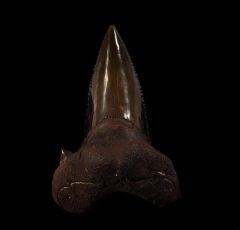
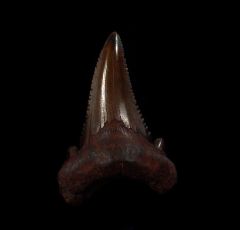
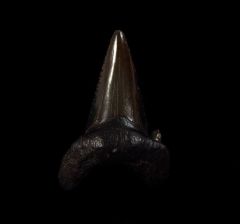
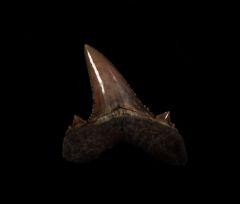
A very rare, Otodus aksuaticus tooth from the copper-red site of No. Carolina. The crown has coarse serrations over the lower 2/3 of crown that disappear in the top 1/3 of crown. The side cusps are typical of the Otodus obliquus. Complete root. Early Eocene - Ypresian age. A very rare collector's tooth. Very few Otodus aksuaticus teeth found at this site!
NC252 SIZE: 2-3/8"Note - Adding 9 early NC red site early Rics, transition teeth, and later Rics in June 2020. Link to NC Auriculatus teeth
Learn More