Search results for: 'auriculatus teeth free florida'
- Related search terms
- teeth frame mississippian period///Megalodon tooth fossil from the Mississippian period that is less than 2 inches in length
- teeth frame mississippian period///Megalodon tooth fossil from the Mississippian period that is less than 2 inches in length/
- teeth frame mississippian period///Megalodon tooth fossil from the Mississippian period that is less than 2 inches in length//
- teeth frame mississip1ff8pian period///Megalodon tooth fossil from the Mississippian period that is less than 2 inches in length
- teeth frame mississip1ff8pian period/Megalodon tooth fossil from the Mississippian period that is less than 2 inches in length
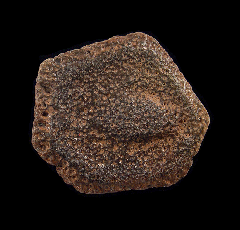
- Giant Armadillo scute - Florida$55.00
A LARGE, well preserved Armadillo scute (Holmesina floridanus) from northern Florida. The Giant Armadillo was an oversized armadillo with a thick shell that evolved in the Pleistocene and became extinct at the end of the Pleistocene in North America. This is a scute is complete with little wear. Well fossilized. No repair or restoration. Authenticity guaranteed.
X811 Size: 1-7/8" x 1-1/2"
Name: Armadillo scute (Holmesina floridanus)
Age: Pleistocene
Location: Northern Florida
Note - Posting 26 mammal and reptile fossils in March 2024. Link to Other Mammals
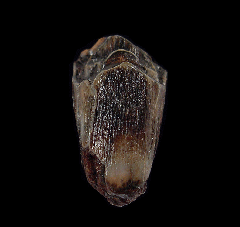
Learn More - Camel - Florida$75.00
A well preserved Camel (Camelops) molar from northern Florida. The Camelops evolved in the late Pliocene and became extinct at the end of the Pleistocene in North America. This is molar is complete with very little wear. Well fossilized. No repair or restoration. Authenticity guaranteed.
X809 Size: 1-3/8"
Name: Camel (Camelops) molar
Age: Pleistocene
Location: Ruskin, Florida
Note - Posting 26 mammal and reptile fossils in March 2024. Link to Other Mammals
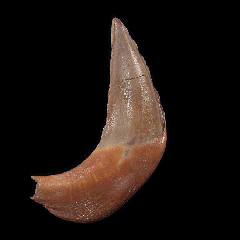
Learn More - Camel - Florida$195.00
A rare, well preserved Camel (Camelops) canine from Hillsborough Co., Florida. The Camelops evolved in the late Pliocene and became extinct at the end of the Pleistocene in North America. This is molar is complete with no wear. One crack. Well fossilized. No restoration. Authenticity guaranteed.
X807 Size: 1-15/16"
Name: Camel (Camelops) molar
Age: Pleistocene
Location: Hillsborough Co., Florida
Note - Posting 26 mammal and reptile fossils in March 2024. Link to Other Mammals
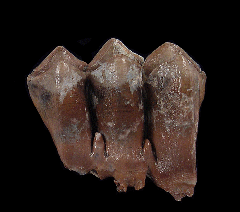
Learn More - Camel - Florida$0.00
A well preserved Camel (Camelops) molar from Hillsborough Co., Florida. The Camelops evolved in the late Pliocene and became extinct at the end of the Pleistocene in North America. This is molar is complete with no wear. Well fossilized. No repair or restoration. Authenticity guaranteed.
X808 Size: 1-1/4" x 1-7/8"
Name: Camel (Camelops) molar
Age: Pleistocene
Location: Hillsborough Co., Florida
Note - Posting 26 mammal and reptile fossils in March 2024. Link to Other Mammals
Learn More - Great White Jewelry Teeth$0.00
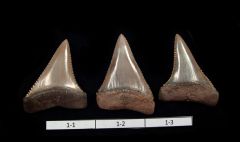
An Extra Large, high quality Great White tooth from Peru with incredible blue color and a brown root. Large serrations. A fantastic tooth. Authenticity guaranteed. Tooth on left side.
P1-1 (Left) SIZE: 1-7/8"
Learn More - Shark Teeth Jewelry - Chile GW$30.00
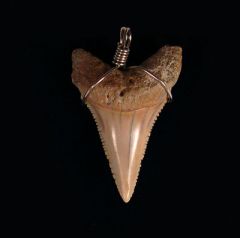
A Great White shark tooth that is wire wrapped for a necklace. All teeth are Pliocene age - 4 million years old! Includes a 18" black or 16" Red leather necklace with clasp. Please specify.
C10J Size: 1-5/8"
Learn More - Shark Teeth Jewelry - Chile Great White$85.00
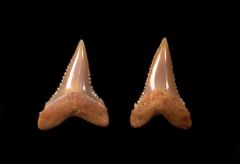
A matched pair of baby Great White shark teeth that can be used for ear rings. You do not see baby Great White teeth very often. Very nice anterior teeth. All teeth are Pliocene age - 4 million years old! Authenticity guaranteed.
C22J Size: 5/8" (measured straight up & down)
Learn More - Otodus obliquus (not serrated)$95.00
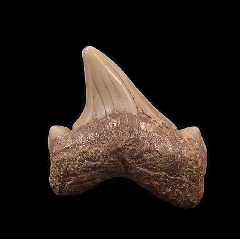
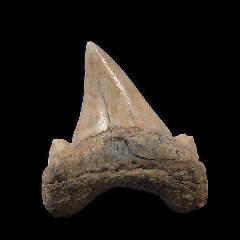
A very rare, early Otodus obliquus anterior tooth from Kzil-Orda Region, Kazakhstan. Otodus obliquus is the ancestor to O. auriculatus (see detailed discussion below) which leads to Megalodon. The bourlette is large and complete. Exhibits no serrations. The starting species to serrated Otodus teeth. These teeth exhibit very good color, gloss, and preservation. A rare, early Eocene (Ypresian) Auriculatus transition tooth. A very challenging tooth to find when building a Megalodon evolutionary set! No repair. Authenticity guaranteed. Note - This western Kazakhstan site is one of the few places in the world where the Otodus obliquus to Otodus auriculatus transition can be found in adjacent early Eocene formation units.
K561 SIZE: 1-1/16"
Note - Adding 24 Kazakh Auriculatus or transition teeth in July 2024. --> Link to Kazakh Auriculatus teeth.
Learn More - Otodus obliquus (not serrated)$135.00
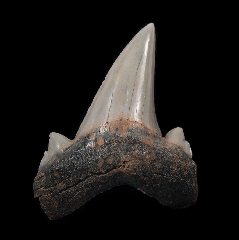
A very rare, early Otodus obliquus anterior tooth from Kzil-Orda Region, Kazakhstan. Otodus obliquus is the ancestor to O. auriculatus (see detailed discussion below) which leads to Megalodon. The bourlette is large and complete. Exhibits no serrations. The starting species to serrated Otodus teeth. These teeth exhibit very good color, gloss, and preservation. A rare, early Eocene (Ypresian) Auriculatus transition tooth. A very challenging tooth to find when building a Megalodon evolutionary set! No repair. Authenticity guaranteed. Note - This western Kazakhstan site is one of the few places in the world where the Otodus obliquus to Otodus auriculatus transition can be found in adjacent early Eocene formation units.
K562 SIZE: 1-1/4"
Note - Adding 24 Kazakh Auriculatus or transition teeth in July 2024. --> Link to Kazakh Auriculatus teeth.
Learn More - Otodus obliquus (not serrated)$200.00
A very rare, early Otodus obliquus anterior tooth from Kzil-Orda Region, Kazakhstan. Otodus obliquus is the ancestor to O. auriculatus (see detailed discussion below) which leads to Megalodon. The bourlette is large and complete. Exhibits no serrations. The starting species to serrated Otodus teeth. These teeth exhibit very good color, gloss, and preservation. A rare, early Eocene (Ypresian) Auriculatus transition tooth. A very challenging tooth to find when building a Megalodon evolutionary set! No repair. Authenticity guaranteed. Note - This western Kazakhstan site is one of the few places in the world where the Otodus obliquus to Otodus auriculatus transition can be found in adjacent early Eocene formation units.
K561 SIZE: 1-1/4"
Note - Adding 24 Kazakh Auriculatus or transition teeth in July 2024. --> Link to Kazakh Auriculatus teeth.
Learn More - Aegocrioceras sp.$0.00
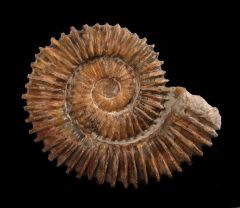
An EXCELLENT early Cretaceous ammonite from Germany showing intricate structure. Excellent color! Large size. Matrix free. A fantastic display item!
X266 BoP Size: 4"
Learn More - Fossil Shark Teeth of the World by Joe Cocke$45.00
"Fossil Shark Teeth of the World" is an excellent identification guide for the collector. This book covers more than 85 shark species with photos of typical teeth. A great guide for the new and seasoned collectors.
BB07 Size: 5-1/2" x 8-1/2"
Learn More