Search results for: '17 vw post 1 du01 youtube'
- Did you mean
- 17 vw postag 1 dung youtube
- 17 vw post 1 dung youtube
- Related search terms
- du01 seven enabl liops
- du01 seven enabl liops/
- du01 seven enabl liops//
- postag recent do good caudal no youtube
- postag recent do good cone no youtube
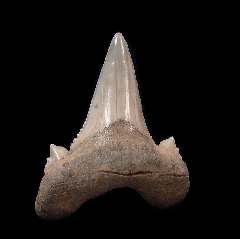
- Otodus aksuaticus (Partial serrated)$325.00
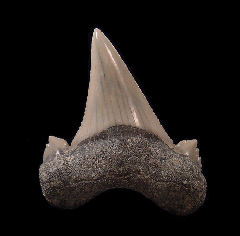
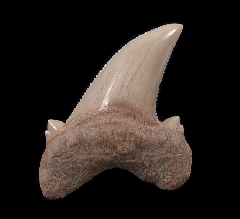
A very rare, early Otodus aksuaticus anterior tooth from Kzil-Orda, Kazakhstan. A transitional tooth leading to O. auriculatus (see detailed discussion below) which leads to Megalodon. The bourlette is complete. This tooth exhibits small serrations along the lower 1/2 of the crown and micro serrations to the tip. These teeth exhibit excellent color, gloss, and preservation. A rare, early (Ypresian) Eocene Auriculatus transition tooth. A very challenging tooth to find when building a Megalodon evolutionary set! No repair or restoration. Authenticity guaranteed. This western Kazakhstan site is one of the few places in the world where the Otodus obliquus to Otodus auriculatus transition can be found in adjacent geologic layers.
K546 SIZE: 1-9/16"
Note - Adding 24 Kazakh Auriuclatus or transition teeth in July 2024. --> Link to Kazakh Auriculatus teeth.
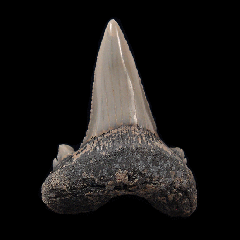
Learn More - Otodus aksuaticus (Partial serrated)$350.00
A very rare, early Otodus aksuaticus anterior tooth from Kzil-Orda, Kazakhstan. A transitional tooth leading to O. auriculatus (see detailed discussion below) which leads to Megalodon. The bourlette is complete. This tooth exhibits small serrations along the lower 1/2 of the crown and micro serrations to the tip. These teeth exhibit excellent color, gloss, and preservation. A rare, early (Ypresian) Eocene Auriculatus transition tooth. A very challenging tooth to find when building a Megalodon evolutionary set! No repair or restoration. Authenticity guaranteed. This western Kazakhstan site is one of the few places in the world where the Otodus obliquus to Otodus auriculatus transition can be found in adjacent geologic layers.
K545 SIZE: 1-3/4"
Note - Adding 24 Kazakh Auriuclatus or transition teeth in July 2024. --> Link to Kazakh Auriculatus teeth.
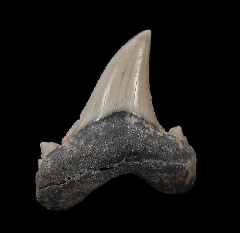
Learn More - Otodus aksuaticus (Partial serrated)$425.00
A very rare, early Otodus aksuaticus lateral tooth from Kzil-Orda, Kazakhstan. A transitional tooth leading to O. auriculatus (see detailed discussion below) which leads to Megalodon. The bourlette is complete. This tooth exhibits small serrations along the lower 1/3 of the crown and micro serrations to the tip. These teeth exhibit excellent color, gloss, and preservation. A rare, early (Ypresian) Eocene Auriculatus transition tooth. A very challenging tooth to find when building a Megalodon evolutionary set! No repair or restoration. Authenticity guaranteed. This western Kazakhstan site is one of the few places in the world where the Otodus obliquus to Otodus auriculatus transition can be found in adjacent geologic layers.
K543 SIZE: 1-7/8"
Note - Adding 24 Kazakh Auriuclatus or transition teeth in July 2024. --> Link to Kazakh Auriculatus teeth.
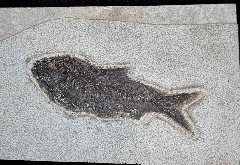
Learn More - Knightia alta$150.00
A sarce, EXTRA LARGE Knightia alta fish from the 18 Inch layer, Green River Fm., Lincoln Co. Wyoming. The Knightia alta is the second Herring-like fish species from the Eocene age (50 MYA). This is a scarce species has a thicker body. Exceptional preservation and preparation. No repair or restoration. All natural. Authenticity guaranteed. An excellent display piece! Note - This item weighs 3 lbs. An international shipping surcharge may be applied to "Free Shipping". Please inquire for cost.
X450 SIZE: 6-3/8"
Note - Adding 17 Green River Fm. Fossil fish in November 2025 --> Link to Fossil Fish
Learn More - Coelodonta antiquitatis (Woolly Rhino)$250.00
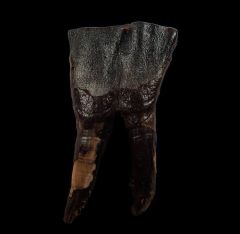
A TOP QUALITY, EXTRA LARGE Coelodonta antiquitatis tooth - the Woolly Rhinoceros. This Ice Age monster lived during the Pleistocene throughout Europe and northern Asia. This molar is complete and well preserved. Rhino material is scarer than Mammoth fossils. An excellent display piece from Siberia, Russia. Authenticity guaranteed.
X754 SIZE: 3-3/4" Height x 2" x 1-1/2"
Note - Posting 5 Woolly Rhinoceras teeth / jaws in October 2022. Link to Rhinocereas teeth.
Learn More - Otodus aksuaticus (Partial serrated)$450.00
A very rare, early Otodus aksuaticus upper jaw, lateral tooth from Kzil-Orda, Kazakhstan. A transitional tooth leading to O. auriculatus (see detailed discussion below) which leads to Megalodon. A July Fossil of the Month. The bourlette is complete. This tooth exhibits small serrations along the lower 1/3 of the crown and micro serrations to the tip. These teeth exhibit excellent color, gloss, and preservation. A rare, early (Ypresian) Eocene Auriculatus transition tooth. A very challenging tooth to find when building a Megalodon evolutionary set! No repair or restoration. Authenticity guaranteed. This western Kazakhstan site is one of the few places in the world where the Otodus obliquus to Otodus auriculatus transition can be found in adjacent geologic layers.
K547 SIZE: 1-15/16"
Note - Adding 24 Kazakh Auriuclatus or transition teeth in July 2024. --> Link to Kazakh Auriculatus teeth.
Learn More - Otodus aksuaticus (Partial serrated)$425.00
A very rare, early Otodus aksuaticus lateral tooth from Kzil-Orda, Kazakhstan. A transitional tooth leading to O. auriculatus (see detailed discussion below) which leads to Megalodon. A July Fossil of the Month.The bourlette is complete. This tooth exhibits small serrations along the lower 1/2 of the crown and micro serrations to the tip. These teeth exhibit excellent color, gloss, and preservation. A rare, early (Ypresian) Eocene Auriculatus transition tooth. A very challenging tooth to find when building a Megalodon evolutionary set! No repair or restoration. Authenticity guaranteed. This western Kazakhstan site is one of the few places in the world where the Otodus obliquus to Otodus auriculatus transition can be found in adjacent geologic layers.
K544 SIZE: 1-3/4"
Note - Adding 24 Kazakh Auriuclatus or transition teeth in July 2024. --> Link to Kazakh Auriculatus teeth.
Learn More - Otodus aksuaticus (Partial serrated)$550.00
A very rare, early Otodus aksuaticus lateral tooth from Kzil-Orda, Kazakhstan. A transitional tooth leading to O. auriculatus (see detailed discussion below) which leads to Megalodon. A July Fossil of the Month. The bourlette is complete. This tooth exhibits small serrations along the lower 1/2 of the crown and micro serrations to the tip. These teeth exhibit excellent color, gloss, and preservation. A rare, early (Ypresian) Eocene Auriculatus transition tooth. A very challenging tooth to find when building a Megalodon evolutionary set! No repair or restoration. Authenticity guaranteed. This western Kazakhstan site is one of the few places in the world where the Otodus obliquus to Otodus auriculatus transition can be found in adjacent geologic layers.
K542 SIZE: 2-1/8"
Note - Adding 24 Kazakh Auriuclatus or transition teeth in July 2024. --> Link to Kazakh Auriculatus teeth.
Learn More - Otodus auriculatus - Kazakhstan$375.00
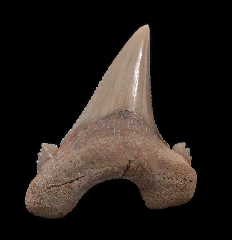
A rare, early Auriculatus lateral tooth from Kzil-Orda region, Kazakhstan. The bourlette is complete. Excellent coarse serrations, large side cusps serrations, and with very irregular serrations. These teeth exhibit fantastic color, gloss, and preservation. A rare early Eocene Auriculatus tooth (Ypresian age - 55 MYA)! No repair or restoration. Authenticity guaranteed. This is the true early Eocene Auriculatus tooth!
K504 SIZE: 2-3/16"
Note - Adding 24 Kazakh Auriuclatus or transition teeth in July 2024. --> Link to Kazakh Auriculatus teeth.
Learn More - Physogaleus contortus$12.50
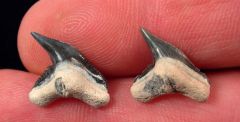
An excellent Physogaleus contortus tooth from the Oligocene of Seminole Co., Florida. F736 is the tooth on the right.
F736 (Right) SIZE: 11/16"
Learn More - Capybara$32.50
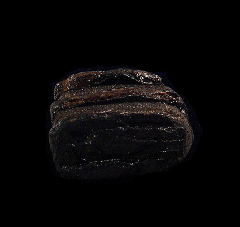
A well preserved extince Giant Capybara molar from Edisto River, So. Carolina. The Giant Capybara was an oversized rodent that evolved in the Pleistocene and became extinct at the end of the Pleistocene in North America. This is a molar tooth with good cusp detail with little wear. Well fossilized. No repair or restoration. Authenticity guaranteed.
X821 Size: 7/8" x 7/16"
Name: Capybara sp.
Age: Pleistocene
Location: Edisto River, So. Carolina
Note - Posting 26 mammal and reptile fossils in March 2024. Link to Other Mammals
Learn More - Isurus desori$40.00
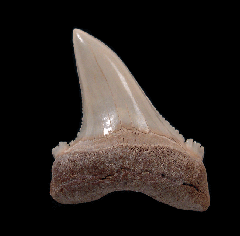
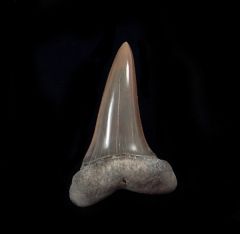
A GEM I. desori, the Narrow-tooth Mako - lateral tooth. Very nice golden tan color with excellent gloss. The root shows incredible detail. Absolutely great preservation and condition - extra sharp edges and tip. These are Miocene age teeth from the Pungo River Fm. Fantastic collector's teeth. Museum quality.
LC333 SIZE: 1-1/2"
Learn More