Search results for: 'du01 size fossil calcul egg'
- Did you mean
- dure size fossil calcul egg
- dung site fossil calcul egg
- Related search terms
- fossil fish id good
- fossil fisher id good/
- du01 seven enabl liops
- du01 seven enabl liops/
- du01 seven enabl liops//
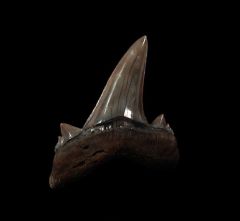
- Otodus mugodzharicus (Partial serrated)$0.00
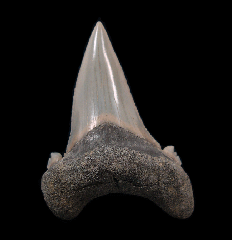
A very rare, early Otodus mugodzharicus upper jaw, lateral tooth from Aktulagay, western Kazakhstan. A transitional tooth leading to C. auriculatus (see detailed discussion below) which leads to Megalodon. A November Fossil of the Month.The bourlette is complete. Tooth exhibits "wavy serrated" edges similar to the Isurus escheri tooth. These teeth exhibit very good color, gloss, and preservation. A rare, early Eocene Auriculatus transition tooth. A very challenging tooth to find when building a Megalodon evolutionary set! No repair. Authenticity guaranteed. This western Kazakhstan site is one of the few places in the world where the Otodus to Auriculatus transition can be found in adjacent layers. Note - This is my last offering of Aktluagay teeth.
K552 SIZE: 1-9/16"
Note - Adding 19 Kazakh Auriuclatus or transition teeth in November 2021. --> Link to Kazakh Auriculatus teeth.
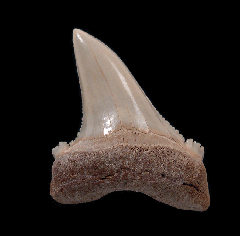
Learn More - Otodus aksuaticus (Partial serrated)$450.00
A very rare, early Otodus aksuaticus upper jaw, lateral tooth from Kzil-Orda, Kazakhstan. A transitional tooth leading to O. auriculatus (see detailed discussion below) which leads to Megalodon. A July Fossil of the Month. The bourlette is complete. This tooth exhibits small serrations along the lower 1/3 of the crown and micro serrations to the tip. These teeth exhibit excellent color, gloss, and preservation. A rare, early (Ypresian) Eocene Auriculatus transition tooth. A very challenging tooth to find when building a Megalodon evolutionary set! No repair or restoration. Authenticity guaranteed. This western Kazakhstan site is one of the few places in the world where the Otodus obliquus to Otodus auriculatus transition can be found in adjacent geologic layers.
K547 SIZE: 1-15/16"
Note - Adding 24 Kazakh Auriuclatus or transition teeth in July 2024. --> Link to Kazakh Auriculatus teeth.
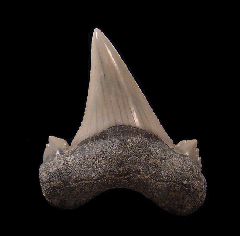
Learn More - Otodus aksuaticus (Partial serrated)$425.00
A very rare, early Otodus aksuaticus lateral tooth from Kzil-Orda, Kazakhstan. A transitional tooth leading to O. auriculatus (see detailed discussion below) which leads to Megalodon. A July Fossil of the Month.The bourlette is complete. This tooth exhibits small serrations along the lower 1/2 of the crown and micro serrations to the tip. These teeth exhibit excellent color, gloss, and preservation. A rare, early (Ypresian) Eocene Auriculatus transition tooth. A very challenging tooth to find when building a Megalodon evolutionary set! No repair or restoration. Authenticity guaranteed. This western Kazakhstan site is one of the few places in the world where the Otodus obliquus to Otodus auriculatus transition can be found in adjacent geologic layers.
K544 SIZE: 1-3/4"
Note - Adding 24 Kazakh Auriuclatus or transition teeth in July 2024. --> Link to Kazakh Auriculatus teeth.
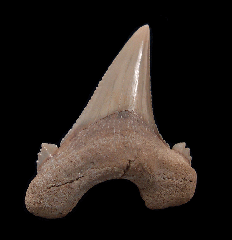
Learn More - Otodus aksuaticus (Partial serrated)$550.00
A very rare, early Otodus aksuaticus lateral tooth from Kzil-Orda, Kazakhstan. A transitional tooth leading to O. auriculatus (see detailed discussion below) which leads to Megalodon. A July Fossil of the Month. The bourlette is complete. This tooth exhibits small serrations along the lower 1/2 of the crown and micro serrations to the tip. These teeth exhibit excellent color, gloss, and preservation. A rare, early (Ypresian) Eocene Auriculatus transition tooth. A very challenging tooth to find when building a Megalodon evolutionary set! No repair or restoration. Authenticity guaranteed. This western Kazakhstan site is one of the few places in the world where the Otodus obliquus to Otodus auriculatus transition can be found in adjacent geologic layers.
K542 SIZE: 2-1/8"
Note - Adding 24 Kazakh Auriuclatus or transition teeth in July 2024. --> Link to Kazakh Auriculatus teeth.
Learn More - Otodus aksuaticus (Partial serrated)$525.00
A very rare, early Otodus aksuaticus anterior tooth from Kzil-Orda, Kazakhstan. A transitional tooth leading to O. auriculatus (see detailed discussion below) which leads to Megalodon. A July Fossil of the Month. The bourlette is complete. This tooth exhibits small serrations along the lower 1/2 of the crown and micro serrations to the tip. These teeth exhibit excellent color, gloss, and preservation. A rare, early (Ypresian) Eocene Auriculatus transition tooth. A very challenging tooth to find when building a Megalodon evolutionary set! No repair or restoration. Authenticity guaranteed. This western Kazakhstan site is one of the few places in the world where the Otodus obliquus to Otodus auriculatus transition can be found in adjacent geologic layers.
K542 SIZE: 2-3/16"
Note - Adding 24 Kazakh Auriuclatus or transition teeth in July 2024. --> Link to Kazakh Auriculatus teeth.
Learn More - Zilchovaspis rogusa$1,150.00
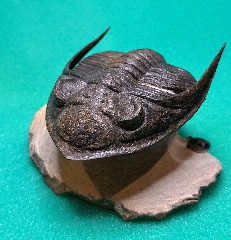
A "Flying" Top Quality, EXTRA LARGE Zilchovaspis rogusa trilobite from Morocco. A November Fossil of the Month. It has German controlled preparation and retains all natural color and detail. The bottom of this trilobite has been cleaned out and it sits on an 1" matrix pedestal. Preparation easily took many dozens of hours to clean this specimen. Incredible prep work! All natural. A Lower Devonian trilobite. One of my favorite Devonian species. Authenticity guaranteed. Note - Specimen weighs 1.2 pounds and a supplemental international shipping surcharge will be applied tp Free Shipping. The largest Zilchovaspis rogusa trilobite that I have seen. A massive trilobite!
XM72 Size: 4-1/2" straightline ; 6" on curve (2-3/4" wide)
Adding 9 quality Moroccan trilobites in November 2025. Link to Moroccan trilobites.
Learn More - Capybara$25.00
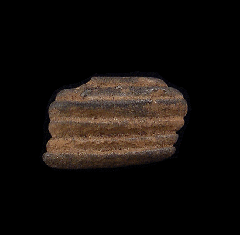
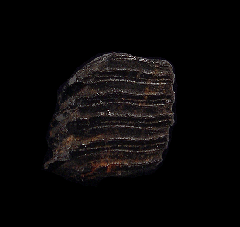
A well preservedextinct Giant Capybara molar from Edisto River, So. Carolina. The Giant Capybara was an oversized rodent that evolved in the Pleistocene and became extinct at the end of the Pleistocene in North America. This is a molar tooth with good cusp detail with little wear. Well fossilized. No repair or restoration. Authenticity guaranteed.
X822 Size: 3/4" x 1/2"
Name: Capybara sp.
Age: Pleistocene
Location: Edisto River, So. Carolina
Note - Posting 26 mammal and reptile fossils in March 2024. Link to Other Mammals
Learn More - Capybara$32.50
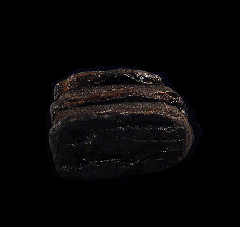
A well preserved extince Giant Capybara molar from Edisto River, So. Carolina. The Giant Capybara was an oversized rodent that evolved in the Pleistocene and became extinct at the end of the Pleistocene in North America. This is a molar tooth with good cusp detail with little wear. Well fossilized. No repair or restoration. Authenticity guaranteed.
X821 Size: 7/8" x 7/16"
Name: Capybara sp.
Age: Pleistocene
Location: Edisto River, So. Carolina
Note - Posting 26 mammal and reptile fossils in March 2024. Link to Other Mammals
Learn More - Capybara$47.50
A well preserved extinct Giant Capybara molar from Edisto River, So. Carolina. The Giant Capybara was an oversized rodent that evolved in the Pleistocene and became extinct at the end of the Pleistocene in North America. This is a molar tooth with good cusp detail with little wear. Well fossilized. No repair or restoration. Authenticity guaranteed.
X819 Size: 5/8" x 11/16"
Name: Capybara sp.
Age: Pleistocene
Location: Edisto River, So. Carolina
Note - Posting 26 mammal and reptile fossils in March 2024. Link to Other Mammals
Learn More - Irish Elk - Megaloceras$0.00
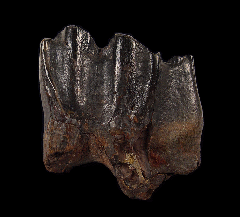
A LARGE, well preserved Irish Elk (Megaloceras giganteus) from the Rhine River, Germany. The Irish Elk was an oversized Elk that evolved in the Pleistocene and became extinct at the end of the Pleistocene in Eurasia. This is a molar is complete with minor wear. Well fossilized. No repair or restoration. Authenticity guaranteed.
X806 Size: 2" x 2"
Name: Irish Elk molar (Megaloceras giganteus)
Age: Pleistocene
Location: Rhine River, Germany
Note - Posting 26 mammal and reptile fossils in March 2024. Link to Other Mammals
Learn More - Carcharodon hastalis - NC Red Site$0.00
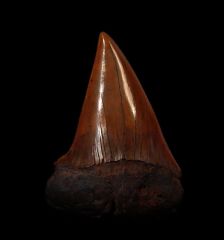
A Top Quality, EXTRA LARGE copper-red I. hastalis tooth from the Meherrin River, No. Carloina. An April Fossil of the Month. A rare copper red color with exceptional gloss. Highest quality enamel. Absolutely great preservation and condition - extra sharp edges and tip - very clean. The root shows very nice detail. and is complete This tooth is the "broad form" of the I. hastalis which appears to a Yorktown Fm., Pliocene age tooth. No reapair or restoration. Exceptional color! An exceptional, rare collector's tooth! Museum Quality. Authenticity guaranteed. You never see 3" copper-red Makos!
NC301 BoP2 SIZE: 3-1/16"
Note - Adding 12 copper-red Hastalis Mako teeth in May2020. --> Link to copper-red Makos.
Learn More - Carcharodon hastalis - Chile$425.00
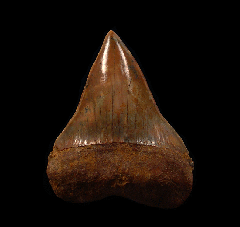
An ultra rare Top Quality Carcharodon hastalis, Broad-tooth Mako, shark tooth - upper jaw anterior tooth from the Bahia Iglesa Fm. of Chile. An April Fossil of the Month. This tooth has a brown, blue & charcoal crown and a brown root. Excellent color! Razor sharp cutting edge. Extra wide root (2-5/16"). Excellent preservation - note nutrient hole on root. Near perfect tooth. This species is the ancestor to the Great White shark. A fantastic color collector's tooth. Authenticity guaranteed. Note - A 3" Chilean C. hastalis tooth is rarer than a 3" Chilean Great White tooth. I have only seen a couple of them!
C301 Size: 3" (2-5/16" wide)
Note - Adding 25 new Chilean Carcharodon hastalis teeth in April 2023 Link to Chilean Mako teeth.
Learn More