Search results for: 'name that end in site'
- Did you mean
- nasu that end in site
- none that end in site
- Related search terms
- names of some look and find books large size for kids ages 5
- site out enabl cohesive devices
- site out enabl cohesive derives
- site 2 bedroom good rd epsom
- names that end in size
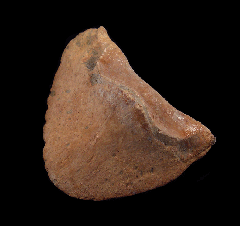
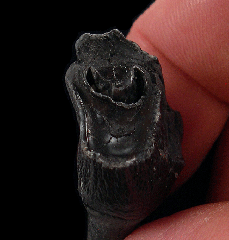
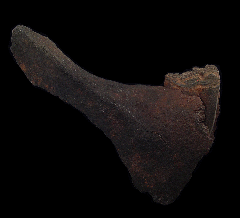
- Equus sp. Hoof Core$125.00
A well preserved horse hoof core bone (Equus sp. ) from Northern Florida. The horse arrived in North America during the late Pliocene and became extinct at the end of the Pleistocene. A well fossilized specimen. No repair or restoration. Authenticity guaranteed.
XH21 Size: 2-1/8" x 3" wide
Name: Equus sp.
Age: Pleistocene
Location: Northern Florida
Note - Posting 23 horse fossils in December 2024. Link to Horse Fossils
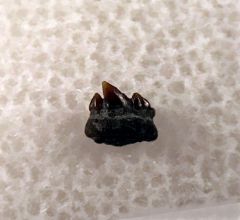
Learn More - Komoksodon kwuthakuth$200.00
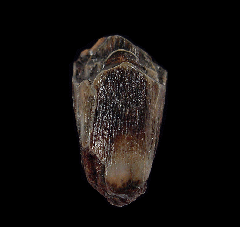
A Very Rare, Top Quality Komoksodon kwuthakuth posterior tooth from Hornby Island, British Columbia, Canada. This is a newly named species from the Late Cretaceous deep water Northumberland Formation deposit. A unique species believed to be Hexanchiforme shark. The crown is complete, both side cusps complete, and root is complete. High quality enamel. No repair. A very difficult tooth to locate and an excellent collector's tooth. Authenticity guaranteed. This incredible specimen is from a 20 year old collection.
CD21 SIZE: 1/8"
Note - Adding 64 Hornby Island deep water shark teeth. -> Link to Hornby Island shark teeth.
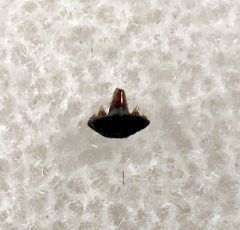
Learn More - Florenceodon johnyi$200.00
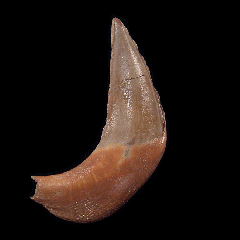
A Very Rare, Top Quality Florenceodon johnyi lateral tooth from Hornby Island, British Columbia, Canada. This is a newly named species from the Late Cretaceous deep water Northumberland Formation deposit. A unique species believed to be Carcharhiniforme shark. The crown has small tip damage and the root is complete. High quality enamel. No repair. A very difficult tooth to locate and an excellent collector's tooth. Authenticity guaranteed. This incredible specimen is from a 20 year old collection.
CD27 SIZE: 1/16"
Note - Adding 64 Hornby Island deep water shark teeth. -> Link to Hornby Island shark teeth.
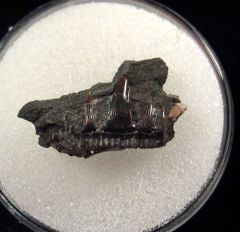
Learn More - Paraorthacodus rossi$135.00
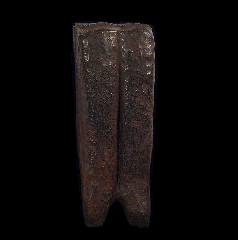
A Very Rare, Top Quality Paraorthacodus rossi tooth from Hornby Island, British Columbia, Canada. This is a newly named species from the Late Cretaceous deep water Northumberland Formation deposit. A unique species believed to be Palaeospinacidae shark. The crown and root are mostly complete with slight damage to the central cusp and one side cusp. High quality enamel. No repair. A very difficult tooth to locate and an excellent collector's tooth. Authenticity guaranteed. This incredible specimen is from a 20 year old collection.
CD30 SIZE: 1/2" Wide
Note - Adding 64 Hornby Island deep water shark teeth. -> Link to Hornby Island shark teeth.
Learn More - Camel - So. Carolina$45.00
A well preserved Camel (Camelops) premolar from So. Carolina. The Camelops evolved in the late Pliocene and became extinct at the end of the Pleistocene in North America. This is premolar is complete with little wear. Well fossilized. No repair or restoration. Authenticity guaranteed.
X810 Size: 1-3/4"
Name: Camel (Camelops) premolar
Age: Pleistocene
Location: So. Carolina
Note - Posting 26 mammal and reptile fossils in March 2024. Link to Other Mammals
Learn More - Camel - Florida$75.00
A well preserved Camel (Camelops) molar from northern Florida. The Camelops evolved in the late Pliocene and became extinct at the end of the Pleistocene in North America. This is molar is complete with very little wear. Well fossilized. No repair or restoration. Authenticity guaranteed.
X809 Size: 1-3/8"
Name: Camel (Camelops) molar
Age: Pleistocene
Location: Ruskin, Florida
Note - Posting 26 mammal and reptile fossils in March 2024. Link to Other Mammals
Learn More - Camel - Florida$195.00
A rare, well preserved Camel (Camelops) canine from Hillsborough Co., Florida. The Camelops evolved in the late Pliocene and became extinct at the end of the Pleistocene in North America. This is molar is complete with no wear. One crack. Well fossilized. No restoration. Authenticity guaranteed.
X807 Size: 1-15/16"
Name: Camel (Camelops) molar
Age: Pleistocene
Location: Hillsborough Co., Florida
Note - Posting 26 mammal and reptile fossils in March 2024. Link to Other Mammals
Learn More - Equus sp. - Florida$47.50
A LARGE, well preserved horse tooth (Equus sp. ) from Ruskin, Florida. The horse arrived in North America during the late Pliocene and became extinct at the end of the Pleistocene. Lower jaw tooth. Very well fossilized specimen. No repair or restoration. Authenticity guaranteed. My highest quality horse tooth! The BEST.
XH04 Size: 3-1/8"
Name: Equus sp.
Age: Pleistocene
Location: Ruskin, Florida
Note - Posting 13 horse fossils in April 2024. Link to Horse Fossils
Learn More - Equus sp. - Florida$47.50
A LARGE, well preserved horse lower jaw section (Equus sp. ) from northern Florida. The horse arrived in North America during the late Pliocene and became extinct at the end of the Pleistocene. Lower jaw section with tooth. Very well fossilized specimen. No repair or restoration. Authenticity guaranteed.
XH03 Size: 5-1/2"
Name: Equus sp.
Age: Pleistocene
Location: Northern Florida
Note - Posting 13 horse fossils in April 2024. Link to Horse Fossils
Learn More - Equus sp. - Florida$115.00
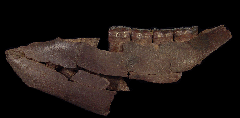
A LARGE, well preserved horse lower jaw section (Equus sp. ) from northern Florida. The horse arrived in North America during the late Pliocene and became extinct at the end of the Pleistocene. Lower jaw section with 4 top quality molar teeth. Very well fossilized specimen. No repair or restoration. Authenticity guaranteed.
XH02 Size: 10"
Name: Equus sp.
Age: Pleistocene
Location: Northern Florida
Note - Posting 13 horse fossils in April 2024. Link to Horse Fossils
Learn More - Equus sp. - So. Carolina$30.00
A LARGE, well preserved horse tooth (Equus sp. ) from ACE Basin, So. Carolina. The horse arrived in North America during the late Pliocene and became extinct at the end of the Pleistocene. Very well fossilized lower jaw specimen. No repair or restoration. Authenticity guaranteed.
XH49 Size: 3-1/16"
Name: Equus sp.
Age: Pleistocene
Location: ACE Basin, So. Carolina
Note - Note - Posting 23 horse fossils in December 2024. Link to Horse Fossils
Learn More - Equus sp. Astragalus bone$25.00
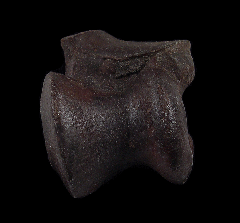
A LARGE, well preserved horse astragalus bone (Equus sp. ) from Northern Florida. The astragalus is the ankle bone. The horse arrived in North America during the late Pliocene and became extinct at the end of the Pleistocene. A well fossilized specimen. No repair or restoration. Authenticity guaranteed.
XH32 Size: 2-1/2"
Name: Equus sp.
Age: Pleistocene
Location: Northern Florida
Note - Posting 23 horse fossils in December 2024. Link to Horse Fossils
Learn More