Search results for: 'does the taylormade distance plus have good feel around the green'
- Related search terms
- goods terrestri a none
- goods terrestri a none/
- good terrestri a none//
- goods terrestri a none//
- the sharks enabl vietsub
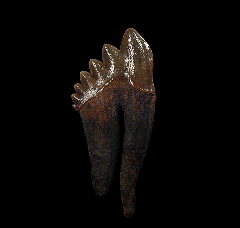
- Basilosaurus cetoides (Archaeocete whale)$1,550.00
A TOP QUALITY, very rare Basilosaurus cetoides, an Archaeocete whale tooth found in the Flint River, Georgia. An exceptional molar tooth (see photo for tooth positions). A July Fossil of the Month. An excellent green colored crown and brown root. Nicely articulated. Incredible preservation! Note - the enamel tip shows absolutely no wear pattern on crown. Whales do not shed their teeth like the sharks so there teeth will wear with age. An Eocene age tooth (35 MYA). No repair or restoration. A fantastic Archaeocete tooth from the Flint River, Georgia. A very rare collector's tooth from an old collection. Perfect tooth!
G1002 SIZE: 2-7/8"
Note - Adding a collection of 27 Basilosaurus teeth from Florida and Georgia in July 2023. Link to Basilosaurus teeth.
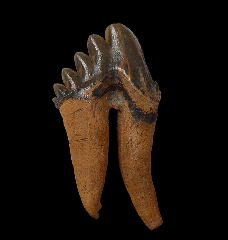
Learn More - Basilosaurus cetoides (Archaeocete whale)$3,350.00
A rare GEM QUALITY Basilosaurus cetoides, an Archaeocete whale tooth found in the Flint River, Georgia. An exceptional molar. An April Fossil of the Month. An excellent green colored crown and tan root. Nicely articulated. Incredible preservation! Whales do not shed their teeth like the sharks so there teeth will wear with age. An Eocene age tooth (36 MYA) from the Ocala Limestone Fm. No repair or restoration. Authenticity guaranteed. A great Archaeocete tooth from the Flint River, Georgia from an old collection. This tooth is part of a rare three associated tooth set - buy all three teeth and receive a 15% discount! One of my favorites!
G1004 SIZE: 2-1/2"
Note - Adding three associated Basilosaurus teeth from Georgia in April 2024. Link to Basilosaurus teeth.
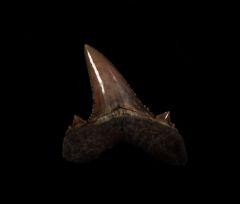
Learn More - Otodus mugodzharicus (Partial serrated)$0.00
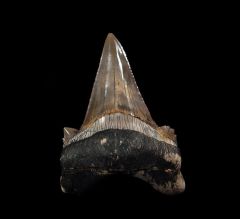
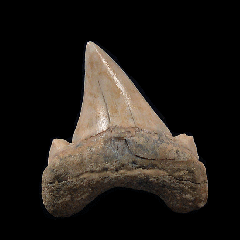
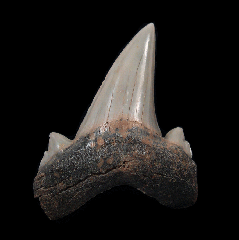
A very rare, early Otodus mugodzharicus upper jaw, lateral tooth from Aktulagay, western Kazakhstan. A transitional tooth leading to C. auriculatus (see detailed discussion below) which leads to Megalodon. The bourlette is complete. Tooth exhibits very fine serrations along the lower 1/3 of crown and micro serrations to the tip. These teeth exhibit very good color, gloss, and preservation. A rare, early Eocene Auriculatus transition tooth. A very challenging tooth to find when building a Megalodon evolutionary set! No repair. Authenticity guaranteed. Note - This western Kazakhstan site is one of the few places in the world where the Otodus to Auriculatus transition can be found in adjacent layers.
K554 SIZE: 1-1/4"
Note - Adding 18 Kazakh Auriuclatus or transition teeth in April 2020. --> Link to Kazakh Auriculatus teeth.
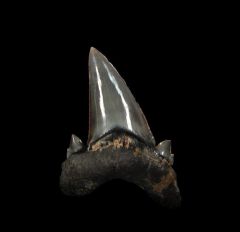
Learn More - Otodus mugodzharicus (Partial serrated)$0.00
A very rare, early Otodus mugodzharicus upper jaw, lateral tooth from Aktulagay, western Kazakhstan. A transitional tooth leading to C. auriculatus (see detailed discussion below) which leads to Megalodon. The bourlette is complete. Tooth exhibits wavy serrations along the lower 1/3 of crown and small wavy serrations to the tip. These teeth exhibit very good color, gloss, and preservation. A rare, early Eocene Auriculatus transition tooth. A very challenging tooth to find when building a Megalodon evolutionary set! No repair. Authenticity guaranteed. Note - This western Kazakhstan site is one of the few places in the world where the Otodus to Auriculatus transition can be found in adjacent layers.
K553 SIZE: 1-1/2"
Note - Adding 18 Kazakh Auriuclatus or transition teeth in April 2020. --> Link to Kazakh Auriculatus teeth.
Learn More - Otodus mugodzharicus (Partial serrated)$0.00
A very rare, early Otodus mugodzharicus upper jaw, anterior tooth from Aktulagay, western Kazakhstan. A transitional tooth leading to C. auriculatus (see detailed discussion below) which leads to Megalodon. The bourlette is complete. Tooth exhibits fine and wavy serrations along the lower 1/3 of crown and no serrations the tip. These teeth exhibit very good color, gloss, and preservation. A rare, early Eocene Auriculatus transition tooth. A very challenging tooth to find when building a Megalodon evolutionary set! No repair. Authenticity guaranteed. Note - This western Kazakhstan site is one of the few places in the world where the Otodus to Auriculatus transition can be found in adjacent layers.
K551 SIZE: 2-1/8"
Note - Adding 18 Kazakh Auriculatus or transition teeth in April 2020. --> Link to Kazakh Auriculatus teeth.
Learn More - Pachycephalosaurus spike$750.00
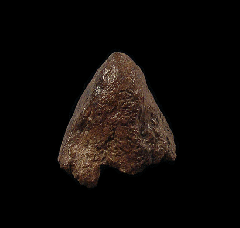
A Top Quality, Rare Pachychephalosaurus wyomingensis spike from the late Cretaceous of northern North America. A complete node with good articulation. Pachychephalosaurus is the dinosaur which is famous for its large domed head surrounded by these spikes and nodes. These spikes and nodes were part of the Pachy skull. This spike has excellent color / patina. It is a complete specimen with no cracks or breaks. Legally collected on private land in the Hell Creek Fm., Powder River Co., Montana. An excellent collector's quality Pachychephalosaurus node. You don't see these skull pieces very often. No repair or restoration. Authenticity guaranteed.
DP34 SIZE: 1-3/16" Height (Base: 1-1/8" x 7/8")
Note - Adding 13 new Pachy spikes, claws, and teeth in April 2023. Link to Pachy fossils catalog
Learn More - Pachycephalosaurus spike$1,125.00
A Top Quality, Rare Pachychephalosaurus wyomingensis spike from the late Cretaceous of northern North America. A complete node with good articulation. Pachychephalosaurus is the dinosaur which is famous for its large domed head surrounded by these spikes and nodes. These spikes and nodes were part of the Pachy skull. This spike has excellent color / patina. It is a complete specimen with no cracks or breaks. Legally collected on private land in the Hell Creek Fm., Powder River Co., Montana. An excellent collector's quality Pachychephalosaurus spike. You don't see these skull pieces very often. No repair or restoration. Authenticity guaranteed.
DP32 SIZE: 1-3/8" Height (Base: 1-1/8" x 15/16")
Note - Adding 13 new Pachy spikes, claws, and teeth in April 2023. Link to Pachy fossils catalog
Learn More - Otodus obliquus (not serrated)$95.00
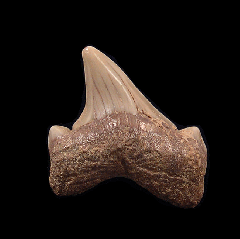
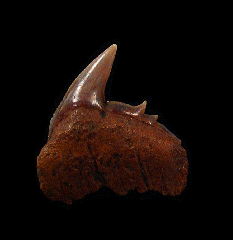
A very rare, early Otodus obliquus anterior tooth from Kzil-Orda Region, Kazakhstan. Otodus obliquus is the ancestor to O. auriculatus (see detailed discussion below) which leads to Megalodon. The bourlette is large and complete. Exhibits no serrations. The starting species to serrated Otodus teeth. These teeth exhibit very good color, gloss, and preservation. A rare, early Eocene (Ypresian) Auriculatus transition tooth. A very challenging tooth to find when building a Megalodon evolutionary set! No repair. Authenticity guaranteed. Note - This western Kazakhstan site is one of the few places in the world where the Otodus obliquus to Otodus auriculatus transition can be found in adjacent early Eocene formation units.
K561 SIZE: 1-1/16"
Note - Adding 24 Kazakh Auriculatus or transition teeth in July 2024. --> Link to Kazakh Auriculatus teeth.
Learn More - Otodus obliquus (not serrated)$135.00
A very rare, early Otodus obliquus anterior tooth from Kzil-Orda Region, Kazakhstan. Otodus obliquus is the ancestor to O. auriculatus (see detailed discussion below) which leads to Megalodon. The bourlette is large and complete. Exhibits no serrations. The starting species to serrated Otodus teeth. These teeth exhibit very good color, gloss, and preservation. A rare, early Eocene (Ypresian) Auriculatus transition tooth. A very challenging tooth to find when building a Megalodon evolutionary set! No repair. Authenticity guaranteed. Note - This western Kazakhstan site is one of the few places in the world where the Otodus obliquus to Otodus auriculatus transition can be found in adjacent early Eocene formation units.
K562 SIZE: 1-1/4"
Note - Adding 24 Kazakh Auriculatus or transition teeth in July 2024. --> Link to Kazakh Auriculatus teeth.
Learn More - Otodus obliquus (not serrated)$200.00
A very rare, early Otodus obliquus anterior tooth from Kzil-Orda Region, Kazakhstan. Otodus obliquus is the ancestor to O. auriculatus (see detailed discussion below) which leads to Megalodon. The bourlette is large and complete. Exhibits no serrations. The starting species to serrated Otodus teeth. These teeth exhibit very good color, gloss, and preservation. A rare, early Eocene (Ypresian) Auriculatus transition tooth. A very challenging tooth to find when building a Megalodon evolutionary set! No repair. Authenticity guaranteed. Note - This western Kazakhstan site is one of the few places in the world where the Otodus obliquus to Otodus auriculatus transition can be found in adjacent early Eocene formation units.
K561 SIZE: 1-1/4"
Note - Adding 24 Kazakh Auriculatus or transition teeth in July 2024. --> Link to Kazakh Auriculatus teeth.
Learn More - Hexanchus griseus - Chile$75.00
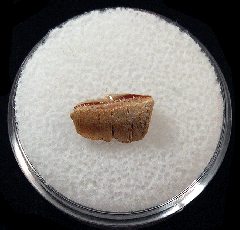
A Pathologic, Top Quality Chilean Hexanchus griseus tooth from the Caldera Basin of Chile. This is an upper jaw tooth with three primary cusps, but it should have had 5 cusps. Two cusp did not form. Excellent preservation and fantastic color. Perfect cusps. These tooth was found in the Bahia Inglesa Fm. and is late Miocene to early Pliocene age. A scarce collector's tooth. Authenticity guaranteed. Unfortunately there are no more teeth coming from this site. This rare piece is from an old collection!
C408U Size: 1" Wide
Note - Adding 18 new Chilean Hexanchus teeth in February 2023 -> Link to Hexanchus Teeth
Learn More - Hexanchus gigas - Chile$85.00
A VERY RARE, Top Quality Hexanchus griseus posterior tooth from the Caldera Basin of Chile. This is complete lower jaw posterior tooth from a large shark. Superb preservation and color. One primary cusp is fully formed. An excellent root - very unique & extremely difficult to find! A Perfect rare collector'stooth. Authenticity guaranteed. Unfortunately there are no more teeth coming from this site. This rare piece is from an old collection. This is one of the few posterior teeth that I have seen - very rare!
C410L Size: 7/16"
Note - Adding 18 new Chilean Hexanchus teeth in February 2024 -> Link to Hexanchus Teeth
Learn More